

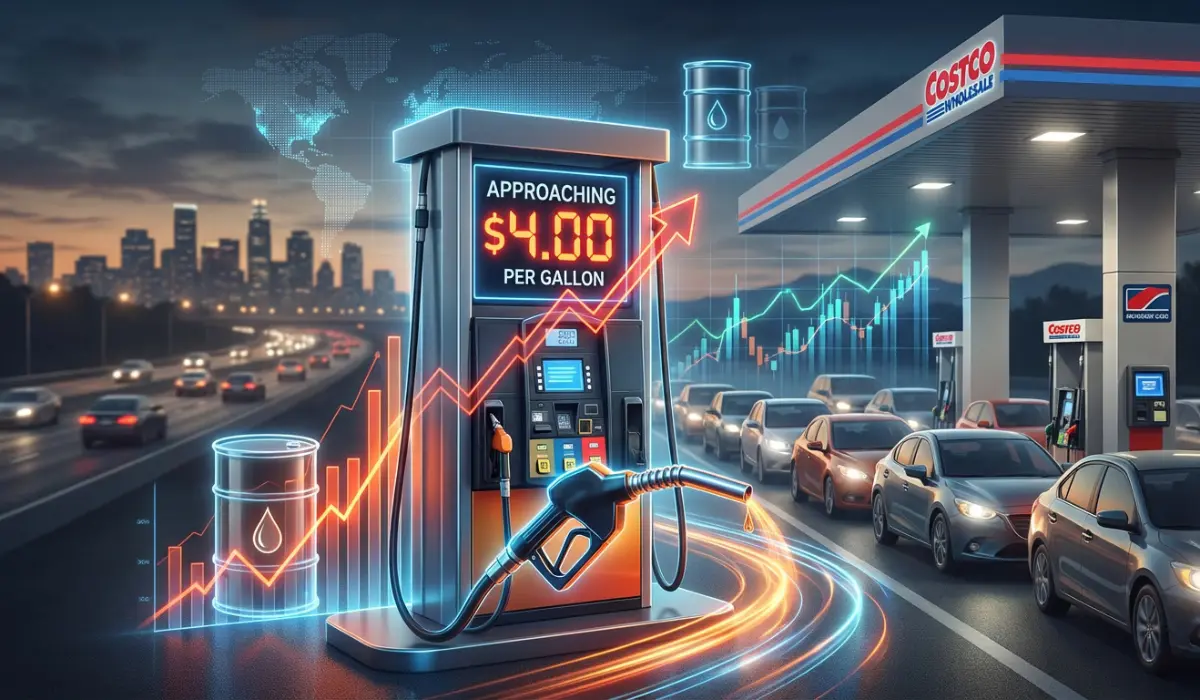
As the US-Israeli-Iran war enters its 12th day with no signs of de-escalation, crude oil prices have shot up to $82.827, marking a ~24% jump from pre-war levels. Gas prices in the U.S. have also risen sharply, driven by global tensions. Today’s national average touched $3.53, with California reporting a record price of $5.29.
Experts estimate that prices would rise further if the Middle East remains tense. Amid this turmoil, Costco, the membership warehouse giant with over 640 operational gas stations in the U.S., has warned of a potential jump in national average gas prices to $4. Costco is famous for offering cheaper gas prices to undercut competitors, hence the warning signals how the Iran war can overwhelm even seasoned supply chains and business models.
How Global Panic Overrides US Self-Sufficiency
America is the biggest crude oil producer in the world with a daily output of around 20.9 million barrels a day. Saudi Arabia and Russia trail second and third with 11.2M bpd and 10.3M bpd. This means that the U.S. production covers 90% of its domestic needs. If so, how does the chaos in the Middle East affect the local gas prices in America?
The world oil trade is interconnected, where the Middle East Brent decides the prices. The US WTI prices track the same, which sparks fear of overnight premiums if things go south in the Middle East. Moreover, the U.S. produces light/sweet oil with lower sulfur content, as opposed to Saudi Arabia’s crude, which is heavier and sulfur-rich. The U.S. refineries process the heavier oil more efficiently, prompting imports from the Middle East.
Today’s State Averages (AAA Fuel Price)
California recorded the highest fuel price today at $5.290 – 49.5% higher than the national average. Washington, Hawaii, Nevada, and Oregon trail right behind with prices way above the national average. Experts estimate that the gas prices can go higher if the U.S.-Iran war drags on.
States with the highest gas prices recorded today:
| State | Regular | Mid-Grade | Premium | Diesel |
|---|---|---|---|---|
| California | $5.290 | $5.482 | $5.680 | $6.101 |
| Washington | $4.687 | $4.926 | $5.166 | $5.644 |
| Hawaii | $4.594 | $4.767 | $5.008 | $5.394 |
| Nevada | $4.297 | $4.582 | $4.853 | $4.788 |
| Oregon | $4.258 | $4.479 | $4.745 | $5.024 |
Crude Oil and Associated Products Price
Crude oil prices rose by over 32% this month due to the tensions in the Middle East. It went up to $95.164/barrel on March 9, when the U.S.-Iran war escalated to threats of a blockade of the Strait of Hormuz by Iran.
| Commodity | Price | Change | Daily % | Monthly % | Yearly % |
|---|---|---|---|---|---|
| Crude Oil | 82.827 | 0.623 | -0.75% | 32.33% | 22.87% |
| Brent | 86.724 | 1.076 | -1.23% | 28.67% | 22.45% |
| Natural Gas | 3.0398 | 0.0198 | 0.66% | -5.85% | -25.84% |
| Gasoline | 2.6446 | 0.0043 | 0.16% | 38.72% | 23.50% |
| Heating Oil | 3.3844 | 0.0378 | 1.13% | 41.68% | 53.58% |
| Coal | 131.10 | -12.70 | -8.83% | 14.10% | 24.98% |
| Ethanol | 1.86 | -0.0475 | -2.49% | 12.20% | 8.76% |
| Urals Oil | 100.67 | 9.70 | 10.66% | 78.05% | 60.69% |
* data as of March 11, 12:40 am EST
The Strait of Hormuz, through which 20% of the global oil flows, is considered a retaliatory chokepoint for Iran against the U.S. Threats and uncertainty around the strait have already shot up oil prices. Experts estimate that a full blockade of the strait would put the energy security of many Asian countries in peril and send crude prices higher than $150 and U.S gas prices above $7.


