

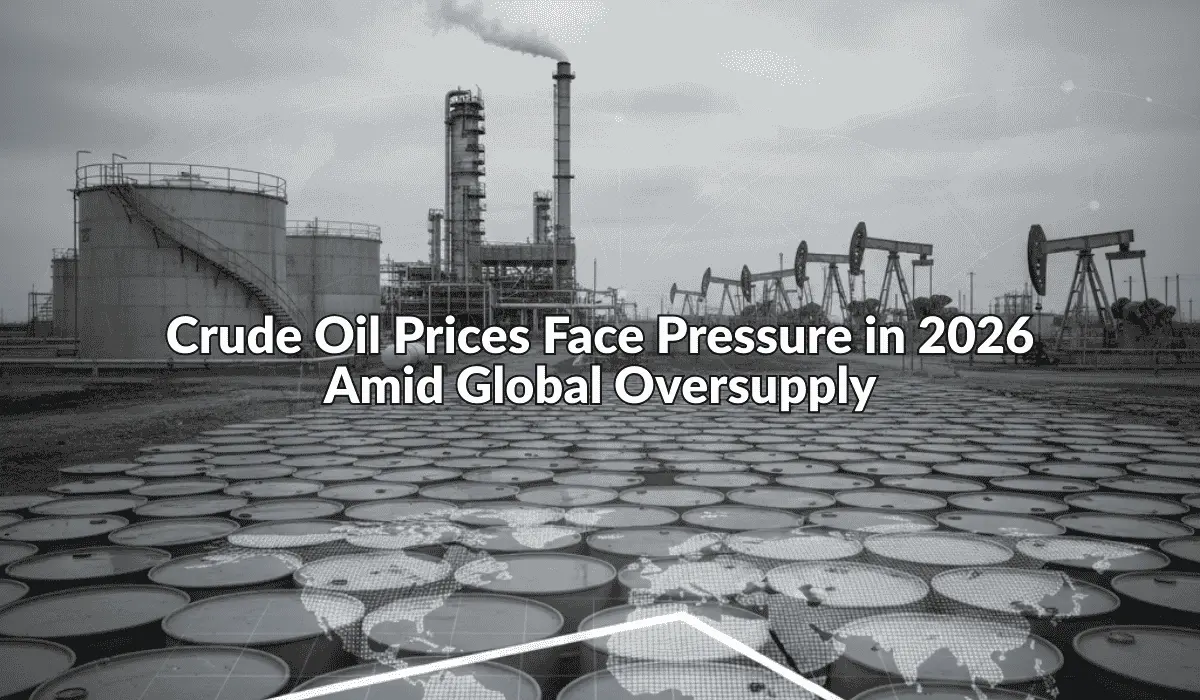
With global oil markets transitioning to a period of chronic oversupply, crude oil prices are bound to remain low for the coming year as there is surplus production and a clear mismatch in the supply-demand curve. As non-OPEC+ nations are on a determined move to revitalize their oil production, there is going to be a clear oversupply in the stock market. With a fundamental shift in the way nations perceive energy production and decarbonization, the oil demand is getting subdued.
With robust production on one side and subdued demand on the other, the result is an effective bear market in the crude oil market. Price forecasts for the coming year 2026, are not optimistic as Brent Crude Oil is projected to average around $55 to $62 per barrel. The case remains the same for WTI (West Texas Intermediate) as well, even with its relatively easier-to-refine crude oil, which carries less sulfur content. WTI has a projected price range from $50 to $65 per barrel.
The Supply Surge: A Wave of Non-OPEC+ Production
While the whole world predicted that the American shale production would level out in the coming years, the reality was a totally different case. With its Permian Basin rich in petroleum, the US retains its status as the world’s largest producer of crude oil. Shale fracking is a powerful weapon in the US arsenal that allowed the US to maintain its spot at the top of the leaderboard.
With Guyana, Brazil, and Argentina surging into crude oil production, a buffer is being created for the world’s crude oil supply. What once used to cause spikes in crude oil prices remains a non-impacting factor as we move through 2025 to 2026. This is mainly because of the increased production capacity of the mentioned non-OPEC+ nations. The steady, non-OPEC+ flow from Brazil, Guyana, and Argentina provides a diversified source of energy that reduces the market’s sensitivity to geopolitical shocks.
The Demand Side: Subdued Growth and Energy Transition
The crude oil surplus is driven by the primary factor of deceleration in consumption growth from the world’s largest importers. The drag on this demand is increasingly viewed as a structural shift fueled by economic cooling and rapid technological evolution in key regions.
To put things into perspective, for a consecutive two decades, the demand for roughly half of the global crude oil was from China. However, China’s transition from being the top consumer has changed the dynamics of the crude oil segment. The Chinese EV (Electric Vehicle) adoption is putting the oil demand away, creating the so-called crude oil surplus condition.
Beyond the effects created by singular entities like China, there are broader trade and manufacturing concerns that have led to a decline in global productivity. The tariff wars instigated by the US were an immediate source of this instability. Tariffs often lead to reduced imports and exports, which consequently affect the shipping industry. With the shipping industry coming to a moderate halt, the consumption of diesel and bunker fuels goes down, creating a ripple effect that fills up the crude oil surplus tanks.
The global growth rate is subdued courtesy of inflation and rising interest rates. These affect the construction and manufacturing industry, who are a primary consumer of fuel. This, in turn, results in a disruption of the supply-demand curve.
The Inventory Overhang and Price Pressure
As we approach the beginning of 2026, there is a critical structural imbalance in the global oil market. Global stockpiles are overflowing as production is much higher than consumption. A huge portion of this supply-side pressure comes from non-OPEC+ nations. This supply pressure coincided with a stagnant growth period, and that means the crude oil production will soon go into surplus production. When an asset/resource like crude oil is in excess supply and low demand, the prices take a massive hit.
As we are nearing the end of 2025, the global oil market is increasingly defined by what analysts call a “downward price channel.” The inventory overhang we explained earlier is the primary driver behind this problem. The projected daily surplus of 2.2 million barrels per day (bpd) acts as a ceiling that prevents prices from sustaining any significant rally.


