

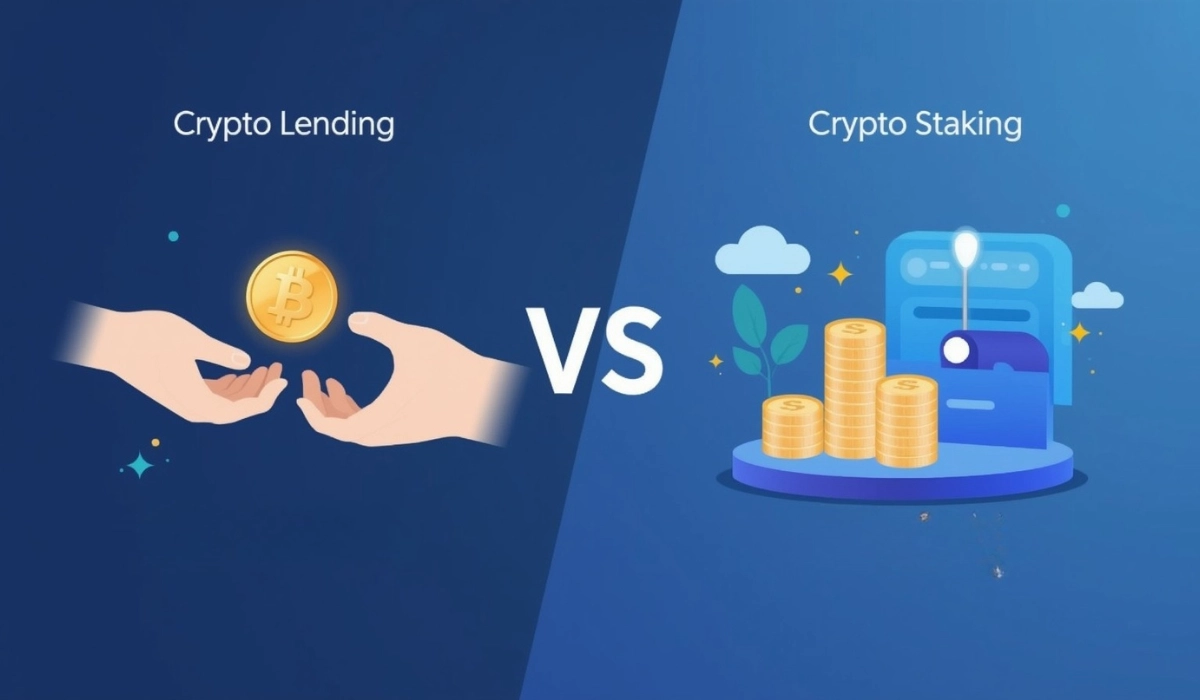
While the mechanisms are different, crypto lending and crypto staking both involve the loan of digital assets to generate a return. Lending refers to loaning funds to a borrower, and on the other hand, staking refers to providing funds to a blockchain network. Both crypto lending and staking are great strategies to earn passive income. While crypto lending platforms are on the rise, staking has replaced mining in many newer blockchains and in networks that have transitioned to proof-of-stake. This article will further discuss all about crypto lending and staking, and their differences. So, keep reading to learn more.
Crypto Lending and Staking Explained: Earn Passive Income with Digital Assets
Crypto lending is a broad term used to describe several mechanisms that exist for lending digital assets to a third party in return for interest. In other words, a provider or lender transfers a certain value of crypto-assets or funds to a user or borrower in exchange for the user placing a value of crypto-assets or funds as collateral. While the investors lend their crypto holdings to borrowers, they receive interest payments from these borrowers in return. The interest payments are also referred to as crypto dividends. Note that the crypto lending is available on both centralized and decentralized platforms. Regardless of where it is practiced, remember that its core principles remain the same. Additionally, most crypto lending platforms accept stablecoins as well. As for earning passive income, crypto lending is comparable to crypto staking, but it still has its differences.
In the modern financial system, it is the banks and institutions that facilitate the vast majority of lending activity. Whereas, individual account holders receive an interest fee on funds they hold with a bank, thereby representing a share of the interest the bank makes from lending those funds out to other account holders in the form of loans or other types of credit. However, in some cases, crypto lending is like a bank service lending platform, where they lend out customer funds and share the interest among the customer base. Note that these services may be regulated by financial authorities, which is why crypto lending might not be available to people in all jurisdictions and is typically offered subject to KYC checks. In most crypto lending models, borrowers are not assessed using traditional credit checks but instead must provide sufficient collateral. In case a borrower defaults, the loan is typically covered by liquidating the posted collateral rather than pursuing legal action.
Regarding crypto staking, it is a way to earn money with your crypto while helping keep the crypto blockchain network active and running. Even though the mechanisms vary, and crypto lending involves credit transactions between two parties, a lender and a borrower, crypto staking is the exact opposite. It involves loaning crypto funds to participate in network security and earn rewards. Crypto holders tend to lock up their funds in order to participate in the network security and earn rewards, and the type of participation can vary. Crypto staking involves validating transactions as a network node or simply delegating funds to a validator for a share of their rewards under a variation of the delegated proof of stake model.
Since crypto staking is a blockchain-based activity, crypto holders can stake their funds in a decentralized, non-custodial way through a supported wallet. Additionally, there are many centralized exchanges and companies that offer crypto staking by pooling funds and distributing rewards. However, these services are more accessible than self-custodial staking and come with a fee.
Crypto Lending vs Staking: Which is Better?
If you are looking forward to simply earning a return from investment, you might not find much difference between crypto staking and lending. There are possibilities to get a better interest rate or reward ratio by shopping around different providers and platforms, but both can vary frequently depending on supply and demand. Thus, maintaining the best rate over time may involve ongoing efforts to reallocate funds. Deciding whether to lend or stake crypto could depend on opting for decentralized, non-custodial services or centralized services through a provider. Understand that the DeFi lending platforms and staking via self-custody wallets offer higher rewards than centralized alternatives and assure transparency as funds are always held in smart contracts on the blockchain.
Keep in mind that blockchain protocols and wallets can be targets for scams and hackers, which is why the user is fully responsible for their funds. The underlying code may be vulnerable, which is why users should be fully aware of the risks. Even though centralized providers can incur fees, they are easier to use and do not require a self-custody wallet. However, it is essential to choose a reputable lending or staking provider with a track record for security and reliability. Talking about the risks associated with crypto lending and staking, volatility seems to be one of the common ones. Volatility is an issue because funds are inaccessible while lent or staked, and cannot be sold in the event of a market downturn.
Note that supporters of blockchain networks may prefer staking over lending since it allows them to participate in network security. Also, it contributes to the longevity of the platform. While lending does not often offer the same feel-good factor, certain lending platforms focus on issues such as financial exclusion by offering credit to those who are unable to obtain it through traditional means.
Conclusion
It may now be clear that crypto lending and staking both involve loaning funds in return for rewards or interests. While lenders provide credit to borrowers, stakers lock up funds to participate in consensus and network security. Note that the returns from lending and staking may not vary much, but many factors like volatility, choice of provider, and value of participation may help decide which suits a person’s preference.


