

Digital assets refer to any digital files or records that are uniquely identifiable, owned, and hold value, ranging from cryptocurrencies and NFTs to digital media and online accounts. They are stored electronically and can be traded or managed, often using blockchain technology to verify ownership.
To be considered a digital asset, an item must be uniquely identifiable, stored electronically, and possess a right or permission for use. Digital assets are essential for modern businesses (storing brand assets and customer data) and individuals (personal memories and financial investments). This article further discusses the role of digital assets, their types, examples, and their risks. So, keep reading to learn more.
Key Characteristics Of Digital Assets
Digital assets are intangible, electronically stored, and uniquely identifiable, possessing economic value through ownership rights, often leveraging blockchain technology for decentralization and security.
Key features include portability, transferability, and, in many cases, built-in scarcity. They are increasingly recognized as legal, rivalrous property that allows for exclusive control and, frequently, fractional ownership.
Other key characteristics include intangibility and digital existence, exclusivity, transferability, programmability, verifiable ownership and security, scarcity, fractional ownership, utility, and value.
Types Of Digital Assets
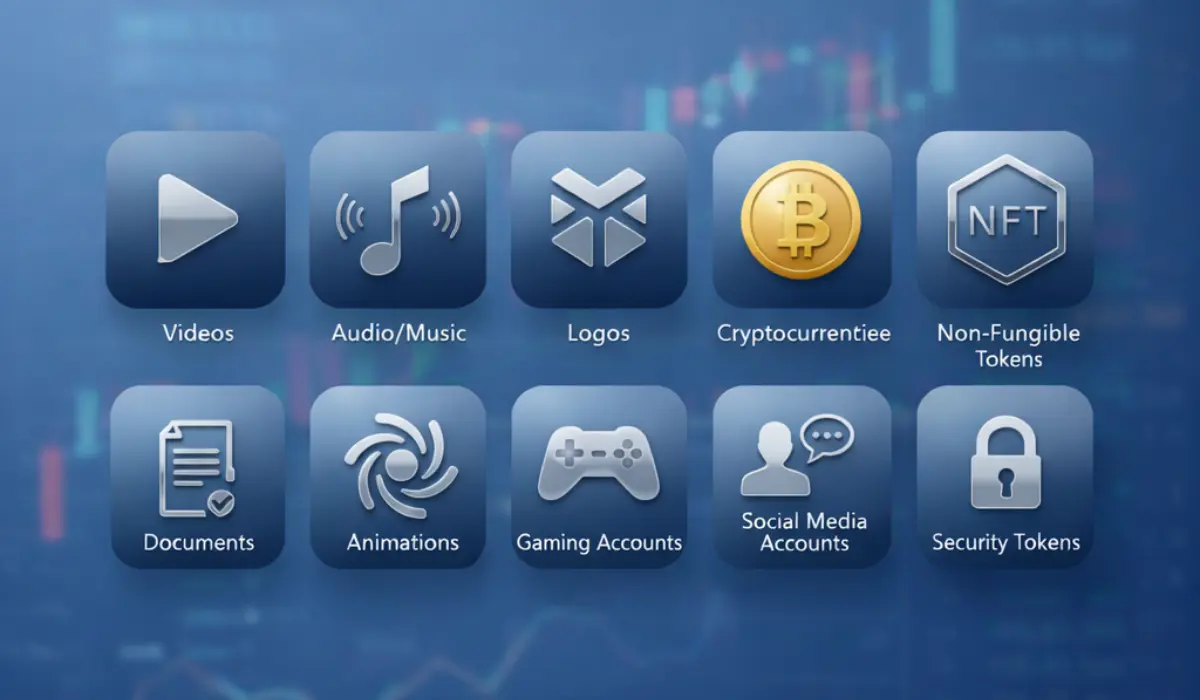
| Photos | Social media accounts |
| Videos | Emails and email accounts |
| Audio/music | Gaming accounts |
| Logos | Cryptocurrency |
| Documents | Nonfungible tokens |
| Animations | Central bank digital currencies |
| Content | Tokens |
| Illustrations | Crypto assets |
| Metadata | Security tokens |
Why Digital Assets Are Important?
As our lives become more digital-based, we increasingly rely on digital information for its speed and simplicity. Digital assets are the foundation of crypto because they enable decentralized ownership, instant cross-border transfers, and programmable finance via smart contracts.
They serve as an alternative, inflation-resistant store of value, enhance liquidity for traditional assets through tokenization, and provide access to decentralized finance (DeFi).
Digital assets have now shown significant institutional adoption and a growing market capitalization, further cementing their importance as a mainstream financial technology.
Digital Assets Vs Physical Assets
Digital assets are intangible, electronically stored items like cryptocurrencies, NFTs, and digital files. They offer high liquidity and fractional ownership, but face higher security risks and volatility.
On the other hand, physical assets are tangible items such as land, gold, and machinery that offer stability, tangibility, and utility but are less liquid and often harder to trade.
While physical assets can be touched, digital assets exist only as code and data, requiring digital access. Physical assets often derive value from scarcity and utility. Digital assets can derive value from utility, but are often driven by market demand and high volatility.
Benefits Of Digital Assets
Digital assets offer significant benefits, including enhanced financial efficacy through decentralized transactions, improved liquidity, and 24/7 market access. They provide secure, transparent ownership records through blockchain technology.
For organizations, digital asset management (DAM) increases productivity, streamlines workflows, and ensures brand consistency.
Transactions can be processed globally in minutes, rather than days, reducing reliance on traditional, slower intermediaries. Digital assets reduce time spent searching for assets or recreating lost files, and enable easy repurposing of content. They provide controlled access, audit trails, and version control, helping to protect against data loss. These advantages make digital assets an increasingly vital part of both the evolving financial ecosystem and modern, digital-first business operations.
Risks And Challenges Of Digital Assets
Digital assets, including cryptocurrencies, stablecoins, and tokenized assets, offer high growth potential but carry significant risks. The risk profile is primarily characterized by intense price volatility, severe cybersecurity threats (hacking, phishing), and a lack of clear, uniform regulations.
Key challenges include liquidity risks for less popular tokens, complex custody issues, market manipulation, and the potential for total loss due to operational failures or fraud.
To manage these risks, investors should use reputable, secure custodians, enable multi-factor authentication, diversify holdings, and remain updated on regulatory changes.
Final Thoughts
The importance of digital assets is increasing every day, both in personal life and business. This highlights the need for effective digital asset management. Digital assets comprise various items, such as cryptocurrencies, photos, and manuscripts, that hold value and ownership. They have become an integral part of our lives. Understanding digital assets’ role in the evolving digital landscape is crucial, as it empowers businesses and individuals to attain their potential for innovation and value creation.
FAQs
- How do digital assets make money?
Digital assets, including cryptocurrencies, NFTs, and tokenized assets, generate money primarily through capital appreciation (selling for a higher price), income generation (staking/yield), and utility within blockchain ecosystems.
- Is a bank account considered a digital asset?
Technically, a bank account is not a native digital asset but rather a digital interface for traditional fiat currency. However, in legal and estate planning contexts, it is classified as a digital asset because it is an electronically stored record that requires specific digital credentials to access and transfer its value.
- What is not a digital asset?
An item is not a digital asset if it lacks exclusive ownership rights or independent value, such as a public website or temporary system cache files. Essentially, if you cannot control, transfer, or derive value from the data, it remains mere information rather than a digital asset.
- Are digital assets a good investment?
Digital assets, like Bitcoin and Ethereum, can be a good, high-growth investment for diversifying portfolios with potential for outsized returns, but they are highly speculative and volatile.


