

Choosing between ETFs and stocks affects the risk and returns of one’s investment portfolio. Stocks are said to be better for investors, especially when they have specific industry knowledge or when returns vary widely. On the other hand, ETFs work well in sectors with more stable returns and offer built-in diversification. Investor expertise, market conditions, and returns on investments play a key role in this decision. Most investors prefer ETFs due to their lower risk, instant diversification, and passive management, whereas individual stocks are better for experienced investors seeking higher returns through active, high-risk, and time-intensive research. This article further discusses the key differences between Exchange Traded Funds (ETFs) and individual stocks, and which is ideal for long-term investment. So, keep reading to learn more.
Key Differences Between ETFs And Individual Stocks
| Aspect | ETFs (Exchange-Traded Funds) | Individual Stocks |
|---|---|---|
| Definition | Investment funds that hold a basket of securities (stocks, bonds, or both) and trade on an exchange like a stock | Represent ownership in a single company |
| Ownership | Ownership in a diversified portfolio of assets | Ownership stake in one specific company |
| Diversification | Built-in diversification across hundreds or thousands of securities | No diversification unless multiple stocks are purchased |
| Risk Level | Generally lower risk due to diversification | Higher risk due to exposure to one company |
| Volatility | Designed to reduce volatility | Can be highly volatile with large price swings |
| Return Potential | More stable, moderate returns over time | Potential for higher returns, but with greater risk |
| Research Required | Less research is needed due to the diversified nature | Requires extensive research and monitoring |
| Capital Requirements | Easier to build a diversified portfolio with less capital | Diversification requires more capital |
| Long-Term Suitability | Well-suited for long-term investing | Riskier for long-term investment due to price fluctuations |
| Flexibility | Ideal for broad market exposure and risk management | Allows for short-term trading opportunities |
ETFs are investments much like mutual funds. They trade on an exchange throughout the day, like a stock, even though they invest in hundreds, sometimes thousands of individual securities. Stocks, on the contrary, represent ownership in an individual company. Every share of stock gives the holder a small stake in the company’s earnings and assets. Investing in ETFs is considered less risky compared to individual securities. However, you can complement the ETFs in your portfolio with specific stocks and bonds. While ETFs provide built-in diversification to reduce risk, individual stocks have the potential for higher returns but come with greater risk.
Individual stocks can be highly volatile, thereby leading to significant price fluctuations, but ETFs are designed to mitigate volatility risks along with offering a way to build a diversified portfolio. Building a diversified portfolio with individual stocks requires capital and substantial research. However, stocks sometimes allow you to take advantage of short-term opportunities that provide higher returns. The main issue with individual stocks is that it is a risky strategy for long-term investment because the performance of the stock price can fluctuate significantly over time. Conversely, ETFs can hold hundreds or thousands of stocks or both, and you won’t have to bet everything on one company.
The working mechanism of ETFs and individual stocks
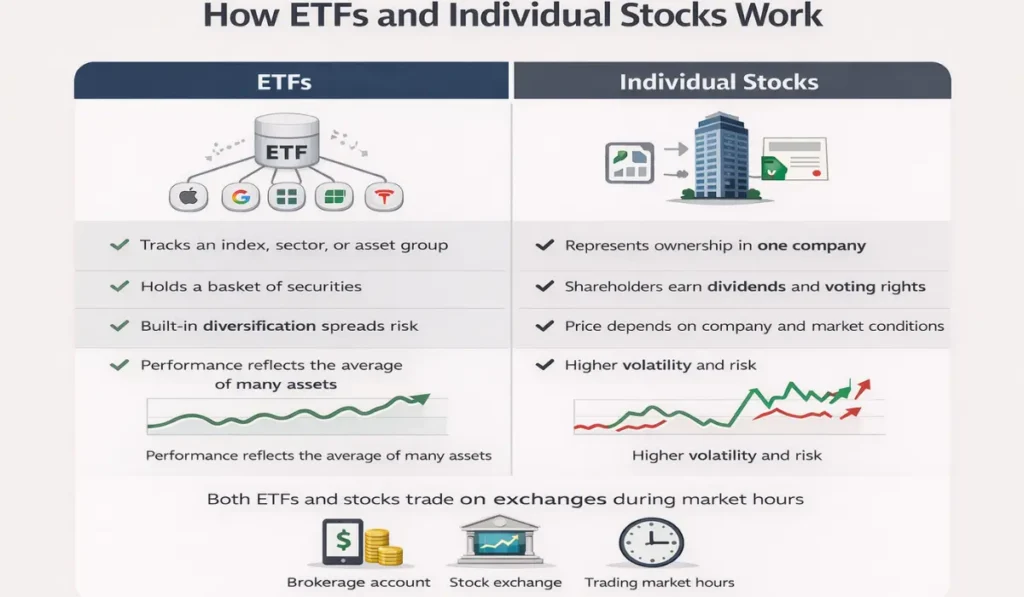
Both ETFs and individual stocks offer a way to participate in the financial markets. However, they differ in terms of structure, management style, and risk, which is why it is important to know how each works. You will need a brokerage account to trade ETFs and stocks to place buy or sell orders in market hours. Both can be traded on an exchange, allowing real-time transactions throughout the trading day.
Regarding how ETFs work, they are designed to track the performance of a specific sector, index, or group of assets. They do so by holding a basket of securities that has a similar composition to that of the underlying benchmark. This diversification can help spread risk because the performance of an ETF is not solely dependent on the success or failure of a single company. It rather reflects the average performance of the entire group of assets, which can be less volatile and more stable compared to individual stocks.
Owning stock in a company makes you a shareholder, giving you rights like the ability to vote on key corporate decisions and receive a portion of the company’s profits in the form of dividends. Stock values can fluctuate depending on company conditions, investor sentiment, and market conditions. You should use a brokerage account to buy or sell shares during market hours to trade stocks.
ETFs vs Stocks For Long-Term Investing
For long-term investing, ETFs generally provide diversified, superior, and low-cost market exposure, making them ideal for consistent wealth accumulation. Individual stocks also provide higher potential returns through targeted, high-risk bets on specific companies, but require significant research and carry higher volatility. A hybrid approach often balances these strategies. ETFs are best for investors seeking steady growth, lower risk, and a ‘set-it-and-forget-it’ strategy. On the other hand, individual stocks are ideal for experienced investors with high risk tolerance, time for research, and specific industry knowledge.
Can You Invest In Both ETFs And Individual Stocks?
Indeed, you can invest in both ETFs and individual stocks. It is a common, effective strategy that combines the stability of broad market exposure with the growth potential of specific, hand-picked companies. This approach uses ETFs for a diversified foundation while using individual stocks to target specific sectors or high-growth opportunities. Combining both can help with diversification and risk management, because ETFs provide instant diversification across hundreds or thousands of securities, thereby reducing the risk associated with any single company. Additionally, investors can use low-cost, broad-market ETFs for the bulk of their portfolio while allocating a smaller percentage to individual stocks. While ETFs offer ease of use, individual stocks can sometimes offer more control.
Final Thoughts
Regarding which is better for investors, it is better to consider a core-and-satellite approach, that is, using ETFs for the majority of the portfolio for stability, while allocating a smaller, higher-risk portion to individual stocks for potential outperformance. Generally, ETFs are said to be better for investors, as they offer instant diversification, lower risk, and passive management. However, individual stocks are ideal for experienced investors seeking higher returns. Combining both often creates a balanced portfolio with a stable ETF foundation.
FAQs
Some of its disadvantages include trading costs, volatility, tracking errors, and liquidity issues.
Individual stocks offer the potential for higher returns, but they come with significantly higher risk than ETFs. It is the ETFs that provide diversified, steadier growth by pooling many stocks.
The best stocks for beginners are generally large-cap, blue-chip companies with stable earnings, low volatility, and a history of reliable performance.


