


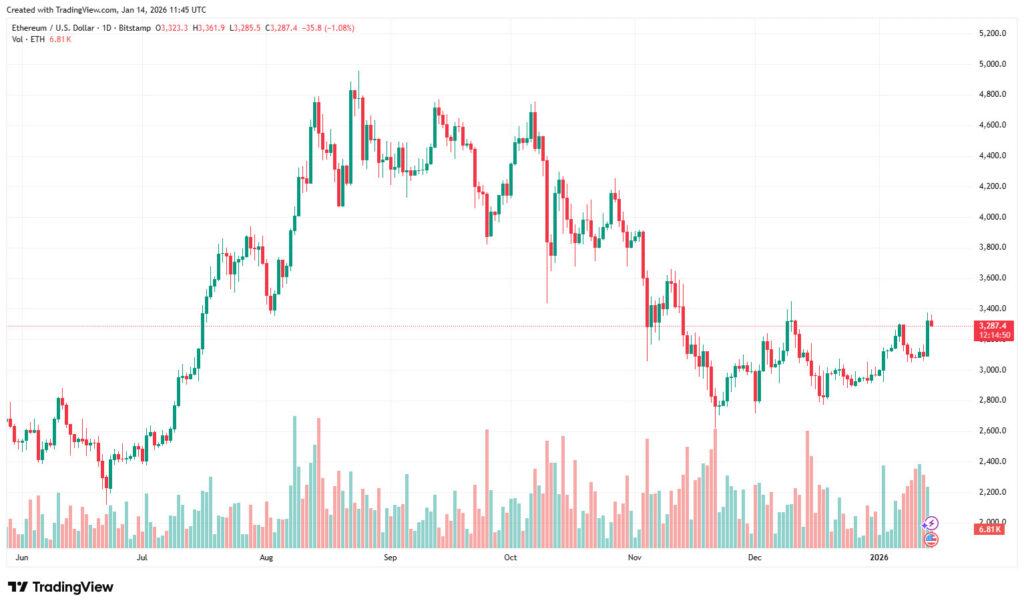
Ether (ETH) has been struggling to sustain price levels above $3,300 over the past two months. This has led to traders questioning whether the second-largest cryptocurrency by market capitalization could achieve a durable bullish momentum in 2026.
Despite the Ethereum blockchain rolling out significant upgrades at the end of last year and maintaining its market lead in terms of on-chain deposits, most investors believe that the chances of ETH reclaiming the $4,000 mark are low, but not impossible.
Ether’s Underperformance Linked to Low DApp and DEX Activity
ETH’s performance since November 2025 has aligned with the broader market dip, with the lack of optimism primarily driven by the weaker overall usage of decentralized applications (DApps) than by issues specifically related to the ecosystem. Regardless, a price upside in the short-term seems to be limited, and traders are showing less interest in DApps, as reflected by declining activity of decentralized exchanges (DEXs).
According to data from DefiLlama, aggregated DEX volumes over the past two weeks totaled $150.4 billion. This number is down 55% from the $340 billion all-time high recorded in January 2025. The 7-day Ethereum DEX volumes are ranging near $9 billion, suffering a 65% pullback from the peak at $27.8 billion in October 2025. This decline pushed Ethereum network fees down 87% from $21.3 million in November to $2.6 million by January. Despite the setback, the ecosystem continued to dominate, handling roughly 50% share of DEX activity when combining data from Layer-2 networks like Base, Arbitrum, Polygon, and others.
Ethereum also leads in terms of total value locked (TVL) on the mainnet, which is strong evidence pointing to institutional preference, even as its competitors, such as Tron, Solana, and BNB Chain, generate comparatively higher network fees. Though some market experts argue that Ethereum has failed to utilize its market dominance among smart contract-based blockchains, this outcome is not a drawback but stems from the network’s strategy for achieving high scalability through rollups.
The number of transactions on Solana, Ethereum’s arch-rival, exceeded the combined total of its top 10 competitors. This highlights the network’s reliance on intensive validation processes and a semi-centralized development framework overseen by Solana Labs. According to data from Nansen, Ethereum processed 54.4 million transactions over the past 30 days. Meanwhile, its layer-2 scaling solution Base recorded more than 600 million transactions in the same timeframe.
393K New Ethereum Wallets Signal Aggressive Post-Fukasa Surge
On the plus side, an average of 327,000 new Ethereum wallets were created daily over the past week, with Sunday recording the highest single-day number ever at over 393,000 wallets. This can be attributed to a combination of protocol-level upgrades, increased stablecoin activity, and a shift in crypto market sentiment. New wallets signal that new users, developers, or institutions are entering the ecosystem. Data also shows that non-empty wallets are now at 172.9 million – an all-time high.
Santiment analysts link this surge in new wallets to Ethereum’s Fusaka upgrade in December, which made using the network cheaper and easier by improving data handling on-chain and cutting the cost of posting information from layer-2s back to the mainnet. The reduced fees and easier interactions with DApps and rollups may have encouraged new users to open wallets.
Along with the protocol upgrade, Ethereum is also benefiting from general sentiment improvement as investors and developers reposition themselves for the new year. Santiment analysts said holder sentiment shifted from negative to neutral and positive by mid-December, which often coincides with more retail users signing up and creating addresses. There was also more interest from new users to enter the ecosystem to explore DeFi, non-fungible tokens, and other apps toward the end of the year.
ETH Momentum Falters as Standard Chartered Cuts Target to $7.5K
Meanwhile, Standard Chartered’s Global Head of Digital Assets Research, Geoffrey Kendrick, said that 2026 could be the “year of Ethereum” even as the banking giant lowered its price targets for the largest altcoin in the market, citing weaker momentum across the board. The bank expects ETH to hit $7,500 by the year-end, down from its initial forecast of $12,000. The prediction still considers a potential upside of over 140%.
“We lower our year-end ETH-USD forecasts for 2026 to 2028 to reflect broader weakness in digital assets. However, we raise our longer-term ETH-USD forecasts,” the bank said.
Under the revised forecast, Standard Chartered targets $15,000 ETH in 2027, down from its earlier prediction of $18,000 and $22,000 in 2028, which is down from $25,000. However, the bank maintained its 2029 target at $30,000 and expects ETH to hit $40,000 by the end of 2030.
Ether’s two-month stretch trading below $3,200 has been particularly challenging for companies that raised debt or equity to build ETH treasury reserves. BitMine Immersion Technologies, the world’s largest corporate holder of Ether, currently holds $13.2 billion worth of ETH, while its BMNR common stock trades at a 9% discount to the value of its digital asset holdings.
But it remains unclear what catalyst could shift the momentum back in ETH’s favor, especially as rival blockchains like Solana and Base provide comparable DApps or functionality for average users, often with lower friction due to their scalable base layer. ETH’s path to $4,000 and beyond depends heavily on renewed demand for blockchain-based applications and an improving crypto risk appetite amid ongoing uncertainty in the U.S. economy.
At the time of writing, Ether (ETH) is trading at $3,329 – up 6.17% in 24 hours.


