

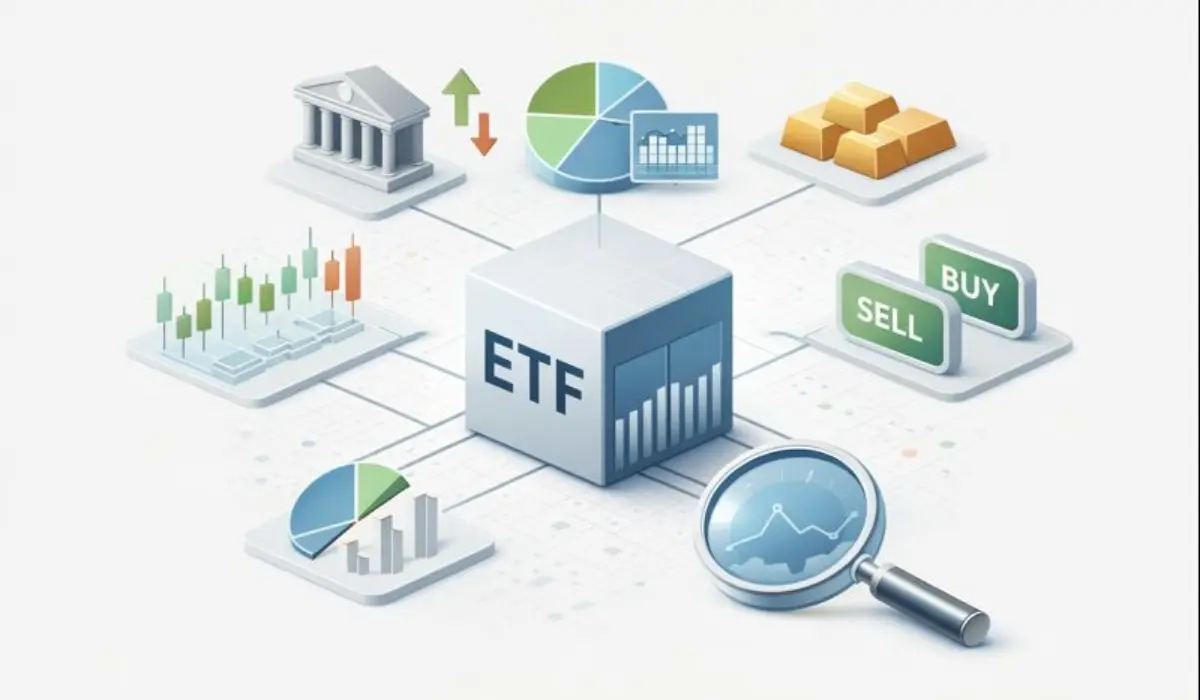
An Exchange-Traded Fund (ETF) is a type of investment fund holding a basket of assets, including bonds, stocks, and commodities, that trades on stock exchanges just like individual shares. ETFs can be structured to track anything from the price of a commodity to a large, diversified stock collection, even specific investment strategies. By purchasing one share of an ETF, investors can own a small portion of a large portfolio, thereby reducing the risk associated with holding individual stocks. Since many ETFs are passively managed to track indexes like the S&P 500, this results in lower expense ratios and high transparency regarding their holdings. This article further discusses how ETFs work and the types of ETFs. So, keep reading to learn more.
How Does An ETF Work?
ETFs have become popular with investors as they provide a way to buy a potentially diversified investment. They provide exposure to hundreds or thousands of different stocks, bonds, and other types of investments in a single trade. This means the performance of ETFs would be determined by the price change of all those assets. It thus offers instant diversification, lower costs than some funds, and intraday trading flexibility.
You can invest in ETFs through a broker (a broker-dealer or financial institution). You can trade ETFs in brokerage accounts and in retirement accounts at most places. Some providers will also allow you to invest in ETFs in your HSA. To invest in an ETF, open and fund an account that can trade ETFs. Then, research ETFs that align with your financial goals and buy the ETF using the ticker. Decide prior to when you want to sell your recently bought ETF. This may seem strange, but planning beforehand could help you have a clear plan and maximize your potential profit or minimize potential losses.
Types Of ETFs In The Stock Market
There is a wide variety of ETFs on the stock market, such as:
Passive ETFs
Passive ETFs focus on replicating the performance of a broader index, which is either a diversified index or a targeted sector or trend.
Bond ETFs
Bond ETFs are used to provide regular income to investors, and their distribution can vary according to the performance of the underlying bonds.
Actively managed ETFs
Actively managed ETFs do not target an index; they rather let portfolio managers make decisions about which securities to buy and sell.
Bitcoin ETFs
Bitcoin ETFs provide exposure for investors to Bitcoin’s price movements in their regular brokerage account by holding and purchasing Bitcoin as the underlying asset.
Ethereum ETFs
Ethereum ETF offers a way to invest in Ether without directly owning the cryptocurrency.
Leveraged ETFs
Leveraged ETFs work to return some multiples on the return of the underlying investments. They use debt and derivatives such as options or futures contracts to leverage their returns.
Industry or sector ETFs
Industry or sector ETFs can track a single industry or sector, like energy or automotive. They aim to provide diversified exposure to a single industry.
Currency ETFs
Currency ETFs track the performance of currency pairs and are used to speculate on the exchange rates of currencies based on economic and political developments in a country.
Inverse ETFs
In inverse ETFs, one can earn gains from stock declines without having to short stocks. It uses derivatives to short a stock, and they act like exchange-traded notes (ETNs) and not true ETFs.
Commodity ETFs
It lets one invest in commodities like gold or crude oil, and holding shares in a commodity ETF is less expensive than owning the physical commodity.
Major Crypto ETFs
There are many popular ETFs, but among them, investors mostly prefer crypto ETFs. Here is the list of some of the major crypto ETFs:
| Ticker | Fund Name | Type |
|---|---|---|
| IBITBTC | iShares Bitcoin Trust | Spot |
| FBTCBTC | Fidelity Wise Origin Bitcoin Fund | Spot |
| GBTCBTC | Grayscale Bitcoin Trust ETF | Spot |
| ETHAETH | iShares Ethereum Trust ETF | Spot |
| BTCBTC | Grayscale Bitcoin Mini Trust ETF | Spot |
| ETHEETH | Grayscale Ethereum Staking ETF Shares | Spot |
| ARKBBTC | ARK 21Shares Bitcoin ETF | Spot |
| BITBBTC | Bitwise Bitcoin ETF | Spot |
| BITOBTC | ProShares Bitcoin ETF | Futures |
| FETHETH | Fidelity Ethereum Fund | Spot |
Who Should Invest In ETFs?
ETFs are ideal for investors seeking low-cost, diversified, and tax-efficient exposure to markets. They can be a good choice for both beginners and long-term passive investors. They are also suitable for those wanting to avoid the high research time of individual stocks, as well as tactical traders needing intraday liquidity. ETFs benefit long-term investors, as they can build a core portfolio with lower volatility through diversification. As for beginners, it offers a good entry point due to lower costs, ease of purchasing, and built-in diversification. Active traders and passive investors can consider investing in ETFs, as they can be used for tactical asset allocation, hedging, or sector rotation, along with tracking benchmark indices with low tracking error.
Final Thoughts
Exchange-Traded Funds (ETFs) provide a cost-effective way to gain exposure to a broad basket of securities, even with a limited budget. Investors can easily build a portfolio that holds ETFs, and instead of individual stocks, they can buy shares of a fund. They offer diversified, cost-effective, and highly liquid portfolios that trade like stocks, providing real-time pricing and tax efficiency. However, it involves risks, such as market volatility, tracking errors, and potential liquidity issues with niche funds.
FAQs
Yes, you can withdraw ETFs from an exchange anytime during market hours, as they are designed for high liquidity and trade like stocks on an exchange.
ETFs should generally be held for the long term, with a minimum investment period of 7 years or more to maximize potential positive returns and manage market risks.


