

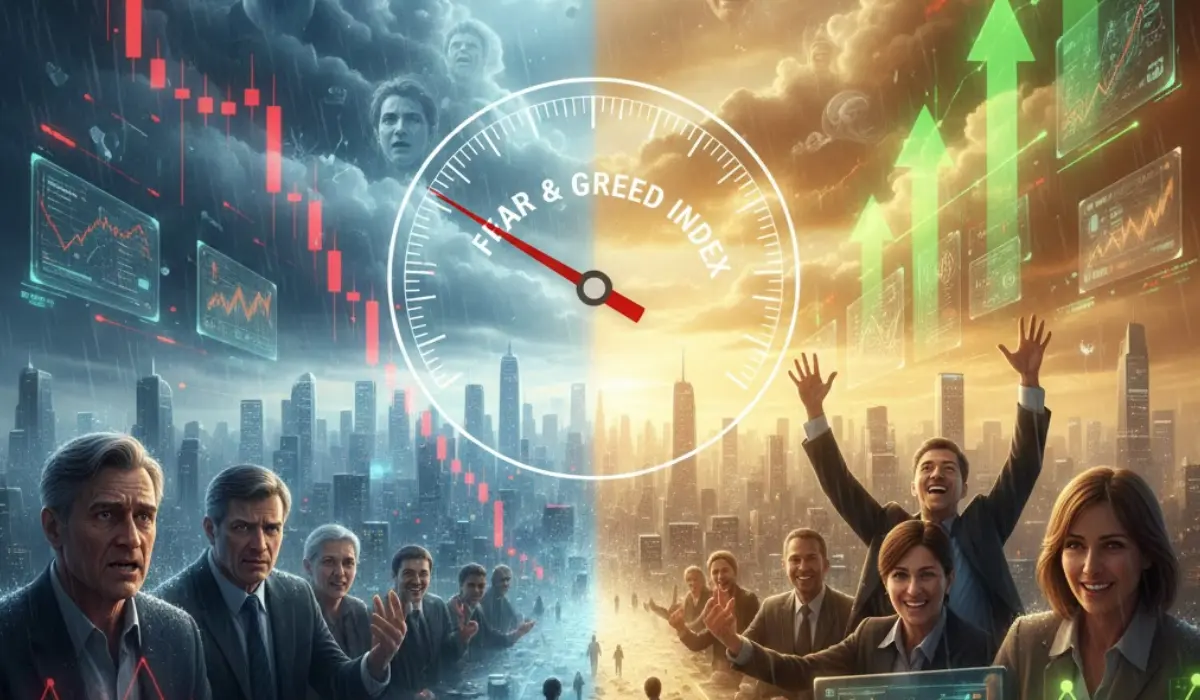
The Fear & Greed Index serves as a key tool to track investor sentiment in the stock market. Developed by CNN Business, it focuses on providing insights into how emotional factors like fear and greed impact stock prices. It offers valuable data for determining if stocks are overvalued or undervalued. The Fear & Greed Index consists of seven indicators, including stock momentum and market volatility. It is thus considered an essential resource to craft informed investment strategies and decisions. This article further discusses the Fear & Greed Index in detail, so keep reading to learn more.
What The Fear & Greed Index Reveals About Market Trends
Investors are often driven by emotions, and the Fear & Greed Index is designed to assess the market sentiment. It tries to measure market trends based on the premise that fear results in stock trading below intrinsic value, and greed causes an upward trend. It is thus considered a useful investment research tool and an effective market timing barometer. Here are the seven indicators used in the Fear & Greed Index:
Market Momentum
Market momentum is measured by comparing the S&P 500 to its average over the past 125 days. It is considered a positive momentum when the current value of the index is higher than the 125-day average. This shifts the index toward greed. On the other hand, when the index is negative or lower than the prior average, it signals investor fear.
Market Volatility
Market volatility can be measured by the VIX and its 50-day moving average. A sharp rise in volatility indicates a fear environment, and low volatility suggests complacency or investor optimism. While VIX is supposed to be a leading indicator of market sentiment changes, its predictive record is not perfect.
Stock Price Strength
The stock price strength analyzes the number of stocks on the NYSE hitting 52-week highs versus those hitting 52-week lows. A surplus of highs over lows signals investor greed, whereas more lows than highs indicate a pessimistic climate.
Stock Price Breadth
It measures the trading volume of advancing stocks versus declining stocks. Trading volume often reflects how investors are feeling, and the Fear & Greed Index incorporates the McClellan Volume Summation Index. This helps understand the trading volume trends on strong days and weak days. A rise in trading volume shows investor greed, and a decline in volume indicates fear.
Safe Haven Demand
Investors often seek safety by reducing stock exposure and increasing bond exposure when they get nervous. The Safe Haven Demand measures this phenomenon by comparing the past 20 stock-trading days of treasury bonds vs. stocks. When the demand for stocks is higher, it indicates that investors are feeling greedier. If bonds are outperforming stocks, it shows that investors are more cautious.
Junk Bond Demand
The index measures junk bond demand through the yield spread between junk bonds and investment-grade bonds. If the difference in yield is smaller, it shows that the investors are greedier or open to more risk. On the other hand, a larger yield spread indicates a more cautious or fearful investing climate.
Put And Call Options
While a put gives investors the option to sell a security at a future date, a call allows investors to buy a security later. The ratio of put options to call options shows whether investors largely expect to be selling or buying going forward. This measures the trend in the five-day average put / call ratio, and a value of 1 would be neutral. However, a number higher than 1 can initiate fear, and a number lower than 1 indicates greed.
How To Read The Fear & Greed Index
A low value indicates fear, while a high value implies greed. Labels are applied to index ranges, allowing investors to interpret the market sentiment easily.
- 0-24: shows extreme fear.
- 25-44: represents a more modest level of fear.
- 45-55: means a neutral market.
- 56-75: indicates investors’ greed.
- 76-100: expresses extreme greed among the investors.
How Traders Use The Fear & Greed Index In Strategies
Generally, the Fear & Greed Index is mainly used to understand how emotions influence investment decisions and to recognize good buying opportunities. Traders use the Fear & Greed Index as a contrarian sentiment-based tool. Buying during extreme fear (0-25) when assets are undervalued and selling during extreme greed (75-100) when they are overvalued. It serves as a market mood measure to prevent herd-mentality decisions. It is also often paired with technical analysis to confirm the reversals in stocks and cryptocurrencies.
Final Thoughts: Is The Fear & Greed Index Reliable?
While the Fear & Greed Index is very useful, it should not be your only investment tool. Always do thorough research and gather information from other sources before making investment decisions. Understand that the Fear & Greed Index is not a perfect predictor and can stay in ‘Greed’ for longer periods during a bull run. This can lead to missed gains if a trader sells too early. So, it is best used to gauge market sentiment trends rather than for precise timing.
FAQs
The Fear & Greed Index is generally considered an accurate, real-time overview of current market sentiment rather than a predictive tool.
The Fear & Greed Index is said to be highly useful for beginners as a sentiment indicator, as it helps visualize market emotions (fear vs. greed) on a scale of 0-100.
A good Fear & Greed Index score depends on whether you are buying or selling, generally using a 0-100 scale where lower numbers indicate fear and higher numbers indicate greed.
The safest time to invest based on the Fear & Greed Index is during Extreme Fear (0-24) because it signals that investors are panic-selling, leading to potentially undervalued assets and better long-term buying opportunities.


