


In a move that has reignited the long-standing debate over the intrinsic value of digital assets, former British Prime Minister Boris Johnson has publicly characterized Bitcoin as a “giant Ponzi scheme.” The comments, published on March 13, 2026, triggered a forceful backlash from prominent industry figures, most notably Strategy Inc. Chairman Michael Saylor. The exchange highlights a deepening philosophical divide between traditional political leadership and the vanguard of the burgeoning decentralized finance sector at a time when Bitcoin continues to test significant psychological price barriers.
Johnson Questions Bitcoin’s Legitimacy
Writing in his regular column and on his social media accounts, Johnson expressed deep skepticism regarding the sustainability and legitimacy of the world’s largest cryptocurrency. The former Prime Minister argued that Bitcoin lacks the fundamental characteristics of a stable currency or a productive asset, suggesting instead that its valuation is predicated entirely on a “collective belief” that could evaporate at any moment.
Addressing his followers on X, Johnson stated that he has “long suspected Bitcoin is a giant Ponzi scheme,” noting that recent reports of investor losses have only heightened his concerns. He argued that the asset class functions by maintaining a “constant supply of new and credulous investors,” a hallmark of fraudulent financial structures.

Johnson’s critique was fueled by a personal anecdote involving a constituent from his local village who reportedly lost approximately £20,000 (roughly $26,000) to crypto-related scams and fees after being lured by promises of quick returns. He specifically questioned the accountability of the network, noting that the anonymous nature of Bitcoin’s founder, Satoshi Nakamoto, leaves investors without a central authority that could be held accountable in the event of losses or hacks. Johnson further compared the digital asset unfavorably to tangible collectibles like Pokémon cards or historical Roman coins, which he argued possess a “recognizable appeal” or the backing of institutional authority.
The Crypto Community Strikes Back
The response from the digital asset community was swift and uncompromising. Critics of Johnson’s column were quick to point out the perceived irony of a former head of state criticizing a decentralized network while the United Kingdom grapples with high fiscal debt and currency devaluation. On social media platforms like X, many investors sarcastically labeled the British Pound and the UK’s own fiscal structure as the “real Ponzi schemes.”
The most prominent rebuttal came from Michael Saylor, the Chairman of Strategy Inc. (formerly MicroStrategy) and one of the world’s most vocal Bitcoin proponents. Saylor, whose company currently holds over 738,000 BTC, roughly 3.5% of the total supply, used his platform to provide a technical defense of the network’s architecture.
Saylor clarified the distinction by noting that a true Ponzi requires a “central operator” to facilitate the fraud. Bitcoin, he argued, differs fundamentally because it has “no issuer, no promoter, and no guaranteed return,” functioning instead as a decentralized network driven by market demand and open-source code.
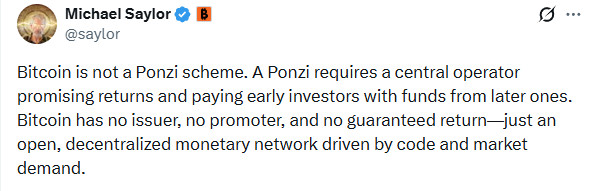
Saylor’s defense centers on this distinction: whereas Ponzi schemes are opaque and centralized, Bitcoin’s protocol is open-source and transparent, with all transactions recorded on a public ledger, a fact he suggests makes it the antithesis of a secretive financial scam.
Market Data and Investor Sentiment
Despite the high-profile criticism, the broader Bitcoin market showed significant intraday volatility rather than a sustained collapse. After hitting a daily high of nearly $73,900 on March 13, 2026, Bitcoin’s price retreated to approximately $70,647 as headlines about Johnson’s comments circulated, representing a dip of roughly 4.4% from the day’s peak.
Even with this pullback, the asset maintained a formidable market capitalization of $1.41 trillion. Analysts noted that while Johnson’s comments contributed to short-term “FUD” (Fear, Uncertainty, and Doubt), institutional sentiment remained buoyed by the recent approval of crypto ETFs by the UK’s Financial Conduct Authority (FCA) and a five-day streak of inflows into U.S. spot Bitcoin products.
For investors, the controversy serves as a reminder of the “headline risk” associated with the crypto market. However, many analysts suggest that the market has become increasingly “numb” to such criticisms from traditional politicians. The entry of major Wall Street institutions into the space has provided a level of legitimacy that was absent during similar rhetorical attacks in 2017 or 2021.
The Irony of Johnson’s Bitcoin Criticism
The irony of Johnson’s comments was not lost on policy analysts. It was during the Boris Johnson administration (2019–2022) that the United Kingdom laid the groundwork for its current crypto regulatory roadmap. Under his tenure, then-Chancellor Rishi Sunak pledged to make the UK a “global crypto asset hub,” a goal that eventually led to the 2023 legislation bringing crypto activity within the regulated financial purview of the FCA.
The current friction between Johnson’s rhetoric and his administration’s legislative legacy highlights a period of growing pains in global regulation. While policymakers recognize the economic potential of blockchain technology and stablecoins, the “retail harm” mentioned in Johnson’s column continues to drive a cautious, often hostile, narrative among the political old guard.
A Clash of Financial Philosophies
The clash between Boris Johnson and Michael Saylor is more than a war of words; it represents the friction between the 20th-century model of state-backed, centralized finance and the 21st-century model of algorithmic, decentralized assets.
This event underscores the importance of distinguishing between the technology of the Bitcoin network and the fraudulent actors who operate on its periphery. While Johnson’s “tales of woe” regarding scammed investors are factually grounded in real-world losses, advocates like Saylor argue that blaming the network for these crimes is akin to blaming the internet for email phishing.
As the UK and the U.S. continue to refine their regulatory perimeters, the debate over whether Bitcoin is a revolutionary monetary tool or a speculative bubble will likely persist. For now, the market seems to side with the latter’s growing institutional utility, even as one of the world’s most recognizable politicians warns that the “jig will eventually be up.”


