

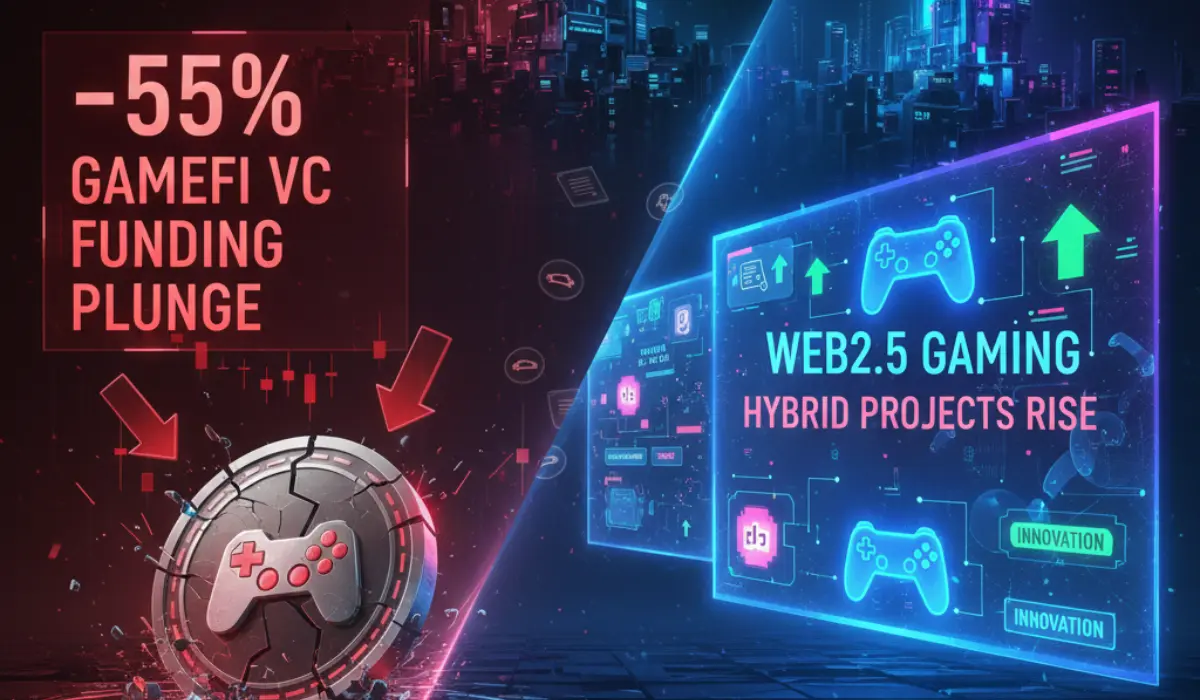
The once-booming GameFi sector faces a stark reality in 2025, as venture funding for projects declined more than 55% year-over-year. This trend mirrors the wider slowdown across the crypto market, but the blockchain gaming space has been hit harder than others.
A scathing report by Delphi Digital explains GameFi’s funding collapse, exposes broken token models, and the market’s quiet evolution into a revenue-first Web2.5 gaming model that gained traction this year.
GameFi Funding Drops 55% YoY as Projects Fail to Deliver; GALA, AXS, ENJ Down 80–90%
As per the report titled “The Year Ahead for Apps 2026,” after pulling in over $147 million in Q1 2025, funding fell dramatically to $73 million in the second quarter. Though it rebounded to $129 million in Q3, funds dried up almost entirely by year-end. This substantial decline signals a profound shift for an industry that is grappling with unmet expectations and cooling investor enthusiasm.
The fallout was so severe that dozens of GameFi studios ran out of runway as their token prices collapsed, and were forced to empty their treasury to sustain operations. CoinGecko data shows that the current total market cap of the gaming sector sits near $6.1 billion, with many tokens down 70%-95% from all-time highs. Market leaders like Axie Infinity (AXS), Gala (GALA), and Enjin (ENJ) have fallen 82%, 86%, and 87%, respectively, since 2024.
Poor retention rates furthered the damage, with many titles seeing a player drop-off of 60% within 30 days, while inflationary play-to-earn (P2E) models were rewarding bots and extractive behavior rather than actual players.
According to DappRadar, in Q2 2025 alone, more than 300 gaming-focused decentralized applications (dApps) were shut down. The DeFi analytics platform itself announced that it would be shutting down operations in 2026 after seven years.
Several interrelated factors added to this negative sentiment. Firstly, macroeconomic pressures on the broader crypto market reduced capital availability, as investors took a step back from risk assets like digital currencies and equities. Secondly, regulatory uncertainty surrounding crypto assets continues to deter institutional investors, and lastly, existing projects failed to meet the lofty demands of the gaming industry.
Many titles that received large backing and promised revolutionary token economies delivered clunky and buggy user experiences or implemented unsustainable tokenomics. This execution gap ultimately led to investor fatigue and more cautious due diligence.
Read More: Kioxia Shares Soar Over 500% in 2025 On AI Memory Demand; Valuation Concerns Persist
Web2.5 Games Blending Gameplay, Payouts, and Blockchain Gain Momentum
Despite these setbacks, Delphi analysts painted a nuanced long-term outlook for the crypto gaming industry. While speculative GameFi has started to fade, there is a new niche in the market. Web2.5 games represent a hybrid model that integrates blockchain technology as a foundational infrastructure layer into traditional gaming, bypassing native token designs to focus on authentic revenue streams and superior player experiences.
Web2.5 games have quietly gained popularity as the studios consider blockchain as an infrastructure rather than a selling point. Studios like Fumb Games, Mythical Games, and Wemix (WEMIX) continue to generate meaningful income by using distributed ledger technology (DLT) to improve margins, increase engagement, or integrate new payment rails.
Stablecoins are playing a pivotal role in accelerating this shift, as they enable seamless nano-transactions, global payments, and engagement rewards, while safeguarding players from exposure to crypto volatility. The report emphasized that this setup allows studios to deliver polished UXs to players that are comparable to traditional game titles, eliminating the often complicated blockchain integrations in the process.
The report noted that as stablecoin usage continues to grow, developers can turn their focus more towards developing fun and engaging gameplay with profitability, fostering broader appeal among mainstream gamers.
Even traditional brands are experimenting with Web2.5 gaming technology. Recently, FIFA discontinued its Algorand-based (ALGO) NFT platform, FIFA Collect, which allowed fans to purchase, collect, and showcase digital collectibles featuring iconic moments from football history. The global soccer governing body has introduced a new mobile-based game called FIFA Rivals, powered by Avalanche (AVAX). FIFA has also launched its own dedicated blockchain platform, called the FIFA Blockchain, which is an Avalanche subnet that serves as the foundation for the organization’s Web3 initiatives.
Although Web3-native games continue to post six-to-seven-figure profits, their user bases are comparatively modest and primarily driven by incentives. As rewards subside, these ecosystems often project waning engagement.
Industry experts view the events that have unfolded this year as a necessary reset after the hype cycle of 2021 and 2022, when billions flowed in with little lasting value. Whether legacy coins like GALA, AXS, and ENJ can recover may depend less on speculation and more on whether the on-chain gaming market finally delivers products that players demand.


