

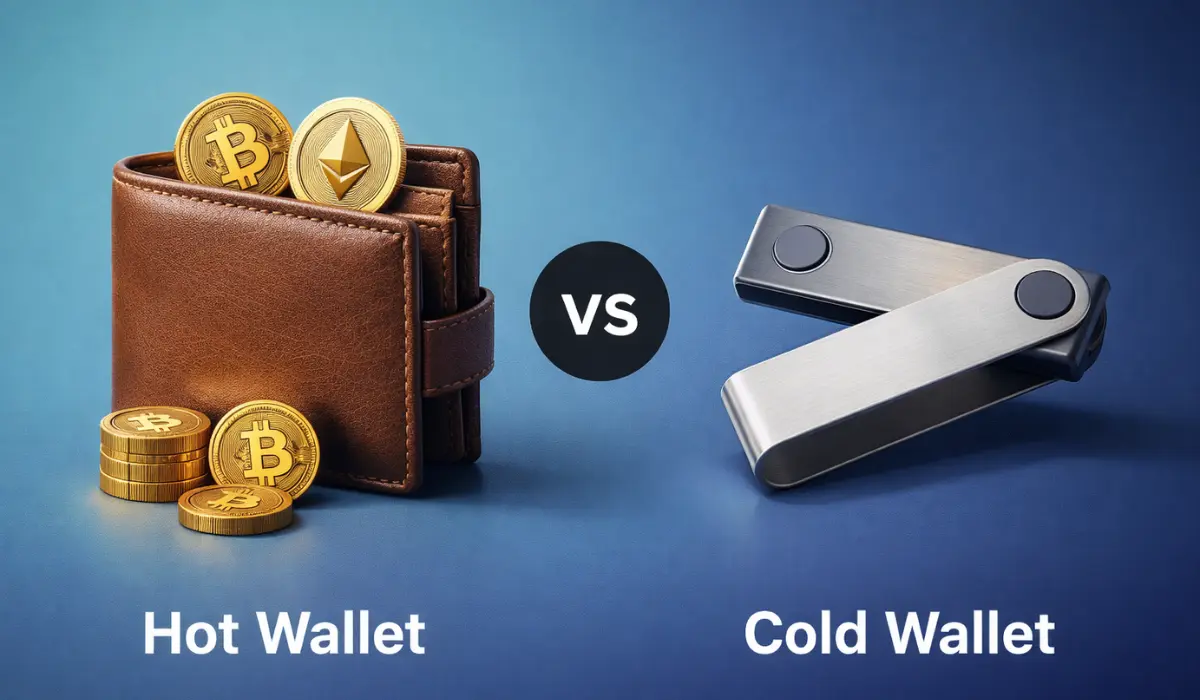
Hot wallets are internet-connected tools that help users access and trade cryptocurrencies quickly. This feature makes them ideal for frequent transactions and trading. On the other hand, cold wallets serve as offline storage devices, just like paper wallets and hardware.
They are known to provide greater security, as they keep crypto assets safe from online threats. While hot wallets provide the convenience of daily use, cold wallets are considered best for long-term storage of larger holdings.
This article further discusses everything you need to know about hot and cold wallets, which is more secure, and when to use each type of wallet. So, keep reading to learn more.
Cold Wallet vs Hot Wallet: Key Differences
Hot wallets are software that is designed to store private keys on a device connected to the internet. They provide several features, including sending, receiving, and storing tokens while managing and viewing all the available tokens in one place. They are accessible from internet-enabled devices, such as laptops, tablets, and cellular phones, which is why hot wallets have been widely adopted by cryptocurrency users. They make it easier to transfer and receive cryptocurrency.
Cold wallets differ from hot wallets largely because they don’t have a connection to another device or the internet. This makes them less susceptible to hacking, which is why they are known as a popular method for storing crypto keys. Cold wallets come as hardware devices that resemble USB sticks. There is an added layer of security in cold wallets because the private keys are entirely kept offline.
Which Wallet Is More Secure?
Choosing a wallet depends on a user’s needs. Cold wallets are said to be more secure than hot wallets, as they store private keys offline, thus protecting assets from online hacks, malware, and phishing attacks. Indeed, hot wallets offer convenience for daily trading, but the online nature of hot wallets poses a security concern. It is because once the seed phrase and private keys have been online, there is no way to know if they are still secret. Regardless of this, hot wallets have been commonly used by those new to the crypto space due to their accessibility and ease of use.
On the other hand, cold wallets are not connected to the internet and are physical devices, like a thumb drive, used to store private keys offline. The nature of cold wallets makes them less vulnerable to online attacks, thereby providing a higher level of security for your cryptocurrencies. However, this feature also makes them less convenient for regular transactions.
List Of Some Of Wallets
Here is the list of some of the best hot and cold wallets:
Hot wallets:

- MetaMask
- Trust Wallet
- Exodus
- Phantom
- ZenGo
- Coinbase Wallet
Cold wallets:

- Ledger Nano X / Flex
- Trezor Safe 3 / Safe 5
- OneKey Pro
- Keystone 3 Pro
- Tangem Wallet
- ELLIPAL Titan 2.0
When Should You Use A Hot Or Cold Wallet?
Hot wallets come in different types, and they serve various purposes. Some are web-only wallets, mobile applications, or even ecosystem-specific wallets. Its main feature is that it generates the seed phrase online and stores private keys online, too. This frequent online presence is what makes transactions convenient and straightforward. Choosing between the two wallets depends on individual needs and preferences. If you are someone who frequently transacts with cryptocurrencies, using a hot wallet is ideal due to its convenience. However, if you are someone who is looking for higher security and long-term storage, a cold wallet would be more suitable.
Best Practice: Use Both Hot And Cold Wallets
Combining both hot and cold wallets is said to be a best practice. While a hot wallet can be used for regular transactions or a small amount of cryptocurrencies, a cold wallet helps store larger amounts of cryptocurrencies for the long-term. This way, using both the wallet offers the convenience of a hot wallet, along with the benefit of the security of a cold wallet. It is also considered the ‘best practice’ for cryptocurrency security, balancing the need for easy and fast transactions with maximum security for long-term holdings.
Final Thoughts
Cold wallets offer maximum security for long-term crypto storage, whereas hot wallets are popular for providing convenience for frequent trading. Since cold wallets are immune to online hacks, they are ideal for high-value assets. On the contrary, hot wallets are susceptible to cyber threats, but allow easy access. Both hot and cold wallets have their advantages and disadvantages, and choosing between them depends on an individual’s needs and preferences.
FAQs
- Do I need a hot wallet if I have a cold wallet?
While not strictly necessary, using a hot wallet alongside a cold wallet is highly recommended for balancing security with convenience.
- What are the disadvantages of a cold wallet?
Cold wallets, while providing top-tier security, suffer from disadvantages such as reduced convenience for frequent trading, higher initial costs, and risks associated with physical loss or damage.
- What is the disadvantage of hot wallets?
The primary disadvantage of hot wallets is their high vulnerability to security breaches due to constant internet connectivity, making them prime targets for hackers, malware, and phishing attacks.
- Which wallet is better for crypto?
The best crypto wallet depends on individual needs. Some of the top choices include Ledger/Trezor for hardware (cold) security, MetaMask for Web3/Ethereum, Exodus for user-friendly desktop/mobile, and Coinbase Wallet/Trust Wallet for mobile simplicity, balancing features like security, ease of use, supported coins, and control (custodial vs. non-custodial).


