

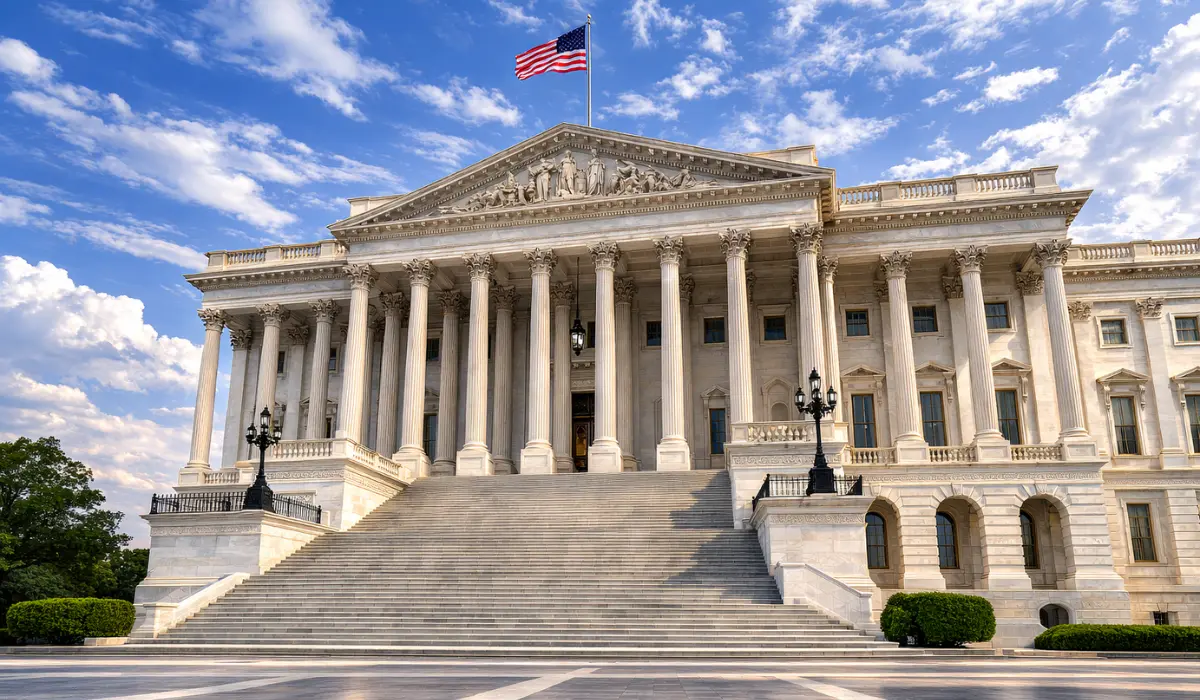
The U.S. Senate Committee on Banking, Housing, and Urban Affairs has advanced the 21st Century ROAD to Housing Act, a bipartisan housing reform bill that includes a significant provision banning the Federal Reserve from issuing a Central Bank Digital Currency (CBDC). The legislation passed with overwhelming support by a vote of 84-6, reflecting rare bipartisan alignment on both housing and digital currency policy.
Affordability and Mortgage Access Initiatives
The 21st Century ROAD to Housing Act was introduced on Monday by the Committee Chairman Tim Scott and Ranking Member Elizabeth Warren, respectively the top Republican and Democrat on the committee. The bill targets supply expansion, affordability programs, mortgage access, and regulatory modernization.
The bill aims to be a comprehensive substitute amendment to H.R. 6644 that includes dozens of housing-related reforms, including streamlining construction in the U.S. (H.R.6644 — 119th Congress (2025-2026)). Being under Title X: Central Bank Digital Currency, the section prohibits the Federal Reserve (the Fed) from issuing a U.S. CBDC that is a direct liability of the Fed without explicit congressional authorization until December 31, 2030.
The ban applies whether issued directly or through financial intermediaries and includes a sunset clause, after which the restriction would expire unless renewed. This reflects the mounting concerns among lawmakers about privacy, financial surveillance, and the potential restructuring of the banking system that could accompany a digital dollar.
However, the inclusion of the digital-currency policy has drawn fresh attention from financial and technology circles, where debates over privacy, surveillance, and the role of government in payments remain unsettled. Further, the bill must be reconciled with the House before reaching the President’s approval, and it remains unclear whether the CBDC provision will survive until final negotiations intact.
Overwhelming Bipartisan Support and CBDC Concerns
The bill has attracted support from both conservative and progressive lawmakers, with 84-6 votes, achieving an unexpected margin. Conservative senators have focused on the CBDC ban as a matter of personal freedom and limited government, while progressive members have emphasized the housing affordability components and tenant protections as their priority.
Key political figures supporting the bill included Senators from states with strong cryptocurrency communities and those who represent regions with a severe housing affordability crisis. The unusual support for the bill has created momentum that surprised many political analysts. Journalist Burgess Everett noted on X, “You don’t see a vote like that every day.”
According to the bill’s provisions, $50 billion will be allocated for new affordable housing construction, expand Section 8 housing vouchers, and create tax incentives for developers who build mixed-income communities. Additionally, it also addresses the zoning reform, encouraging municipalities to eliminate single-family zoning restrictions that have contributed to housing shortages in many metropolitan areas. These provisions garnered support from housing advocates across the political spectrum.
However, the CBDC ban has reignited debates about privacy rights in the digital age. Privacy advocates raised concerns that government-controlled digital currencies could enable surveillance capitalism at an unprecedented scale, tracking every transaction and eventually limiting purchases based on political or social criteria. While CBDC’s supporters countered it by pointing out the benefits, like faster payments, reduced fraud, and improved policy implementation.
Next Step: Senate Debate
The bill will now move forward for further Senate debate, which is scheduled in the coming weeks and will eventually require approval from the House of Representatives, where its future remains uncertain due to mixed views on CBDC policy.
The legislation process could extend several months, with potential amendments and compromises along the way. Industry groups from both the housing and cryptocurrency sectors are mobilizing to influence the outcome.


