


The status of economies around the world and their stock markets are influenced by various factors that are internal or external to those economies. Understanding these macroeconomic factors is crucial for navigating stock market volatility.
Indicators such as GDP, inflation, employment, and retail sales provide valuable insights into the overall economic health, influencing stock valuations and investment decisions. Let’s examine how the key macroeconomic factors impact stock market trends and how you can leverage them to optimize your investment portfolio.
What are Macroeconomic Factors?
Macroeconomic factors are broad market factors that affect the economy as a whole. These factors may be external to a country and are often man-made or natural, but they can change the course of an economy.
Macroeconomic factors impact the key parameters of an economy, like the GDP growth rate, stock market trends, major industries, etc. Therefore, it is important to understand these factors and ascertain their impact on the economy as a whole.
Macroeconomic Factors Impacting the Stock Market
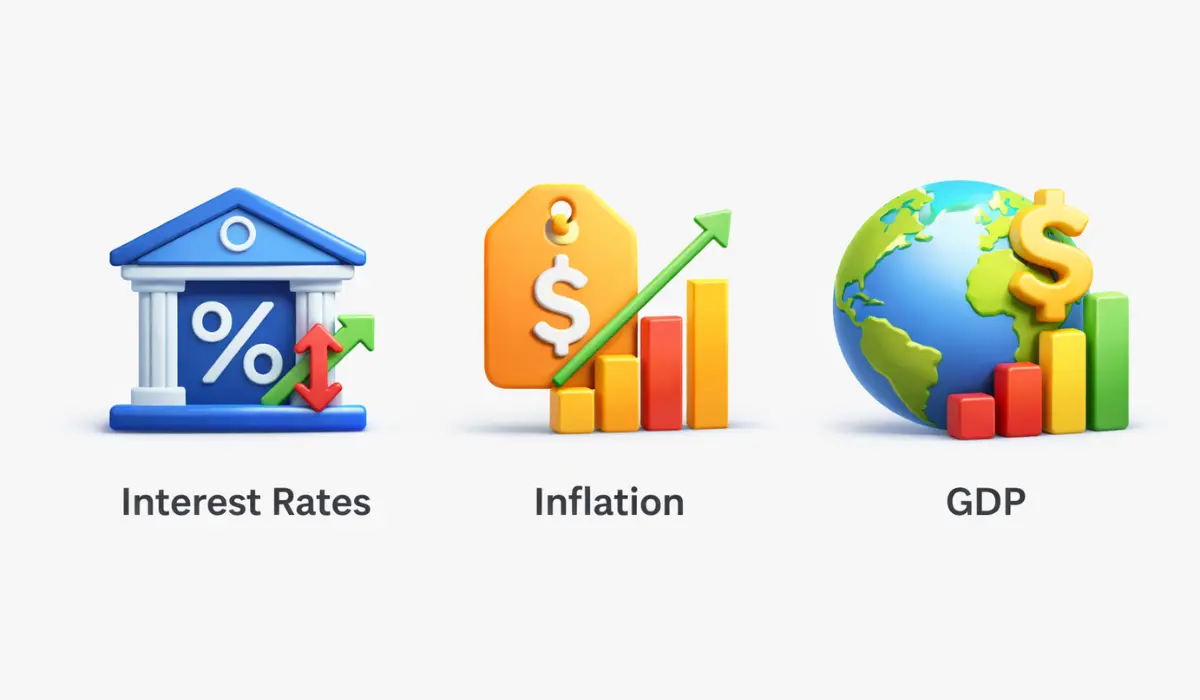
Stock markets are highly volatile and are one of the first pillars of an economy to react to any macroeconomic changes. Let’s examine some of the key macroeconomic factors and their impact on the stock markets.
Interest Rates
In a high-interest-rate environment, borrowing costs increase, potentially reducing consumer spending and business investment. In contrast, in a low-rate environment, spending power potentially increases as the borrowing costs decreases, boosting business investment.
Inflation
In an inflationary environment, consumers’ spending power can decrease with the increase in the price of goods. The reduced flow of money into the economy will affect businesses as people convert cash, choosing to spend only on essentials and to forego luxuries.
GDP
GDP of an economy is the measure of the relative performance of the economy in absolute terms as well as in percentages. It is the value of all the goods and services produced in the country that is measured annually and quarterly. The stock markets react immediately to the announcement of the GDP results of the country.
A rising GDP level indicates a positive outlook for the economy. Thus, it boosts the stock prices.
Changing Political News
Factors such as inflation, rising crude oil prices, and Fed interest rates are external factors that affect a country’s stock market. While certain factors, like the political scenario of a country, are internal factors that could have an immediate impact on the stock markets. An unstable political scenario will result in an adverse impact on the stock markets of the country. Additionally, any new policies adopted by the government will also have a direct impact on the stock market.
How the Market Reacted to Macroeconomic Changes
Historically, several unexpected global macroeconomic and environmental changes have increased volatility and impacted the markets. Below are a few examples of such situations. Let’s see how the market tackled them.
Covid-19 Pandemic
The economic outlook worldwide altered unexpectedly after the World Health Organization (WHO) declared the COVID-19 outbreak a global pandemic. Markets experienced dramatic movements, and the severity of the health crisis resulted in a growth shock.
The global stock market fell 34% from its pre-pandemic high before fully recovering by August 2020, aided by fiscal and monetary policies. After the growth outlook was revised, the bond markets rallied.
Inflation Shock of 2021-2022
After the COVID-19 pandemic, inflation spiked to 5% by mid-2021 and then to over 9% by mid-2022. To tackle this rampant inflation, the Federal Reserve (Fed) raised interest rates from 0.25% to 5.5% throughout 2022 and into 2023.
Oil Crisis
In October 1973, the Organization of Arab Petroleum Exporting Countries (OAPEC) announced that oil exports to the U.S. would be banned. This move put a strain on the U.S economy, given the dependence on foreign oil. Following the announcement, U.S. equities fell 32%, while inflation-sensitive commodities and gold soared over 50%, producing a positive return.
Counter Changing Economic Environments with Balance
Diversification can primarily help to reduce the impact of sudden upsets in the stock and bond markets. Additionally, a more active approach to portfolio allocation can help mitigate the damage caused by sudden market shifts. The best approach may be to build a portfolio that would balance risks across growth and inflation environments. Thereby, you can stay ahead of the struggles and be prepared to perform in any season.
Conclusion
Macroeconomic factors will impact the stock market of a country, although they may or may not be geo-specific. Hence, it is important to be aware of global developments. Seasoned as well as experienced traders and investors, thus, will consider macroeconomic factors and their impact while making projections of the stock markets and any investment decisions.
FAQs
How does the economy affect the stock market?
A growing economy can aid in a strong or bull stock market.
What is a macro analysis in the stock market?
Macro analysis is a study of broad economic factors that influence the financial markets as a whole.
What causes stocks to go up?
If there are more investors buying a stock than selling, the stock price will go up.
Who controls the stock market prices?
The supply and demand determine the price of a stock.


