

What the Ghosts of Keynes and Marx Teach Us About America and Britain’s Eerily Similar Collapse
Aug 28, 2019
Member-only
Save
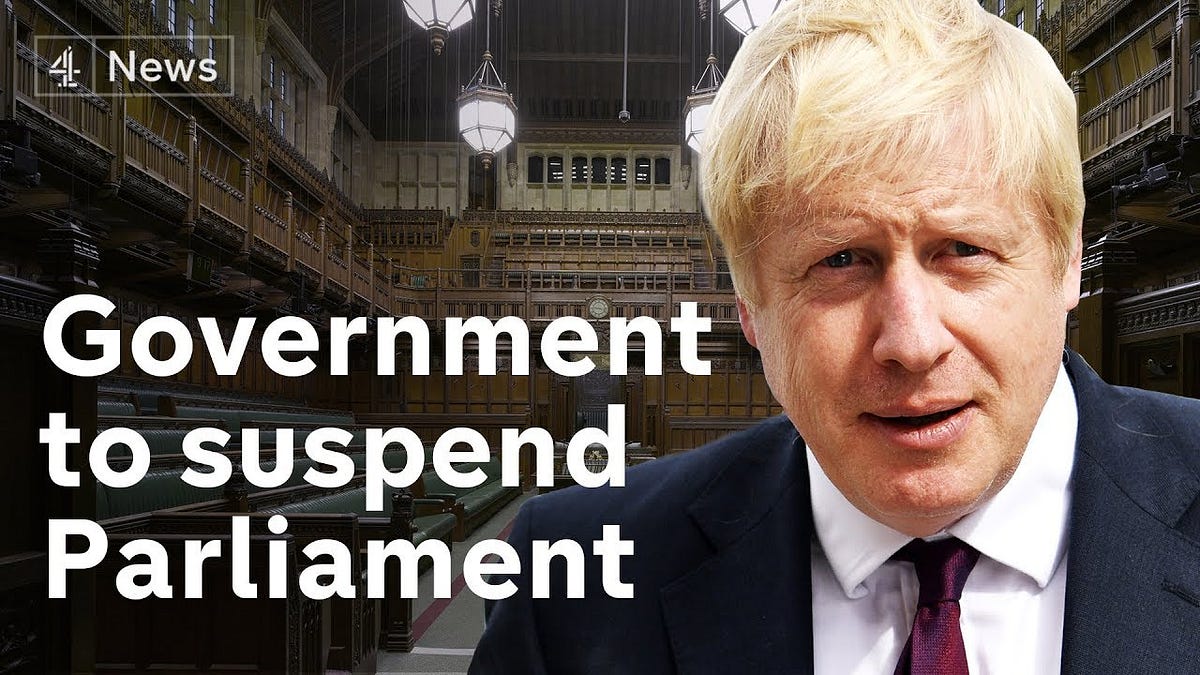
In case you haven’t heard by now, British parliament’s been suspended, to try and force through a catastrophic No-Deal Brexit. In case you’re not British, that means that there will be food rationing, medicine shortages, bank runs, and other assorted surreally dystopian events. And there’s America — where every sane American left fully expects Trump to try to steal the next election, with a little help from Russia and the Supreme Court.
How are we to make sense of all this — simultaneous, sudden, rampant authoritarianism in two of the world’s most powerful and richest countries? How weird is that? (It’s true that Europe’s had its brush with extremism — and yet it seems to have fended it off. Sure, there are extremists in the European Parliament — but what they’re not doing is reshaping society wholesale. They have been kept at bay.)
I suppose that it’s just a giant, cosmic coincidence that the world’s two most capitalist societies are imploding into authoritarian-fascism. Yup. just one big, incredible, surreal, bizarre, gruesome coincidence that American and Britain are melting down into authoritarianism…simultaneously. Bad luck!
(Sure, It’s probably a stretch to call what’s happening to Britain “fascism” — if you want to nitpck, I’d call it authoritarian hypernationalism. But emerging fascism’s certainly a fair description of America, where dehumanization, camps, torture, raids, and family separation are all just everyday parts of life.)
So. Do you detect a note of sarcasm? You should. It’s not just one big coincidence…one of history’s largest…modern history’s biggest…that Britain and America, crumbling as democracies. That’s what the thinking of our Anglo societies would have you believe, after all. But does it really make any sense? Isn’t it a little bit too convenient to believe the two of the world’s most notable countries are melting down into the same things…at the same time…in the same ways? That, my friends, implies: for the same reasons.
That is exactly what happened to the Anglo world. Capitalism implodes into fascist-authoritarianism, if it goes too far — and that is precisely the situation both American and Britain face. The world’s two most capitalist countries are imploding into fascist-authoritarianism of varying degrees…because that is what runaway capitalism does.
First, a little analysis, to dispel any nitpicking. Britain and America are very miuch world’s most capitalist countries. That means: the countries with the highest share of private GDP, versus public GDP. About 75–80% of the economy is capitalist in America — about as high as a society can possibly go, unless you don’t want any schools, roads, hospitals, or universities. In Britain, it’s about 70%. In the rest of the rich world, by contrast, the private component of the economy is just somewhere between 40 and 60 percent. That’s Europe, Canada, etcetera: they are true social democracies, which means they’re balanced between socialism and capitalism, in proper terms.
But Britain and America never became true social democracies. Britain struggled to — and America didn’t, thinking it could solve it’s problems with a) bombs b) guns c) more capitalism. Either way, both failed to make a transition to true social democracy, meaning healthcare, education, retirement, housing, and so on, as guaranteed rights for all — a social contract where the social surplus is shared amongst people, not simply hoarded at the top. (Britain got close, in the 90s — but then spent two solid decades undoing what progress it had made.)
What happened as a result? Well, what always happens when capitalism is left to its own devices. The economy’s gains flowed to the very richest. Middle incomes stagnated. Living standards for the average person began to fall catastrophically. That’s not an overstatement or hyperbole or a metaphor: today, there are only two societies in the world where life expectancy, incomes, and savings, are all falling in tandem, not rising. That’s not even true in Iraq or Pakistan, my friends. There are…only two such countries (outside maybe North Korea.) Those two countries are America and Britain.
Now, anyone — and I mean anyone — sharp eyed enough to see this trifecta of ruin, falling life expectancies, income, and savings, in tandem, should have also expected a colossal social implosion. Mount Vesuvius going off, and leaving behind a smoking wreck. Why? Because when people’s lives begin to fall apart, my friends, they turn to demagogues for feelings of strength, power and safety again. Those demagogues, invariably, point the blame at anyone different, anyone other, anyone outside the tribe. What is really happening is that society is regressing backwards into tribalism, serfdom, and feudalism. Better to have a strong protector — to whom you owe fealty, a portion of your harvest — than to have no protection at all. But protection from whom? And what fealty does this new lord demand?
Well, what happened in America and Britain was eerily similar. In America a campaign of shattering austerity began in the 80s, thanks to Reagan. The idea was to “drown the government in a bathtub.” The average American came to believe government was a sinister, inept, incompetent liability. So who was going to offer him or her affordable healthcare, education, retirement?
Austerity was one part of a two pronged ploy to reshape society along totalist capitalist lines — totalist, as in, “there should be no other force in society.” The private sector should offer every last thing in society, from schools to hospitals to retirement, American’s economists and politicians said, every bit as rigid, extreme, and fundamentalist as their Soviet adversaries, just their mirror image. Americans were told that because the government was lazy, spendthrift, and dangerous, the private sector — aka capitalism — would be better off providing them everything. Any sane person might have interjected at this point —wait, what? — but apparently, there weren’t too many left.
So capitalism as be the all and end all of human thinking and society became the only thought a generation of crackpot economists, politicians, and thinktank pundits had. That’s not a joke — I mean that quite literally: they thought it was actually “the end of history.” Yet being riddled by that old American disease, arrogance — they didn’t look at Europe, where at that precise moments, living standards were beginning to skyrocket, precisely because Europeans enjoyed the basics of life as human rights…not because of capitalism at all. (Did you know that Spain will be the society with the world’s highest life expectancy by 2050?)
So what was the result of this great experiment, every bit as grand as the Soviet Union’s, this epic social transformation, letting the wolves of capitalism loose to run with the night? Did Americans end up living better lives? Of course not. What happened was a kind of hidden hyperinflation — that American economists still can’t talk about it. The price of healthcare skyrocketed by 5000%. The price of education soared by 3000%. Food, 1500%. And so forth. Yet American incomes never rose to match. Americans ended up, by the early 21st century, living paycheck to paycheck — and genuinely shockingly for a rich society — dying in massive debt, which means they never earned, saved, or owned anything in real terms whatsoever.
What the? Still, nobody in American’s elites seemed to notice or care. Cruelty and pain were, after all, part of the plan. The more the better!
And so by 2010 or so, the American middle class had become a minority…for the first time in history. Where else did that happen? In Weimar Germany. What was the result? I don’t need to tell you, I’m sure. The lesson should have been very clear: where the middle class collapses, fascism and authoritarianism don’t follow far behind.
And yet, in adding an even more bizarre twist to this already backward story, a generation of British leaders and thinkers decided to…follow America’s lead — not Europe’s. They savaged what progress Britain had made to becoming a social democracy. The NHS was starved. The BBC was politicized. Every kind of benefit or protection that people enjoyed was slashed or eliminated, from labour protections to literal police forces. Austerity became the single principle by which British life was organized, the false god to which all its institutions bowed.
And the result, unsurprisingly, was…exactly what it had been in America. Just a decade or two after American life imploded…British life did, too…because just a decade or two after America began hyper-austerity…Britain did, too. Cause, meet effect. Remember the trifecta — falling life expectancies, incomes, and savings? By now — the 2010s — British and American life were following the same contours of implosion. Why did no one much notice, even at this grim juncture? Why did even, for example the British left bow to American style “deficit” thinking…trickle-down economics by another name? Nobody could say. Were there any working minds left in these societies at all?
Perhaps because at this point, the tides of authoritarian-fascism were already surging. Britain voted for Brexit at the exact moment that Americans elected Trump. It’s true that both results were marginal — and that both of these campaigns were heavily propagandized by Russia, rendering their results questionable at best. And yet, there was a very real current flowing through both these societies, like electricity.
Brexit blamed falling British living standards, bizarrely, on Europe. It exploited Britain’s old xenophobias — centuries of conflict with the Continent. Trumpism blamed falling American living standards of Mexicans, Latin Americans, Muslims, gays. It exploited America’s old xenophobias and bigotries.Do you see how precisely, exactly, eerily similar both were?Demagogues pointing the finger at the “others”, the most powerless groups of all —to sate a frustrated, enraged people, shattered by the desperate anxieties of capitalism, of perpetually living hand to mouth, all too ready to believe them. Bang! The fuse was lit.
Marx, from his grave in Highgate, looking down on the boroughs of London and the shires of England, was probably laughing. Not in glee. But in something like pity — one so great it outlived whole worlds. Because he had predicated all this centuries ago. Capitalism, he said, was prone to perpetual, cyclical, systemic crises of “overaccumulation”. As returns to capital mounted, too much money piled up at the top, where it was effectively hoarded. The rich became the super rich became the ultra rich. But only at everyone else’s expense. Stagnation ripped like a terrible tsunami through the middle and working class. Inequality spiked. Resentment and fury mounted. The economy had a hole where a heart should be. And eventually, poverty drove people to do what poverty tends to do: to turn on their neighbors and peers and colleagues, just to feed their children.
Does that sound exactly — exactly — like what happened to America and Britain to you? It should. If you’re intellectually honest with yourself, even if you’ve been brought up to see Marx as kind of American hate figure —like I was, partly — you should admit: he was a lot more right than our crackpot economists ever were.
Now, his solution for all that, of course, was a global socialist revolution. It never came to be. Or did it? Is that what happened in Europe — only in gentle, peaceful ways, in a kind of tender and careful and delicate compromise between capitalism and socialism?
Two centuries later, in the jaws of the Great Depression, John Maynard Keynes would echo Marx’s thinking. He would say that runaway capitalism resulted in “imbalances”, that is, unpayable debts for some nations, and massive credits, for others. Imbalances would drive some nations into poverty, poverty would light the authoritarian-fascist spark — bang! That was his famous explanation for World War II — how the impoverished Weimar Republic, unable to pay the reparations of World War I, imploded into the Nazi regime.
But the idea was much the same. Keynes’ imbalances. Marx’s overaccumulation crises. The theme was this: capitalism piles up too much capital in the hands of those who already “own” the most. The rest stagnate as a result. The result of growing poverty is social destabilization, mass authoritarian movements, the regression to earlier forms of social order, like tribalisms, which define blame the “problem” of growing poverty of the “other”, and then try to solve it, with violence, dispossession, hatred, with Final Solutions. Do you see how similar this line of thinking is?
That, my friends, is why the two most capitalist countries on earth are also the ones collapsing into authoritarian-fascism. It isn’t just modern history’s biggest coincidence. Sheer, dumb bad luck — who’d believe that?
Britain and America were the ones most vulnerable to crises of overaccumulation — which is what the great financial crash of 2007–8 really was a face of — because they are the most capitalist countries of all. Crises of over accumulation leave the hearts of societies stagnant, they turn aspiring middle classes into masses of new poor, they turn neighbor against neighbor and region against region. Society embarks on a kind of quest to find the most vulnerable group — and blame its problem of stagnation, of falling living standards — on them. In Britain, that was Europeans; in America, it was Mexicans and Latinos and Muslims. Once the most powerless group in society has been found, then the job is simple: if our poverty is their fault, then we must get rid of them. Hence Brexit. Hence Trumpism.
And hence Europe’s resilience to extremism, too. Social democracy protected it better against crises of overaccumulation — because European social contracts, which guarantee the basics of life, healthcare, retirement, education, and so forth, as free, and as human rights, serve as buffers against poverty, too. They ensure that the rich can’t get too rich, that capital must flow back towards the middle and working clases. Europe is safeguarded by social democracy from capitalist crises — because social democracy ensures everyone has at least a little bit of capital. (As a result, those feelings of rage and failure and neglect — though they’re still present in Europe, to be sure — aren’t dominant, like they are in Britain and America.)
Keynes’s ashes, scattered over the Sussex Downs, watch us still. What do they see? Keynes’ ambition was to build a global social democracy — so that the ravages of fascism and authoritarianism, driven by the crises of capitalism, never happened again. We set up the World Bank and the IMF for his great vision. They never quite got there, it’s true. But at least we — as a world — tried. Something positive, beautiful, noble, and true. Even if, like so many things, like our very own bodies, it fell into decay and despair. Don’t we all?
And yet I like to think that Marx watches from Highgate, and Keynes looks on from those Downs, smiling gently. And what they see is this: their own countries — Marx was the consummate bourgeois Londoner, and Keynes the consummate Oxbridge intellectual — failed the thinking of their own great minds. The great insight that they both had. Understanding just how lethal capitalism’s failures can be — and just how catastrophic their consequences can be. America and Britain never got there.
But Europe did, at least. Was there a socialist revolution? Maybe not. But there was a social democratic one. And the worlds’ last two staunchly capitalist countries are imploding, my friends, because they never took part in it. So where was there to go — but backwards?
Perhaps, then, the world can learn something from what the ghosts of Marx and Keynes smile at. Not in glee, but with a kind of gentle pity, a kind of immense grief, born of an titanic understanding that still — still, all these decades later — penetrates right to the hearts of our broken worlds. Aeschylus said that wisdom is born in the fall of every tear. Maybe the three of them, together, embrace us like children, even now.
UmairAugust 2019


