

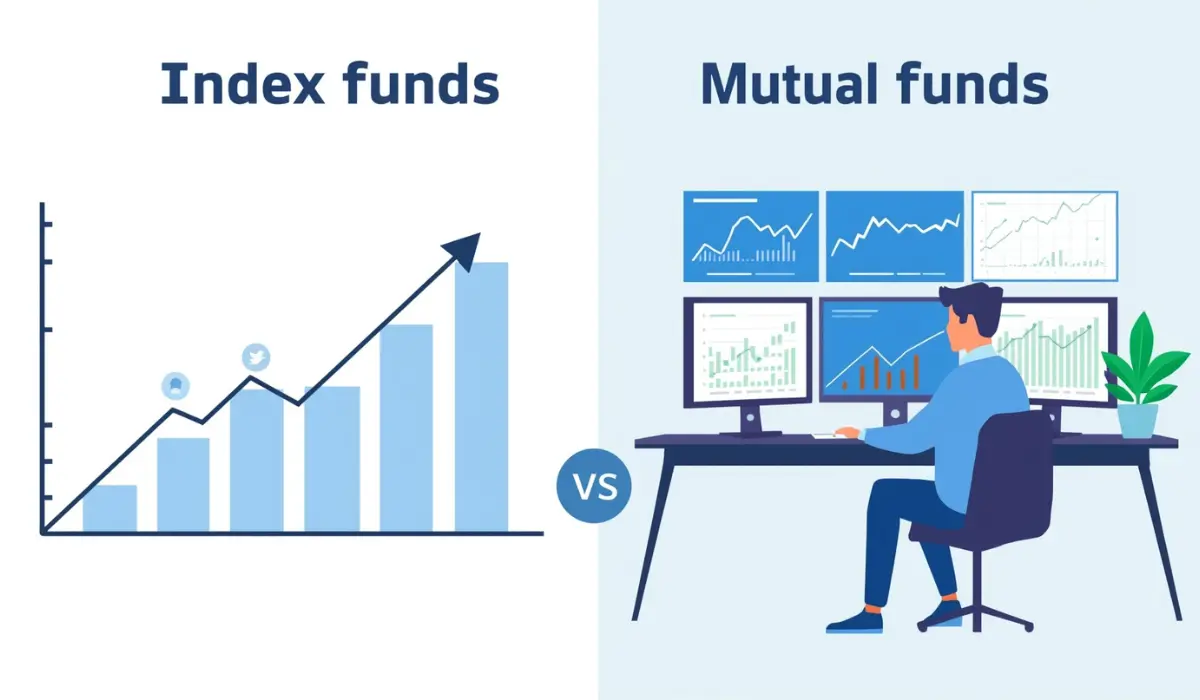
Index Funds and Mutual Funds represent two opposing philosophies in wealth building through stock markets. Index Funds aim to grow your investment passively, in proportions that reflect the natural ebb and flow of the market. On the other hand, mutual funds are managed by experts who proactively attempt to outperform the market.
The table features a side-by-side analysis of key aspects of Index funds and Mutual Funds. The sections that follow explain each fund in detail.
Comparing Index Funds and Mutual Funds
| Aspect | Index Funds | Mutual Funds |
|---|---|---|
| Management Style | Passive | Active (experts research and hand-pick stocks) |
| Risk | Low | High |
| Fees You Will Pay | Low (0.015% – 0.06%) | High (0.5% – 2.0%) |
| Investment Goal | Match market returns | Aims for better returns than the market |
| Portfolio Turnover | Very low (5% or less) | High (50% – 100%+) |
| Tax Efficiency | High (fewer taxable events) | Lower (more capital gains) |
| Diversification | Broad (500+ stocks) | Selective (50-100 stocks) |
| Best For | Beginners, long-term investors | Experienced investors who can tolerate bigger risks |
| Examples | Vanguard 500 Index Funds (VFIAX)Fidelity 500 Index Fund (FXAIX)Schwab S&P 500 Index Fund (SWPPX) | Fidelity Contrafund (FCNTX)T. Rowe Price Blue Chip Growth (TRBCX)Dodge & Cox Stock Fund |
What Are Index Funds?
Index funds are passive investment vehicles that allocate your money into the top companies in stock market index lists. This “stock market index list” is most often the S&P 500 or NASDAQ-100, which consists of the biggest, stable, blue-chip companies such as Microsoft, Amazon, and Walmart.
Let’s assume that you are going for a mutual fund that subscribes to the S&P 500 as its benchmark. The money you invest in such a fund is going to a huge pool of funds, which is then used to buy shares of the 500 Companies in the index (S&P 500 list). The amount allocated for each company is decided by the market capitalization weighting of the company.
Hence, the decision on how much to invest in each company in the index list is purely mathematical. For example, if you were to invest $100 in an index fund now, your fund will be allocated like this:
| Company | Current Weight | Your $100 |
|---|---|---|
| NVIDIA | 7.35-7.76% | ~$7.35-7.76 |
| Apple | 6.44-7.04% | ~$6.44-7.04 |
| Microsoft | 6.22-6.57% | ~$6.22-6.57 |
| Alphabet (Google) | 4.35-5.71% | ~$4.35-5.71 |
| Next 496 companies | ~73-76% | ~$73-76 |
Note: These percentages are based on market capitalization as of late 2025 and are subject to change.
Changes in this allocation are only made when the index officially changes or to rebalance when the weights shift significantly. This is in stark contrast with Mutual Funds that track and respond to every movement in the market.
Pros
- Low Fees
- Consistent Market-matching returns (~10%)
- Tax efficiency
- Simple and easy to start
Cons
- Less flexibility during crashes
- Miss potential for larger gains
- Market-cap concentration risk
What are Mutual Funds?
Mutual Funds are actively managed by a team of financial professionals who bet that they can deliver a better return than the index fund. While index funds have historically delivered an average of 10% of returns, mutual funds aim for 12-15% or more. Here, your money doesn’t automatically go to companies listed in index lists. Instead, managers make the call for where to invest and how much to invest in each company.
Mutual fund portfolios are comparatively more dynamic than Index funds since the managers make frequent changes in response to the changing market conditions. Mutual funds have a 50-100% annual turnover, which means that the managers replace all or half of your holdings yearly. Some aggressive mutual funds might have portfolio turnovers that exceed 200%. This is in stark contrast with index fund turnover that approximate 5% per year.
A daunting statistic that anyone who intends to deposit in a mutual fund comes across is that 85-90% of the funds fail to beat the S&P 500 index over 10+ years. Moreover, the fees charged by mutual fund managers can also accumulate into a substantial amount over the year. For example If you invest $10,000 in a mutual fund that charges 1.5% in fees, you are spending $150 in a year to pay your manager. This can also compound over the years if you make capital gains.
Pros
- Bigger returns (12-15%)
- Protection from crashes to a certain extent (managers respond fast when the market crashes)
- Better capitalizes on emerging opportunities
- Professionals and expert analysts to devise and adjust strategies
Cons
- High fees
- High risk (85-90% Mutual funds fails to beat the market in a 10+ year long timeline)
- Higher tax (if frequent capital gains)
Conclusion
Choosing between the two funds we discussed here doesn’t have to be a dilemma if you have a clear understanding of these funds and clarity in your personal financial goals. If you want to bet on your fund manager to outperform the market (against the odds that 85-90% mutual funds are failing to meet the objective), go with mutual funds. Make sure that you research the fund and its history well before committing. If you are a beginner who doesn’t want to dive into the complexities and wants a decent ~10% return without taking big risks, go for Index funds.


