

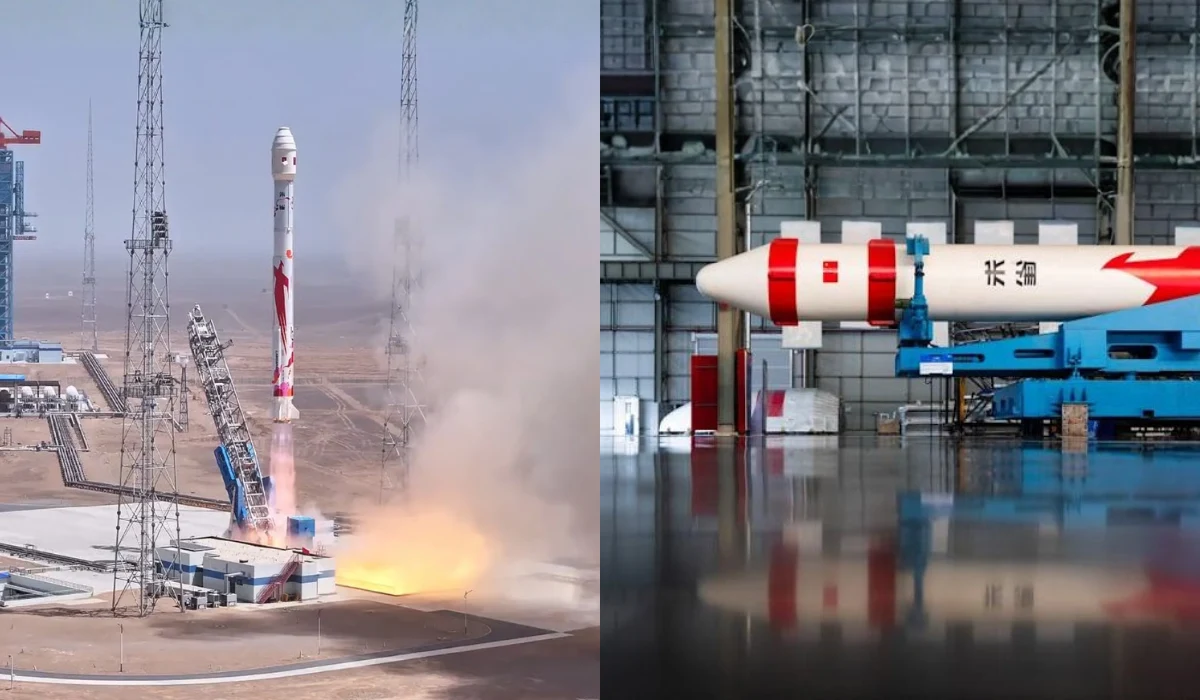
Chinese rocket developer LandSpace hopes to take on Elon Musk’s SpaceX, the company that it drew inspiration from. Earlier this month, the space startup conducted its first reusable rocket test.
LandSpace is now preparing to go public to fund its future projects, just as its bigger and far more successful American rival is considering an initial public offering (IPO) of its own.
LandSpace Spearheads China’s Space Race To Rival SpaceX’s Falcon 9
Earlier this month, LandSpace became the first Chinese entity to conduct a test for a fully reusable rocket, when its Zhuque-3 made its maiden flight after blasting off from a remote launch pad in northwestern China. This has drawn comparisons to its U.S. counterpart, SpaceX.
Even though the Zhuque-3 test failed, the company is steadfast in its aim to become the only company other than SpaceX to use reusable rockets, providing a fresh impetus for Beijing’s space industry, which has long been dominated by risk-averse, state-owned entities. While LandSpace failed to complete the crucial final step of landing and recovering the rocket’s engine booster, the startup plans to fix the issue before the second test flight planned in mid-2026.
Zhuque-3’s deputy chief designer, Dong kai said in a recent episode of the Tech Early Know podcast that if the second flight succeeds in its recovery stage, then the company plans to use a reused first stage for launch. While speaking to state broadcaster CCTV, Dai Zheng, another chief designer at the company, highlighted SpaceX’s success in being able to push its rockets to the edge and even into failure, allowing them to quickly identify limits and iterate on them.
Dai said that his decision to leave the China Academy of Launch Vehicle Technology, the country’s leading state-owned rocket developer, in 2016 to join LandSpace was partly motivated by SpaceX’s focus on rocket reusability and his desire to launch a Chinese counterpart.
LandSpace is focused on providing China with its low-cost option for rocket launches similar to SpaceX’s battle-tested Falcon 9, and is expected to play a major role in Beijing’s plan to roll out a constellation of 10,000 satellites by 2030.
Kai said in the podcast interview.
“Falcon 9 is a successful configuration that has been tested by engineering. After studying it, we recognize its rationality; this is learning, not imitation. Calling Zhuque-3 a ‘Chinese Falcon 9’ is a very high compliment,”
While Western space agencies regularly broadcast their launches and even mishaps, Chinese-led space programmes have historically refrained from sharing details about failed launches. However, earlier this month, the state media covered two failed attempts at landing and recovering a rocket booster for use in future launches, one by LandSpace and the other by the state-owned China Aerospace Science and Technology Corporation (CASC), which came just three weeks after Zhuque-3’s maiden flight. In December, LandSpace also allowed foreign media to visit its engine factory floor.
China opened up the space industry to private entities in 2014. Since then, the government has been supporting domestic startups, including LandSpace, to tap into the capital markets by making it easier for them to pursue IPOs. Dai pointed out that the generous financial backing that SpaceX received from private backers is what allowed it to incur huge losses while testing the Starship, the company’s reusable launch vehicle.
He reiterated that Chinese companies are not able to do that yet, but Beijing has recognized the impact of allowing capital markets to support companies in areas like commercial space flight.
SpaceX is the pioneer in reusable rocket technology, with the company’s Falcon 9 launching around 150 times a year, or roughly three times per week. Its booster is regularly reused, often dozens of times in one go, if necessary.
Elon Musk Lauds Zhuque-3’s Design, But Claims Chinese Rivals Are 5 Years Behind America’s Capabilities
In October, SpaceX founder Elon Musk took note of Zhuque-3’s design, claiming that Chinese-made rockets had adopted key aspects of the Starship spacecraft and applied them in a similar design to the Falcon 9. While Musk said the rockets could beat the Falcon 9 at its current capacity, he suggested that the Chinese challenger’s launch cadence would take more than five years to reach the level of SpaceX’s workhorse model, at which point the U.S. firm would have transitioned to its heavier, latest generation model Starship that will be capable of carrying out over 100 times the annual payload to orbit of Falcon 9.
LandSpace has planned 10 launches for all its models next year. However, Dong said that it will be difficult for one company to reach the kind of frequency emitted by its arch-rival without the support of an entire ecosystem.
Other executives at the company previously stated that the financial cost of a high-frequency testing and launch regime was crucial to SpaceX’s success, and the only way LandSpace could hope to amass enough funds to sustain a similar reusable rocket program would be by tapping into China’s capital markets.
Beijing Allows Space Companies To Tap Into Capital Markets, Launch IPOs To Seek Private Funding
LandSpace has completed the tutoring process for a potential IPO, a November filing with the China Securities Regulatory Commission (CSRC) showed. This process involves an investment bank, in this case, the state-owned China International Capital Corp (CICC), coaching company executives on IPO-related issues. The company’s stock is expected to be listed on Shanghai’s technology-focused STAR market in 2026.
LandSpace is likely to trade in a segment of the STAR Market that was created in June to host companies that are not yet profitable but are involved in frontier technologies, major technological breakthroughs, bright commercial prospects, and heavy investment in research and development. Corporate records show that since its founding in 2015, LandSpace has conducted multiple funding rounds totalling around half a billion dollars.


