

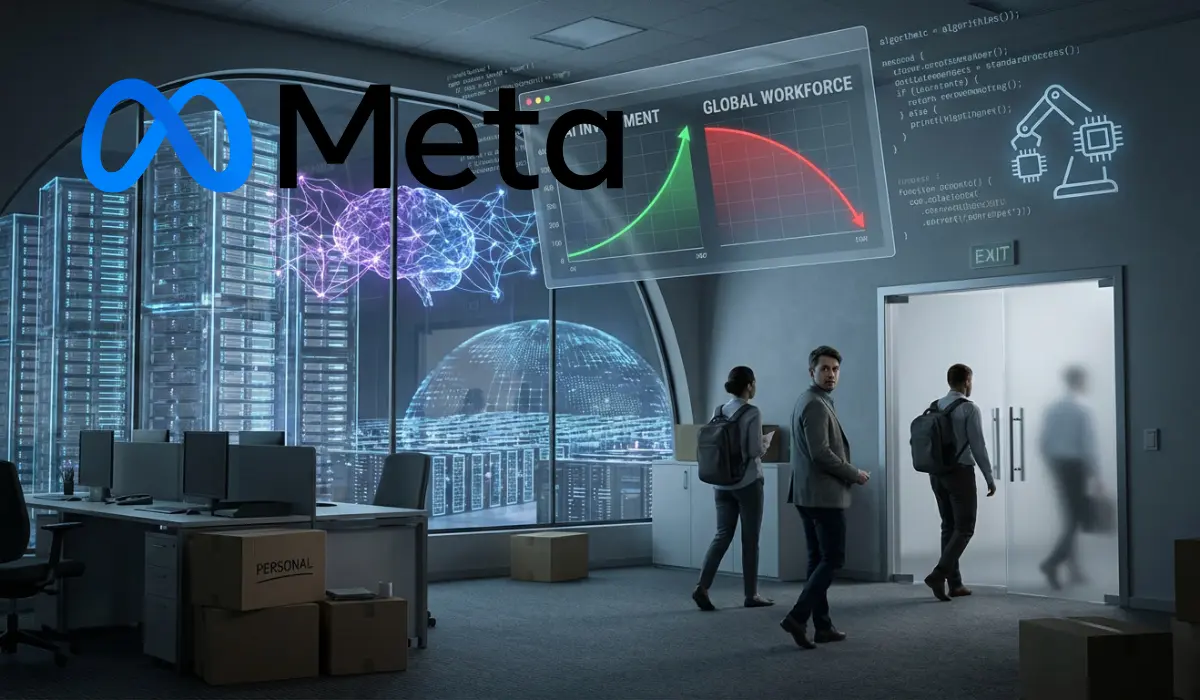
Meta Platforms, Inc., is reportedly planning sweeping layoffs that could affect 20% or more of its workforce, potentially up to 16,000 employees, as the company seeks to offset rising artificial intelligence (AI) infrastructure costs and improve efficiency through AI-assisted operations. This layoff would be the most significant job cut in Meta’s history since its ‘year of efficiency’ restructuring in late 2022 and early 2023. No dates have been set for the layoffs, and the final scale remains unconfirmed.
Meta Plans More Job Cuts Amid Heavy AI Investments
Sources familiar with the matter reported that the parent company of Facebook and Instagram, Meta, is seeking to offset the massive capital expenditures required for its artificial intelligence infrastructure while pivoting toward a smaller AI-assisted employee base. Meta had laid off 11,000 staffers in November 2022, around 13% of its workforce at the time, and around four months later, it announced it was cutting another 10,000 jobs.
Although no further details are disclosed about the layoff, senior executives have reportedly been instructed to begin planning for significant personnel reductions. The sources spoke anonymously, as they were not authorized to disclose the cuts.
Meta’s spokesperson, Andy Stone, has characterized the reports as speculative. Yet, the move follows a series of high-profile investments in “superintelligence” teams and data centre expansion. The border trend reflects a shift across tech, with companies like Amazon cutting 16,000 jobs and the fintech firm Block cutting nearly half of its staff due to AI-driven efficiency gains.
High AI Costs and Talent Wars Force Meta to Tighten Spending
The CEO of Meta Platform, Mark Zuckerberg, has recently suggested that AI tools are allowing smaller teams to accomplish tasks that previously required large departments. This sentiment mirrors a broader trend across the Silicon Valley landscape, where companies are replacing traditional roles with automated systems.
Over the last year, Zuckerberg has been pushing Meta to compete more forcefully in generative AI. The recent move comes amid $600 billion in planned investments in data centres by 2028. Meta has also spent approximately $2 billion acquiring startups, including the AI firm Manus and the social platform, Moltbook for AI agents, while simultaneously building a new AI superintelligence team and navigating recent setbacks with its Llama 4 and Avocado AI models. These costly bets exert immense pressure on the company to find internal efficiencies.
Despite the heavy spending, Meta has also faced technical hurdles, including the abandonment of its ‘Behemoth’ model last year, which followed benchmark criticisms. All these challenges, combined with the high cost of talent acquisition for AI researchers, have necessitated a tighter grip on operational spending through future layoffs.
Meta’s superintelligence team has been working to reassert the company’s standing this year by building a new model called Avocado, but the performance of that model has slowed and lagged behind expectations. Its release has also been pushed far back.
Tech Partnership Aims to Scale Meta’s AI Capabilities
However, Mark Zuckerberg has highlighted early efficiency gains, noting that projects once required large teams are now being completed by individual experts. Additionally, in February, Meta partnered with Advanced Micro Devices to power Meta’s AI infrastructure with up to 6GW of AMD Instinct GPUs, aligning Meta’s product roadmaps across hardware, software, and systems.
CEO and Chair of AMD, Dr. Lisa Su, commented about the partnership, “We are proud to expand our strategic partnership with Meta as they push the boundaries of AI at unprecedented scale.” Meta believes that the collaboration will position it to advance and innovate at an unmatched pace, with powerful and efficient new hardware co-designed with the software stack to handle massive growth.


