

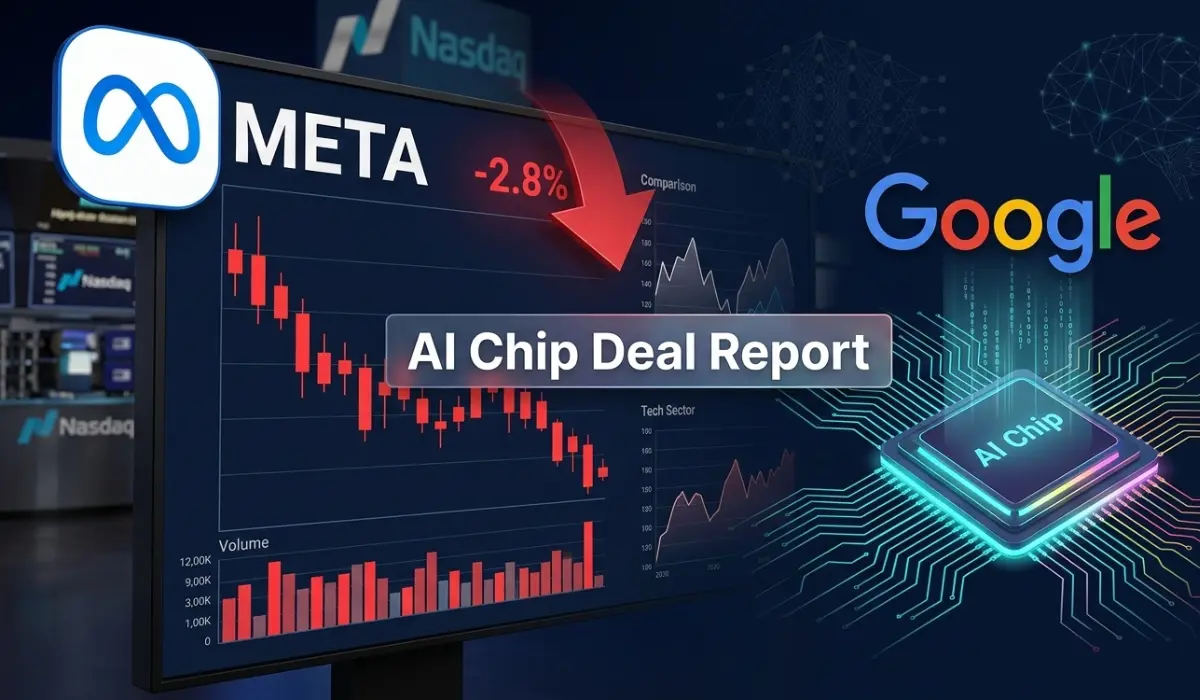
Meta established a multi-billion-dollar lease with Google to accelerate the supply of AI chips. This agreement ensures Meta’s access to Google’s TPUs, which are specifically engineered for large-scale AI training and inference. Previously, Meta Platforms has been relying heavily on the major leading chip makers, Nvidia and Advanced Micro Devices, for advanced GPUs to train complex models like Llama. To expand AI infrastructure and fulfill growing demand, Meta committed $115 billion to $135 billion in investment for 2026, a significant increase over 2025.
The market shows a slight decline in Meta’s stock price as investors weigh massive spending risks against the sustainable gains expected from these high-value deals. Meta’s strategic deals raised investor concerns about massive upfront costs that may compress the company’s profit margins. Does the massive capital expenditure signal burning cash or fuelling a better future?
Meta’s Spending Spree Underscores Rising Investor Anxiety—Is it a Risk or Opportunity?
By signing a multi-billion-dollar agreement with Google, Meta is navigating a challenging market landscape as its stock experiences a significant decline from recent peaks. Meta currently hovers around $645–$650, followed by 8.83% dip compared to the previous trading day. The Capex roadmap of Meta reflects the company’s massive spending on the expansion of AI infrastructure. Pushing the boundaries of AI, earlier in February, Meta signed a strategic deal with AMD to deploy up to 6 gigawatts of AMD GPU capacity. Similarly, Meta and Nvidia signed a multi-year deal to supply millions of AI chips to bolster Meta’s AI workloads.
As the company is in the realm of reshaping the AI infrastructure through implementing partnerships with multiple AI giants, AMD, Google, and Nvidia, the investors are concerned about the cost structure and operational flexibility. Investors expressed concern over the massive capital investment in AI, with Meta committing $115 billion and $135 billion in 2026, which is almost double its investment in 2025. The spending spree indicates Meta’s major push to accelerate and support AI infrastructure and metaverse projects, alongside diversifying the suppliers of AI chip providers.
Securing the billion-dollar deal with Google, Meta can hedge against supply chain shortages and negotiate better pricing, eliminating the risk associated with reliance on a single supplier. The deal positions Meta to dominate the AI landscape by improving performance across its various AI platforms. Despite the upside gains of the massive deal, the investor reaction caused the stock price of Meta to follow a downward trend. The decline encapsulates investor skepticism about Meta’s cost structure and AI strategy in the midst of a turbulent market. Scaling this massive, energy and capital-intensive project raised concerns about the short-term profitability and near-term returns of the company. By leasing TPUs from Google, which are four times faster than Nvidia’s, Meta can successfully execute negotiations with Nvidia for their Blackwell chips.
In the short run, the capital-intensive partnership with Google may erode investor confidence in Meta; however, in the long run, the deal could increase AI exposure, enabling Meta to yield better financial returns and dominate the market. Overall, Meta’s partnership with Google, Nvidia, and AMD can be perceived as the company’s strategic move to secure its future against supplier bottlenecks.


