

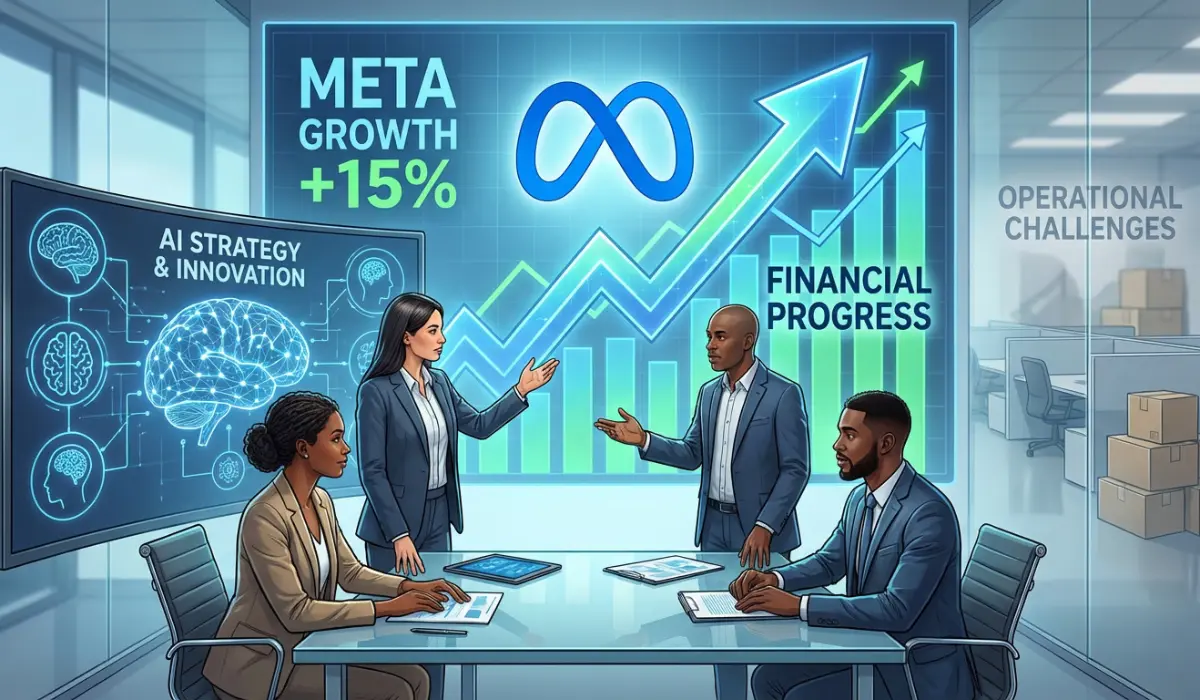
Meta shares climbed approximately 3% on Monday, recovering from a Friday slump, following reports that the social media giant is weighing its largest workforce reduction since 2022. According to a Reuters report, Meta plans to cut more than 20% of its workforce of approximately 79,000, potentially affecting more than 15,000 employees, to offset a surge in artificial intelligence spending. While Meta has characterized the reports as “speculative,” the market’s positive reaction suggests investors are increasingly comfortable trading headcount for high-tech infrastructure.
Betting on Headcount —The $135 Billion AI Pivot
Meta’s financial pivot represents a massive reallocation of capital, as evidenced by its latest earnings report. In its fourth-quarter earnings report, the company revealed that AI-related capital expenditure could reach between $115 billion and $135 billion this year alone—nearly doubling its 2025 investment. This spending is part of a massive $700 billion “arms race” involving tech hyperscalers like Amazon, Alphabet, and Microsoft. However, as the bill for data centers and specialized chips comes due, investors have grown wary of the timeline for actual returns on investment.
By signaling a massive reduction in headcount, Meta is attempting to bridge the gap between “spending big” and “earning big.” A 20% reduction would surpass Meta’s previous record of 11,000 layoffs, making this the largest workforce cut in the company’s history. Zuckerberg is positioning 2026 as the definitive turning point for Meta’s evolution from a social networking giant into an AI-first enterprise.
The urgency behind these layoffs may also be driven by intense competitive pressure. Despite the massive spending, Meta’s latest foundational model, codenamed Avocado, has reportedly faced internal setbacks. Reports suggest the model has struggled to meet benchmarks in reasoning and coding, causing it to lag behind rivals like Google’s Gemini 3.0 and the latest iterations from OpenAI. By slashing headcount, Meta can redirect billions of dollars into its superintelligence teams and high-stakes talent wars. In this current climate, top AI researchers are reportedly being offered pay packages worth hundreds of millions of dollars, which makes personnel costs for specialized talent a major line item.
This move toward extreme efficiency is gaining traction among analysts. Barton Crockett of Rosenblatt Securities suggests that a 20% headcount reduction could save Meta approximately $6 billion annually, providing a 5% boost to adjusted core earnings.
Pricing the Next Era of Computing — A Major Shift in the Technology Sector
Meta is not alone in this strategy of the “AI Purge,” as several other tech giants have announced similar moves throughout early 2026. Amazon cut 16,000 corporate roles in January to refocus on AI integration, while Oracle is planning thousands of cuts to manage a cash crunch resulting from its own data center build-outs. Similarly, Block reduced nearly half its staff, with CEO Jack Dorsey explicitly citing AI-driven productivity gains as the justification. This suggests a macro-economic shift where tech companies are no longer judged by the size of their workforce, but by the efficiency of their computing power.
Meta shares climbed approximately 3% on Monday, reaching roughly $627, successfully recovering from a sharp slump the previous Friday. Wall Street is cheering the move because it signals that Meta is willing to slash personnel costs to offset its massive $135 billion AI capital expenditure planned for 2026.
As Meta prepares for its first-quarter earnings report on April 29, 2026, the focus will remain on whether these efficiency measures can deliver the promised margins. While a spokesperson for Meta called the current layoff reports speculative, the market’s positive reaction suggests that shareholders are ready for the transition. For Wall Street, the shift from human labor to hardware infrastructure is viewed as a necessary price for dominance in the next era of computing. The coming months will determine if this learner structure can actually accelerate the development of Meta’s next-generation models or if the loss of institutional knowledge will create new hurdles.


