

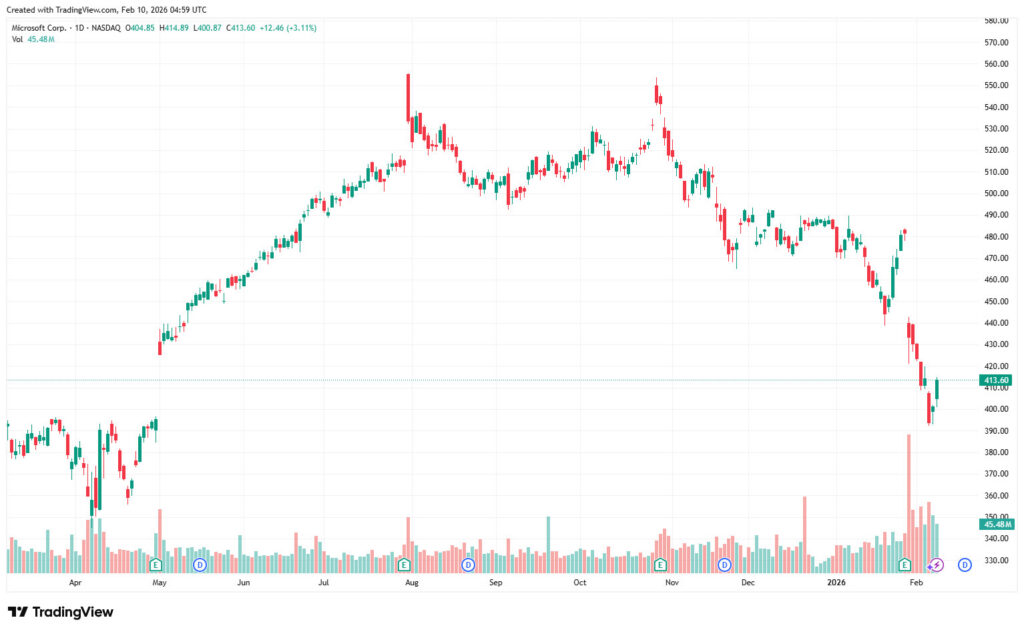
Microsoft Corporation (MSFT) shares closed at $413.60, up $12.46 or 3.11% at 4:00:02 PM EST, before extending gains in overnight trading to $415.52, adding another $1.92 or 0.46% by 11:15:43 PM EST. For the first time in more than a decade, Microsoft (MSFT) is trading at a lower valuation multiple than IBM (IBM), a rare inversion that is reshaping how investors interpret the modern AI Trade. According to Dow Jones Market Data, Microsoft’s forward price-to-earnings ratio has fallen to 23.0x, below IBM’s 23.7x, marking the first such crossover since July 25, 2013. The valuation gap officially inverted on January 29, 2026, underscoring a structural shift rather than a short-lived market anomaly.
Meanwhile, International Business Machines Corporation (IBM) shares closed at $296.34, down $2.59 or 0.87%, before edging higher in overnight trading to $296.73, gaining $0.39 or 0.13% by 11:13:23 PM EST.
A Historic Valuation Inversion Explained by Forward P/E Ratios
The Forward P/E Ratio has long been a shorthand for how markets perceive future growth, risk, and capital efficiency. For over a decade, Microsoft consistently traded at a premium to IBM, reflecting its dominance in software, cloud platforms, and recurring enterprise revenue. IBM, by contrast, endured years of multiple compressions as it unwound legacy hardware exposure and restructured its business model.
That relationship has now flipped. IBM’s forward P/E of 23.7x reflects renewed confidence in its software-first, consulting-driven strategy, while Microsoft’s 23.0x multiple represents its lowest relative valuation against IBM in more than 12 years. The market is no longer valuing Microsoft solely as a capital-light software leader, but increasingly as an infrastructure-heavy AI builder.
IBM’s Software Pivot Gains Market Credibility
IBM’s valuation recovery has been driven by its successful transformation into a software-centric enterprise services company. Hybrid cloud, automation, and AI-enabled consulting have replaced hardware as the core earnings engine, reducing capital intensity and stabilizing cash flows.
In the context of the AI Trade, IBM benefits from an asset-light exposure. Its AI revenues are largely embedded within software subscriptions and consulting engagements rather than massive physical infrastructure deployments. That distinction has become increasingly important as investors reassess risk-adjusted returns across the AI ecosystem.
Microsoft’s AI Ambitions Come With a Capital Cost
Microsoft’s multiple compression is not a referendum on demand. Azure continues to deliver strong growth of approximately 39%, and Copilot has reportedly reached 15 million paid users, reinforcing Microsoft’s leadership in enterprise AI adoption.
However, the scale of Microsoft’s investment cycle is reshaping valuation math. The company is projected to spend roughly $115 billion in Capital Expenditure in 2026, largely focused on data centers, AI accelerators, and physical cloud infrastructure. While these investments are strategic and long-duration, they introduce near-term margin pressure and extend payback timelines, factors that the market is now pricing in more aggressively.
Institutional Investors See Value in the Reset
Despite valuation pressure, some institutional investors are stepping in. Diamond Hill Capital increased its Microsoft position by 11,670 shares, signaling confidence amid volatility.
This positioning reflects a broader trend: investors increasingly differentiate between AI leaders with durable cash flows and those relying on continuous capital escalation to sustain growth.
AI Trade Shifts From Hype to Return on Investment
The valuation inversion between Microsoft and IBM highlights a broader evolution in the AI Trade. After years of enthusiasm-driven multiple expansion, markets are rotating toward tangible ROI, free cash flow durability, and capital discipline. Asset-heavy infrastructure builds are being scrutinized more closely, while software and consulting models are being rewarded for efficiency.
Both Microsoft and IBM remain pillars of the Dow Jones Industrial Average, but their current pricing echoes earlier periods of American industrial expansion. where foundational infrastructure investments, like the 1850s railroads, were essential yet slow to monetize.
Whether Microsoft’s discount to IBM persists will depend on how quickly AI revenues scale relative to capital outlays. For now, the market has delivered a clear message: even the most powerful software platforms are no longer immune to the cost of building the future.


