

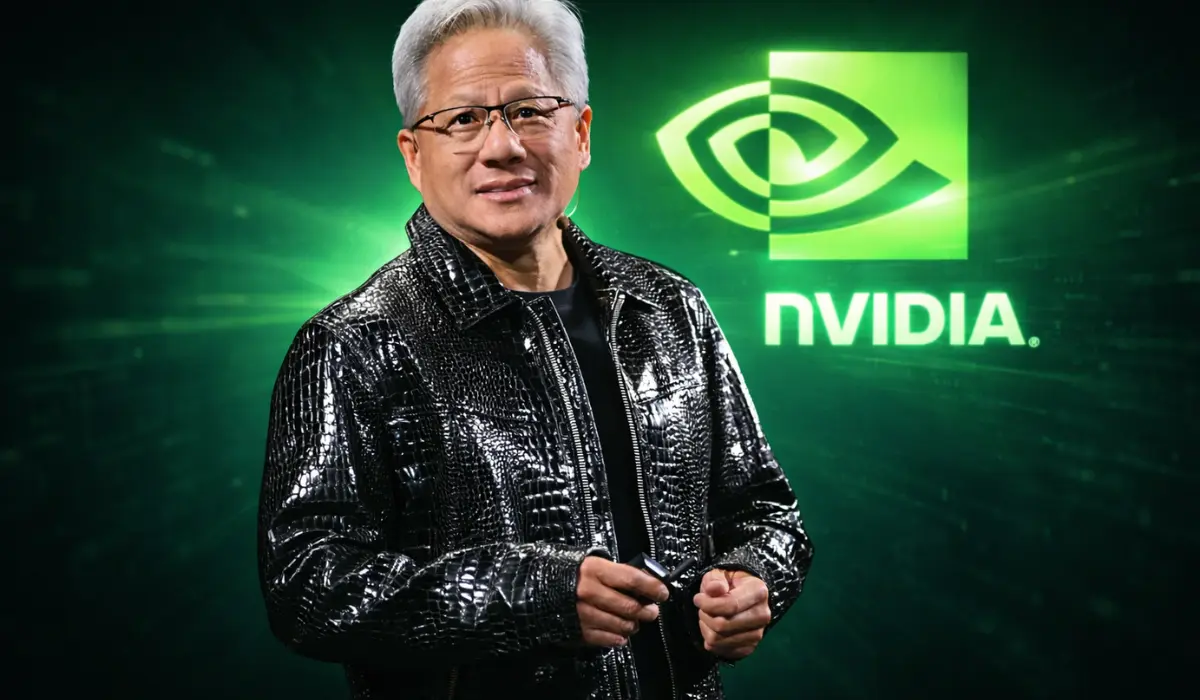
NVIDIA CEO Jensen Huang has published a blog post emphasizing that artificial intelligence represents the largest infrastructure build-out in human history, likening it to foundational systems like electricity or the internet. In the blog, Jensen Huang stated that AI represents the largest infrastructure build-out in human history, spanning industries from energy to software. This perspective frames AI as not just a technology trend but as an essential infrastructure.
Jensen Huang Describes AI as a “Five-Layer Cake” Ecosystem
The blog from the tech leader arrived ahead of the company’s highly anticipated developer conference, which was scheduled next week, alongside the company’s announcement of a multiyear partnership with AI research firm Thinking Machines Lab. The partnership will witness the chipmaker provide upwards of 1 gigawatt’s worth of its next-generation Vera Rubin chips to the research firm.
At the annual meeting of the World Economic Forum, speaking with the CEO of BlackRock, Larry Fink, Huang described AI as a “five-layer cake”, which encompasses energy, chips, infrastructure, models, and ultimately the application layer, with every layer independent. Huang also added that every layer must be built and operated, which means that the platform shift is creating job opportunities, from energy and construction to advanced manufacturing, cloud operations, and application development.
Huang later explained in his blog that AI is positioned not as a software product or a chatbot but as an industrial buildout on the scale of electrification, one that requires trillions of dollars in physical construction and a massive workforce of electricians, pipefitters, steelworkers, and network technicians.
Huang’s argument of needing a larger workforce for the buildout starts with a foundational shift in how computing is working. He stated that while the traditional retrieves stored instructions, the new AI generates output in real time, with every response created being new based on the context provided, generating intelligence on demand. As it is produced in real time, Huang argues that the entire computing stack beneath it has to be reinvented.
The timing of the blog is crucial, as it came after weeks of mounting anxiety about AI’s impact on employment, following Block Inc.’s mass layoffs and Anthropic’s CEO Dario Amodei’s comments about job displacement. The tech stocks have been selling off on the combination of these fears since this year. However, Oracle Corporation’s (ORCL) Q3 FY2026 earnings have eased the concerns over mass spending on AI, as the firm reported a strong fiscal-year earnings report, beating Wall Street expectations.
U.S. Department of Defense Labels Anthropic a National Security Risk
In the meantime, Anthropic has filed a lawsuit against the U.S. Department of Defense (DOD) to challenge a ban on its AI technology, which the Pentagon labels a ‘supply chain risk for national security”. The firm, led by Dario Amodei, argues the designation is unjust and has voted to fight in court. The DOD’s decision follows Anthropic’s refusal to remove restrictions on mass domestic surveillance and fully autonomous lethal weapons.
While the controversy has also drawn support for Anthropic from across the artificial intelligence community, with more than 30 employees from OpenAI and Google DeepMind filing a statement supporting the firm’s lawsuit. The supporters argued that the government designation was an arbitrary use of power, which could harm the broader AI industry.
The conflict came amid the heightened tensions between AI firms and government agencies, particularly regarding security and export controls. NVIDIA has also signaled a strategic shift, reducing its investment in both OpenAI and Anthropic ahead of their expected IPO’s, a move that reflects a recalibration of its AI partnership despite the prior commitment.


