

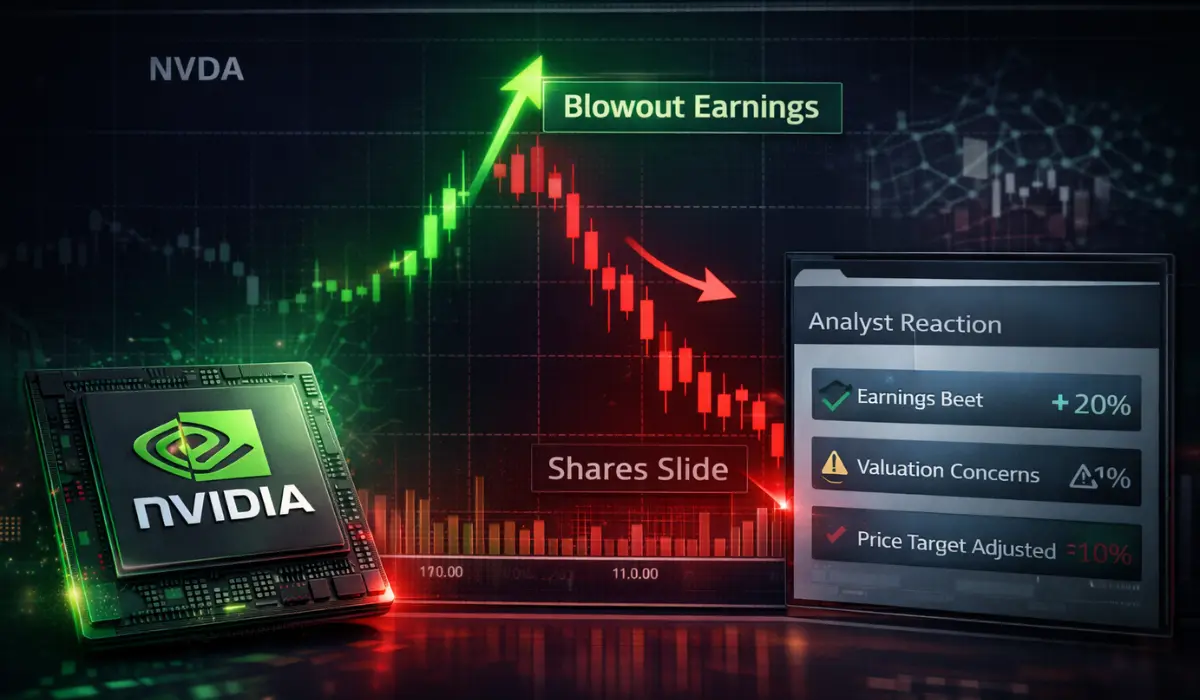
NVIDIA Corporation’s (NVDA) stock fell more than 5% on Thursday, February 26, 2026, marking its worst day since April, despite reporting strong earnings and exceeding analyst expectations for revenue, profit, and forward guidance. Wall Street’s reaction reflects a growing concern about AI sustainability rather than the firm’s performance.
Strong Q4 Earnings Beat Expectations
NVIDIA reported an Earnings Per Share (EPS) for the quarter of $1.62 on revenue of $68.1 billion, beating Wall Street’s estimation of EPS $1.53 on revenue of $65.8 billion. Additionally, Nvidia also offered Q1 guidance between $76.44 billion and $79.56 billion, suppressing Wall Street’s consensus of $72.8 billion. The firm’s data center drove the majority of the growth, bringing in $62.3 billion for the period, above the analysts’ expectation of $60.2 billion. (Nvidia Press Release)
The company’s earnings report came just a few weeks before the company is set to host its GTC 2026 event in San Jose, California, where it is expected to make several major product announcements, following the launch of its Vera Rubin AI superchip architecture, during the annual CES technology conference in Las Vegas in January.
NVIDIA recently expanded its agreement with the Meta Platform to include a massive, multiyear deal that will see the chip company allow the social media giant to use both of its Blackwell Ultra and Vera Rubin AI processors, accompanied by the first major standalone deployment of its Grace CPU servers. Despite this momentum, the dip evokes a cautious environment. NVIDIA was far better than Advanced Micro Devices (AMD) and Broadcom, which came down roughly 1% and 3%, respectively. while Intel (INTC) rose by almost 27% over the past year.
Growing Fears of AI Disruption Across Industries
Companies across different industries, ranging from trucking to software, have been rattled this year by the fear of AI disruption to their businesses. The elevated valuation and high capital expenditures have set a high bar for these firms. In a survey of credit investors released by the Bank of America earlier this week, 23% of respondents viewed an AI bubble as their top concern, up from 9% from December.
However, Salesforce was on the winning side of Wall Street, up 3.2%. The firm later reported a stronger profit for the latest quarter than analysts expected. Hyperscalers like Amazon, Meta, and Microsoft have projected a combined spending of $610 billion for the year, with each of the ‘magnificent Seven’ members citing rising demand for AI products. However, capital expenditures have exceeded expectations, with these firms investing heavily in data centres using Nvidia chips, but their free cash flow is under pressure. Investors are skeptical about AI ROI, questioning whether the billions spent on AI infrastructure will generate sufficient future profits.
Despite the sell-off, analysts remain overwhelmingly bullish, with 61 out of 66 analysts rating Nvidia a ‘buy’ or ‘strong buy’, with an average price target implying roughly 37% upside. The next major catalyst may come at the GPU Technology Conference in March, where Nvidia is expected to unveil the new product roadmaps.


