

Nvidia (NVDA) heads into its upcoming earnings report with investor expectations recalibrated after Goldman Sachs reset its stock forecast, reaffirming confidence in the AI chip leader while sharpening the debate around what comes after the current boom. In a note led by James Schneider, Goldman reiterated a $250 price target for Nvidia.
With near-term growth well understood and largely priced in, analysts are shifting attention squarely to management’s commentary on 2027 visibility.
Goldman Sachs maintained its constructive stance on Nvidia stock even as valuation multiples sit near historic highs. The demand for Nvidia’s latest Blackwell architecture remains exceptionally strong, driven by hyperscaler capital expenditure, enterprise AI adoption, and surging orders from next-generation model developers such as OpenAI and Anthropic. However, the key message from the Wall Street analyst was a pivot in narrative: growth through 2026 is no longer the differentiator. What matters now is what comes next.
Earnings Expectations and the $2 Billion Beat
Wall Street currently expects Nvidia to post $65.55 billion in Q4 revenue, but Goldman Sachs is forecasting a materially stronger outcome. The firm projects a $2 billion revenue beat, citing faster Blackwell ramp, better-than-expected pricing power, and continued tight supply conditions. If realized, this magnitude of outperformance would reinforce Nvidia’s dominance in accelerated computing and validate the durability of its data center growth engine.
The earnings release, scheduled for Feb 25 / Feb 27, is widely seen as one of the most consequential market events of the quarter. NVIDIA’s stock has become a bellwether for the broader AI trade, and any signal from CEO Jensen Huang regarding long-term demand could reverberate across technology markets.
The 2027 Visibility Question
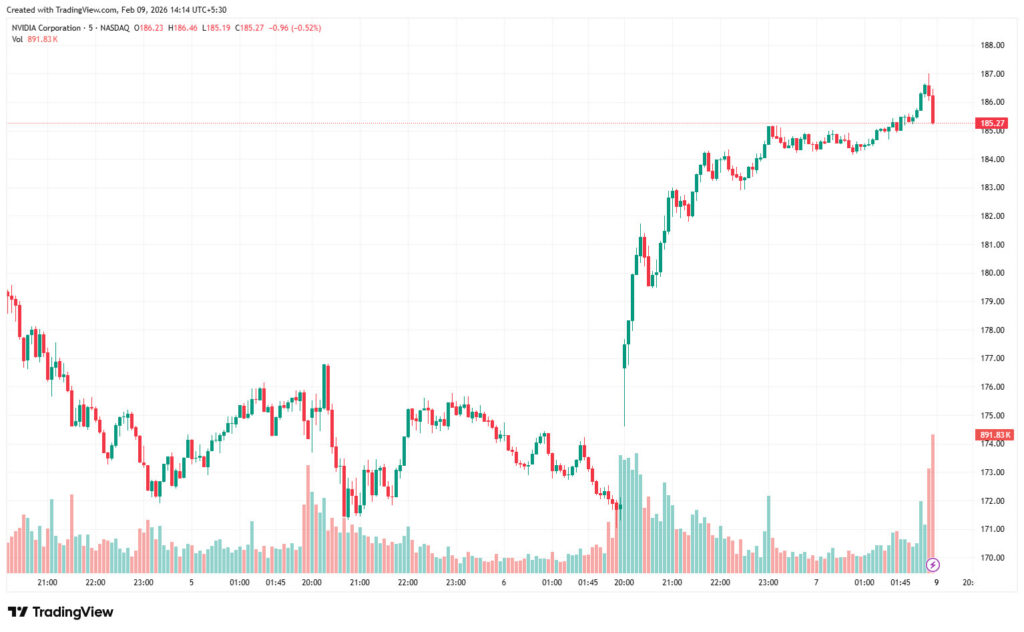
Goldman Sachs explicitly noted that Nvidia’s 2026 growth trajectory is “already priced in.” As a result, the firm believes the earnings call will hinge on management’s ability to articulate credible demand drivers for 2027. That includes updates on the Rubin architecture, Nvidia’s next-generation platform expected to follow Blackwell, and how early customer engagement is shaping capacity planning.
For investors, clarity around Rubin is critical. While Blackwell anchors current revenue growth, Rubin represents the next leg of Nvidia’s roadmap and a key determinant of whether hyperscalers maintain aggressive hyperscaler capex through the latter part of the decade. Goldman sees early visibility here as a potential catalyst for Nvidia stock, particularly if management signals accelerated timelines or broader customer adoption.
China, H200, and Regulatory Overhang
Adding a layer of geopolitical complexity is the status of Nvidia’s H200 chip exports to China. Goldman highlighted pending U.S. government approval for H200 sales to ByteDance, a development that could unlock incremental revenue while easing concerns about China-related headwinds. While not central to the bull case, approval would represent meaningful upside optionality at a time when investors are scrutinizing every incremental growth lever.
Competitive Moat Remains Intact
Despite rising competition from custom silicon initiatives at Alphabet (Google) and other hyperscalers, Goldman Sachs remains confident in Nvidia’s structural advantages. The firm pointed to Nvidia’s CUDA software ecosystem as a durable moat that continues to lock in developers and enterprises, reinforcing long-term pricing power and customer stickiness.
CEO Jensen Huang is expected to emphasize Nvidia’s full-stack strategy, spanning hardware, software, and networking, as a key reason the company remains central to the AI buildout.
The Goldman Sachs forecast reset does not signal waning confidence in Nvidia. Instead, it raises the bar. With near-term growth largely discounted, Nvidia stock now trades on narrative, specifically, whether management can convincingly extend the AI growth story into 2027 and beyond. For investors, this earnings call may be less about what Nvidia has already achieved and more about how far ahead it can still see.


