

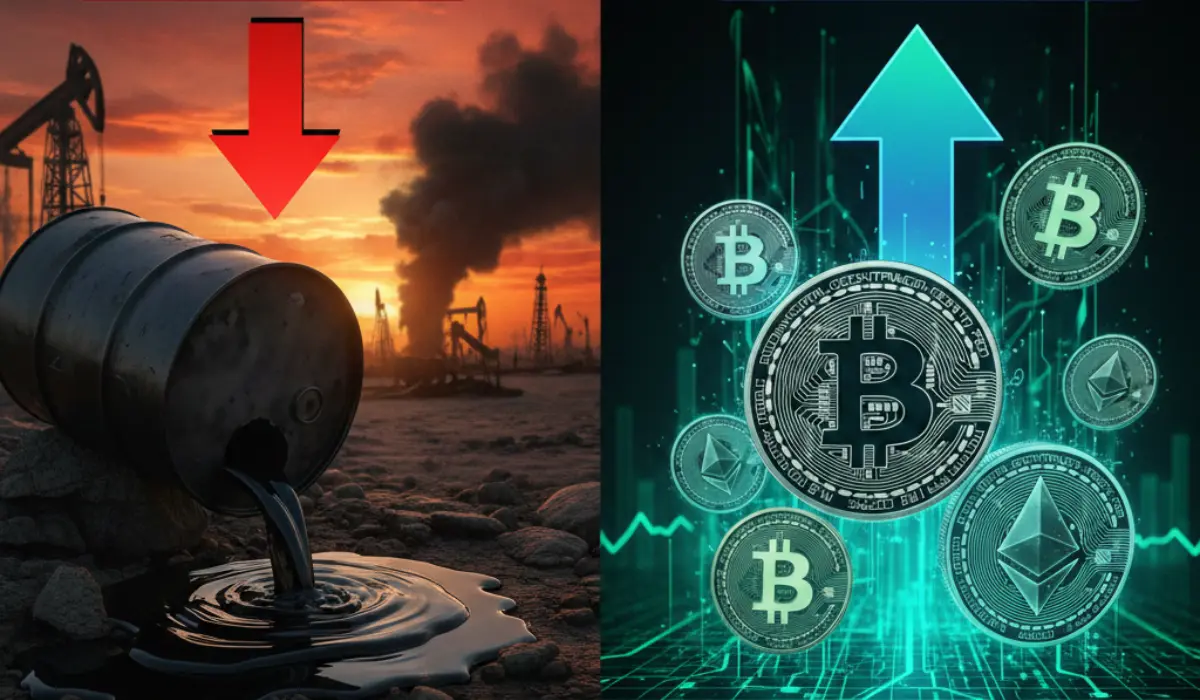
Monday saw the global financial markets undergo a period of whiplash as oil prices registered their highest level since July 2022, only to fall into a record-breaking tailspin after U.S. President Donald Trump told reporters that the war with Iran could be coming to an end – though he later went on to ramp up the war rhetoric on social media over Tehran’s threats.
In a phone-in interview with CBS News, Trump suggested that the U.S. and Israel-led military operations against Iran – launched in late February — were nearing a conclusion. The Pentagon claims to have struck more than 30,000 Iranian targets in the first week of “Operation Epic Fury,” neutralising Iran’s navy, air force, and primary communications networks.
Trump Declares Iran War is Over, Oil Prices Tumble 28% to Below $90, Bitcoin Posts Gains
“I think the war is very complete, pretty much,” the President told CBS News. “If you look, they have nothing left. There’s nothing left in a military sense.”
Earlier on Monday, the global oil benchmark – Brent Crude (BZUSD) – had skyrocketed to a four-year high of $119.50 per barrel, driven by fears of a total blockade of the Strait of Hormuz – the maritime transit route responsible for handling 20% of global oil daily. Reports also suggested that the Iranian Revolutionary Guard Corps (IRGC) had largely halted oil and gas exports. The surge threatened to reignite fears of global recession and stall the post-pandemic economic recovery.
However, Trump’s comments triggered an immediate and dramatic reversal in energy markets. According to OilPrice data, prices had plummeted roughly 28%, falling back to approximately $85 per barrel by Monday evening. This $30 swing over 24 hours marked one of the most volatile periods for the energy sector in recent years.
Market Analysts Attribute Crypto Relief Rally to Cooling Oil Prices
While oil retreated, the cryptocurrency market posted modest gains, largely following the lead of other risk assets like tech stocks. Bitcoin (BTC) reclaimed the $70,000 level, rising 3.1% over 24 hours, while Ether (ETH) held steady just above $2,000.
Analysts suggest that the relief rally for digital assets was driven by a descalation in geopolitical fear and the potential for eased inflation as oil prices cooled globally.
Speaking to crypto media outlet Cointelegraph, Augustine Fan, partner and head of insights at crypto trading software service provider SignalPlus, said that it is generally hard to take “headline comments” at face value, especially with other members of the Trump White House stating the war is still in the beginning phase, and US military assets still deployed in the region.
“Crypto prices will continue to follow other risk assets without a fundamental narrative of its own in the near term, and macro leadership will still be driven by oil,” he added.
Though Fan does not expect the conflict to be resolved “any time soon,” he believes bitcoin could do “relatively better” as a potential store of value during times of uncertainty.
Meanwhile, Andri Fauzan Adziima, research lead at Bitrue, told Cointelegraph that if Trump’s claims that the war with Iran is almost over are proven to be true, then he expects a “strong relief rally” for crypto, driven by plunging oil prices, eased inflation, geopolitical scares, and renewed risk appetite. However, doubts remain amid mixed signals from Iran and potential for prolonged uncertainty, he added.
Iran Doubles Down on Hormuz Strait Blockade, Trump Threatens to Hit “Twenty Times Harder”
Despite the optimism of a swift end to the ongoing war, the situation remains far from settled. Shortly after his CBS interview, President Trump took to social media to issue a stark warning to Tehran, threatening to hit “TWENTY TIMES HARDER” if it attempts to stop the flow of oil within the Strait of Hormuz. He added that the U.S. would target “easily destroyable” sites that would make it “virtually impossible for Iran to ever be built back, as a Nation, again.”
Meanwhile, the Iranian government has dismissed Trump’s claims of a near-victory as nonsense. A spokesperson for the IRGC stated that Iran would indeed “determine the end of the war,” reiterating that not a single litre of oil would leave the Persian Gulf if strikes on its soil continued.
As the G7 prepares to meet to discuss a coordinated release of emergency oil reserves to counter the potential Middle East blockade, investors remain on edge. While Trump’s signals point to a potential end to the conflict, the reality on the ground suggests that the road to stability in the region and the global markets remains fraught with volatility.


