

Key Takeaways
- Fear of an AI bubble grips the stock market. Many investors took an early exit from tech-heavy stocks that were deeply connected to the AI sector, fearing an AI bubble.
- The rampant profit-taking caused the S&P 500, along with other major names such as NASDAQ and Dow Jones Industrial Average, to plummet.
- Tech giant Broadcom recorded a better-than-expected fourth-quarter performance. But lost their hand on the stock market as their stocks fell nearly 11% on Friday.
- Industry experts review the problem as a cyclical pattern and not one that is going to affect the market on a broader scale.
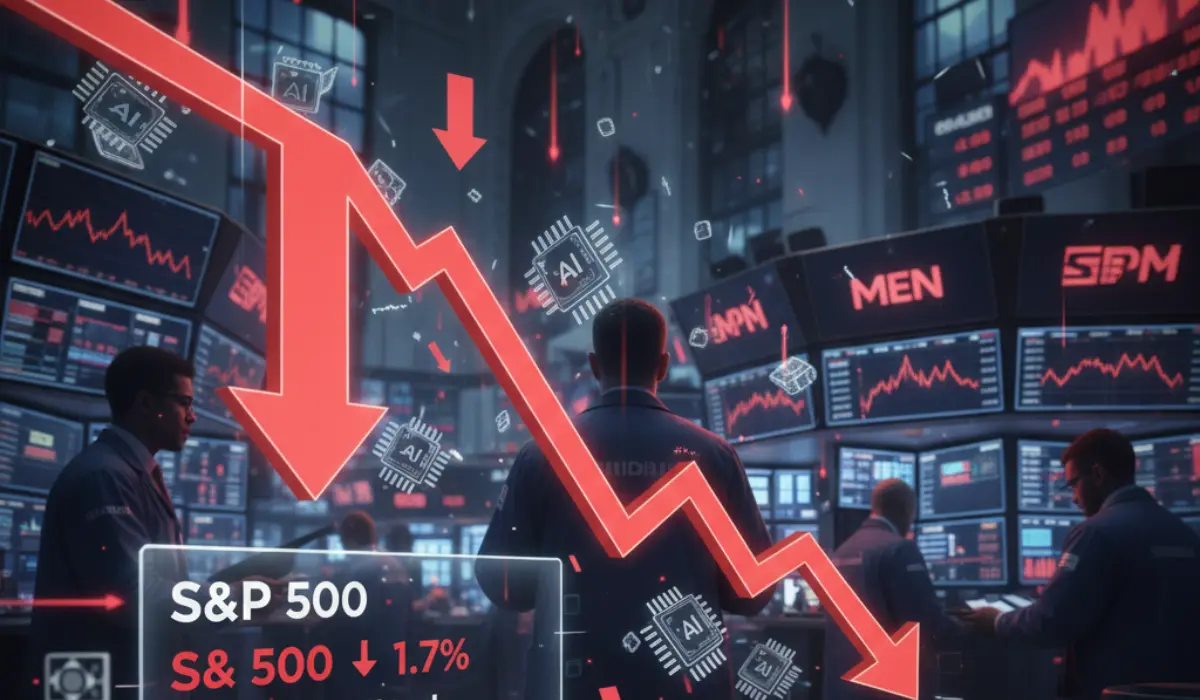
The fear of an AI bubble has fueled the drawdown of the S&P 500 from its record Friday. Traders en masse pulled out of tech stocks and transitioned towards value assets. This was soon after news regarding the underperforming Broadcom and Oracle stocks came out, and a rumor regarding the AI bubble strengthened.
Traders and investors also feared a potential risk in the tech market due to inflated valuations and increased volatility. The fund rotation towards safer assets meant that massive selloffs pressured the market. The failure to deliver on deadlines and the AI hype at its peak had all contributed to the downfall.
An Overview of the Fall
While the S&P 500 fell a staggering 1.07%, the Nasdaq composite declined by an overall 1.69%. By falling 245.96 points below, the Dow Jones Industrial Average marked a net 0.51% loss. Prior to this fall, the Dow Jones Industrial Average had hit an all-time high of 48,756.34.
Due to concerns over margin dilution and near-term revenue, Broadcom, the chipmaker, fell nearly 11% hurting the overall Nasdaq tech sector. The more worrying aspect of this fall was that this came even after the company had marked a greater output than the fourth quarter expectations. Industry experts commented that a “sell-the-news” sentiment after the press meet from Broadcom had much to do with its downfall despite the company’s overall better performance.
Tech Stocks Lose While Value Stocks Win
It was not just Broadcom that had to bear the brunt of the fall. Alongside Broadcom, tech giants like AMD, Palantir Technologies, and Micron closed the day in losses. While the tech sector was largely underperforming, the financials, healthcare, and industrials markets saw gains by the end of the day.
Visa, Mastercard, UnitedHealth Group, and GE Aerospace were winners of the day. A drastic shift towards more traditional and stable assets was triggered by the fear of an upcoming AI bubble. Jed Ellerbroek, portfolio manager at Argent Capital Management, said that investors were “skittish”. Even though there was no outright pessimism among the investors, the sentiment regarding AI was definitely not good.
Rampant profit-taking took place in the AI-tied tech sectors, and Friday marked a rotation, where investors transitioned from tech-heavy stocks back to large-cap stocks. It is noteworthy that this rotation came after just one day, as traders have been actively trading on tech-heavy stocks on Thursday.
Industry Experts Call The Phenomenon “Cyclical”
According to industry experts, the phenomenon that has shattered the hopes of the stock market after the Thursday rally is not a permanent marker; rather, it is a cyclical event. While the AI-related stocks may have lost for a day, courtesy of the AI bubble theories rocking the market, it is not permanent.
The general trend is one of risk-off, and investors are holding on to that sentiment, according to analysts and industry experts. This may soon change as clarity is achieved regarding the AI bubble. The Broadcom CEO’s comments also triggered a negative sentiment, according to UBS analyst Timothy Arcuri.


