

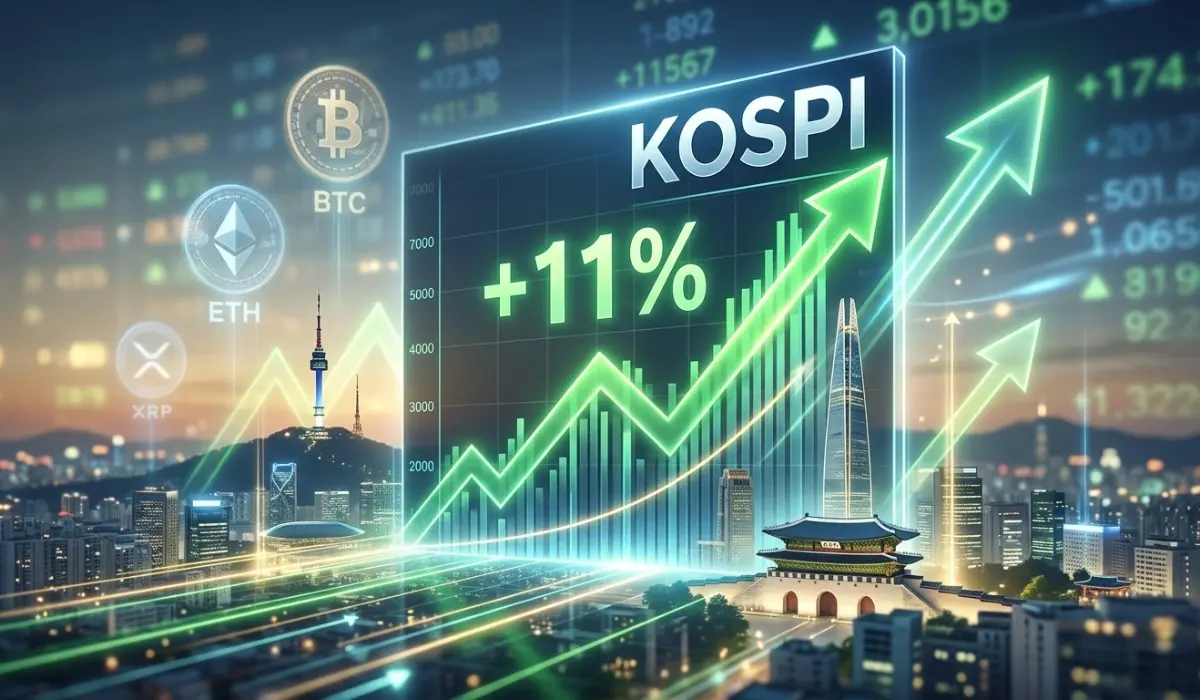
Despite the ongoing geopolitical turmoil in the Middle East, the Asian stock market has managed to put forth a strong face. Notable among the performances of various indices is South Korea’s large-cap stock index, the Korea Composite Stock Price Index (KOSPI), which surged by 11% today. The surge was unexpected as it happened immediately after the steepest single-day fall of the stock on Wednesday. Investors and market watchdogs are seeing this as an instance of the KOSPI taking over the crypto market.
On Wednesday, KOSPI closed as low as 5093; however, today the stocks rebounded to 5682, after reaching an intraday high of 5715. This change of scene was largely attributed to the hopes of the US-Iran war de-escalating and the oil prices stabilizing. There were rumors that Iran was having back-door talks with the US to put an end to the ongoing war, which reflected in the performance of the Asian stock market. Japan’s Nikkei 225 surged 4%, and Australia’s S&P/ASX 200 opened 0.38% higher.
The South Korean Government’s 100 Trillion Won Shield
Today, South Korean President Lee Jae-myung announced the immediate activation of the 100 trillion won ($68 billion) Market Stabilization Fund. According to him, this move was aimed at smoothing the volatility of the capital markets caused by the Middle East crises. This is also a probable reason for the sudden surge in the KOSPI index.
On top of that, the Korea Exchange (KRX) triggered a “sidecar” trading curb today at 9:06 a.m. after a sharp, rapid surge in KOSPI 200 futures prompted a 5-minute suspension of program trading. This helped break the circuit to further stabilize the volatility of the market.
The Primary Catalyst of KOSPI’s Rebound
The primary catalyst that triggered the rebound of the KOSPI index was the sudden cooling of the tensions in the Middle East. For days, the Strait of Hormuz had been a focal point of anxiety as the U.S.-Iran Conflict threatened to choke off the global energy supplies, augmenting fuel prices.
However, the reports about the U.S. Central Intelligence Agency (CIA) opening a successful backchannel with Iran’s Ministry of Intelligence to hold talks have eased the tension. Oil Prices (WTI and Brent Crude), which had spiked toward $120 per barrel, plummeted back to the $85 range.
Samsung Electronics and SK Hynix both surged over 12%, and LG Energy Solution and POSCO Holdings also followed suit, which reflected in KOSPI’s performance. Hyundai Motor Company and Kia also saw double-digit gains, benefiting from the easing of shipping concerns in the Middle East.
Analysts see this event as a value-up initiative aimed at killing the “Korean discount” effect, the tendency for South Korean stocks to be undervalued compared to global peers, which was quite frustrating for the local investors. Consequently, the Bank of Korea (BoK) has taken a “wait-and-see” approach to analyse the future implications of the current rebound of KOSPI.
KOSPI versus Crypto: The Beginning of a New Trend
The young investors of South Korea had almost abandoned investments in the KOSPI stock index and had flocked to cryptocurrencies such as Bitcoin, due to the sheer glamor of the decentralized finance world. However, as KOSPI has overtaken Bitcoin in terms of value, investors are reconsidering the KOSPI stock index.
While Bitcoin, sometimes dubbed “digital gold”, was viewed in early 2026 as a potential hedge, the market, when pivoting to “Risk-On,” favored industrial giants such as Samsung and Hyundai. This will lead many South Korean investors to expand their portfolio and include the KOSPI index as part of their investments. This might result in investors considering stocks as a potential option, even after the current geopolitical tensions ease, which is seen as the beginning of a new trend in the global capital market.


