

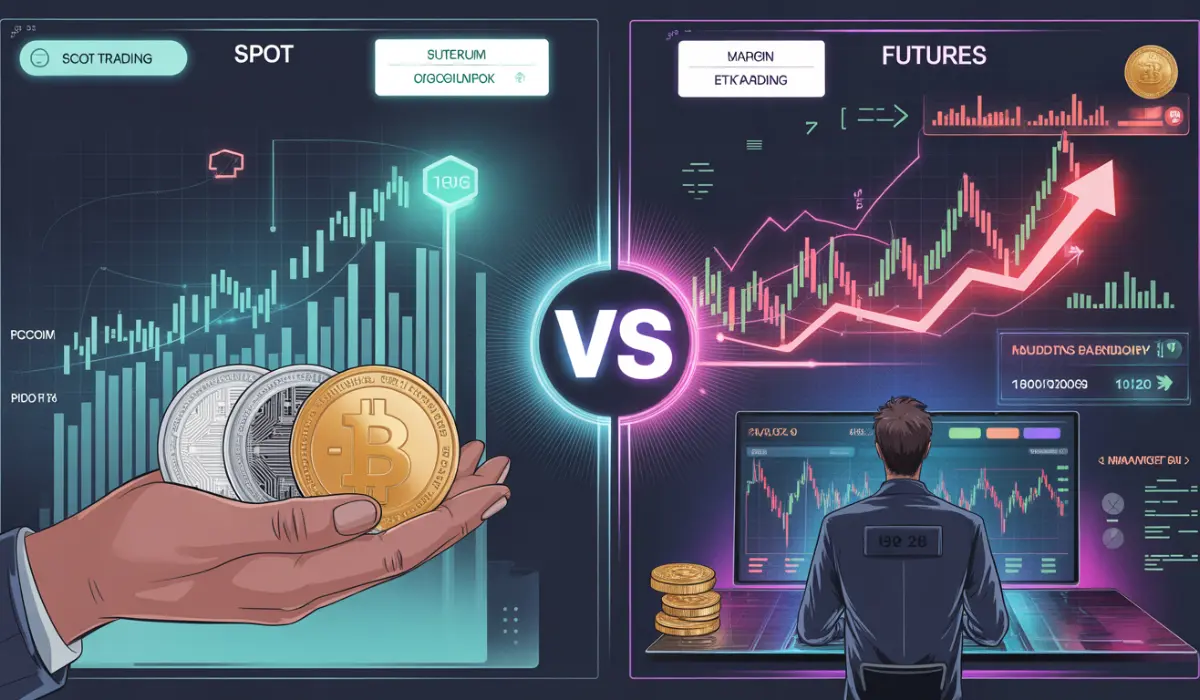
Many investors struggle to decide whether spot trading or futures trading is the right choice, especially when starting out in the crypto market. The differences can seem complex, with each approach offering distinct risks and rewards. This beginner-friendly article breaks down those differences clearly to help you choose with confidence.
What is Cryptocurrency Spot Trading?
Cryptocurrency spot trading refers to the direct buying and selling of digital assets at the current market price. In this type of trading, the transaction is settled immediately, meaning the buyer receives full ownership of the cryptocurrency as soon as the trade is completed. Unlike derivative products, spot trading involves the actual asset, not a contract tied to its price.
What is Cryptocurrency Futures Trading?
Cryptocurrency futures trading involves buying and selling contracts that are based on the future price of a digital asset rather than the asset itself. Traders do not own the cryptocurrency when they enter a futures position. Instead, they are speculating on whether the price will rise or fall. Futures trading allows participants to profit in both upward and downward markets by taking long or short positions. These contracts either have a fixed expiry date or exist as perpetual contracts that do not expire.
Key Differences In Ownership, Leverage, Risk, Profit Potential, And Cost.
Ownership And Settlement Differences
In spot trading, investors buy and own actual digital assets such as Bitcoin, Ethereum, Solana, or Binance Coin at the current market price on crypto exchanges like Coinbase, Kraken, or Binance. The asset is settled immediately and can be withdrawn or held long-term.
Futures trading offers contract-based exposures without ownership. On platforms like Bybit or OKX, traders use futures contracts to take long or short positions. Often, with leverage and margin, focusing on price movement rather than holding the asset itself.
Leverage And Margin Explained
Leverage and margin are key features of futures trading in crypto markets. Leverage allows traders to control a larger position using a smaller amount of capital, known as margin. For example, a trader can use leverage to amplify gains from price moves in Bitcoin or Ethereum, but losses are also increased, raising the risk of liquidation.
Spot trading usually does not involve leverage because traders are buying an actual digital asset at the market price. Since ownership is direct and fully funded, borrowing is required, which keeps risks lower compared to futures trading.
Risk And Volatility Comparison
Risk and volatility play a major role in crypto trading, especially in futures markets. Futures trading in assets like bitcoin or Ethereum involves leverage and margin, which can lead to margin calls or forced liquidation when prices move sharply. Sudden price swings can quickly wipe out positions on exchanges such as Binance, Bybit, or OKX.
In spot markets, traders won the digital assets outright, so there is no liquidation risk. While prices can still be volatile, losses are limited to the amount invested, making spot trading generally less risky.
Profit Opportunities
Futures trading allows traders to profit from both rising and falling prices of cryptocurrencies like Bitcoin, Ethereum, Solana, and Binance Coin. Using derivatives such as perpetual contracts on exchanges like Binance, Coinbase, OKX, Kraken, and Bybit, traders can apply leverage and margin to amplify gains. Funding rates, volatility, and the order book affect positions, but liquidation risks remain high. Unlike spot trading, which benefits mainly from price appreciation, futures are closely monitored by regulatory bodies like the Commodity Futures Trading Commission (CFTC), European Securities and Markets Authority(ESMA), and the US Securities and Exchange Commission (SEC).
Fees And Trading Costs
Spot trading on exchanges like Binance and Coinbase usually involves straightforward trading fees with no funding rates or overnight costs. Traders buying Bitcoin, Ethereum, or Solana pay only standard exchange fees. In contrast, futures trading with derivatives and perpetual contracts incur additional costs: funding rates, overnight fees, and higher leverage-related expenses. Volatility can increase liquidation risk, and margin requirements differ. Regulators like the SEC, CFTC, and ESMA keep a close watch on these practices to ensure transparency and fairness.
Who Should Use Spot Trading Vs Futures Trading?
Spot trading suits beginners and long-term investors, as it involves buying cryptocurrencies like Bitcoin, Ethereum, and Solana, directly on exchanges like Binance, OKX, and Kraken, with lower risk and no leverage.
Futures trading, using derivatives or perpetual contracts with leverage and margin, appeals to active traders seeking short-term profits and volatility, and price swings. However, risks like liquidation, funding rates, and regulatory oversight by the SEC, CFTC, and ESMA make it less suitable for inexperienced investors.
Ongoing Regulatory Disputes
For decades, economists and traders have clashed over a central question: do futures markets provide a clear window into what goods are actually worth, or do they just stir up trouble for everyone else? At its heart, this is a debate about the “true price.” While these markets are designed to help businesses manage risk and gather information, critics worry that high-stakes gambling in the futures pits creates wild price swings that hurt everyday buyers and sellers in the local market.
Do Futures Markets Discover True Prices or Add Volatility?
The futures market often reacts first when new information hits. News like supply shortages or political changes usually show up in the futures prices before spot market moves. Because trading is fast and low-cost, most buyers and sellers take part, which helps prices stay balanced. When futures and spot prices drift too far apart, traders step in and trade the difference, pulling prices back toward reality.
At the same time, the futures market can create sharp price swings. When speculation takes over, and leverage is heavily used, prices may move based on emotion rather than real supply and demand. Forced selling can drag the spot price lower and pressure physical sellers.
Most of them agree that futures markets are helpful over time, as they improve pricing and allow risks to be managed more efficiently, which can reduce volatility in the long run. However, sudden shocks, heavy leverage, and fast trading can cause sharp price moves that do not always match real market conditions.
According to a research article, “Price discovery in bitcoin spot or futures?” by Dirk G. Baur and Thomas Dimpfl, the price discovery is led by the spot market and not the futures market. The supremacy of spot trading over futures trading is because overall bitcoin trading volume in the spot market is much higher than in the futures market combined. This constant activity allows spot prices to react faster and lead price discovery more consistently.
Bottom Line
In conclusion, spot trading offers a straightforward approach centered on asset ownership and steady price growth, making it suitable for cautious participants. Futures trading, on the other hand, provides flexibility through leverage and two-way price exposure but comes with higher risk. The right choice ultimately depends on trading experience, strategy, and risk appetite.


