


A stock market cycle is the natural, recurring pattern of rising and falling stock prices. In other words, it refers to the trends and patterns that arise in different markets or business settings.
During a cycle, certain asset classes or securities outperform others because of their growth-aligned business models. Each market cycle duration is usually between two major peaks of a common benchmark that highlights a fund’s performance in both rising and falling markets.
What Are Stock Market Cycles?
A stock market cycle forms when trends within a particular sector or industry develop as a result of new products, meaningful innovations, and the regulatory environment. These cycles are said to be observable, and during such periods, numerous companies within an industry show growth in revenue and net profits.
Identifying the phase of a market cycle in real-time can be challenging, which also makes it difficult to generate precise trading strategies. They are often hard to pinpoint because they rarely have a specific or clearly identifiable beginning and end point.
However, many investors use strategies to profit from them by trading securities before directional shifts. A market cycle can last anywhere from minutes to years, depending on the market and the time frame being analyzed.
The Four Main Phases Of Stock Market Cycles
The stock market cycles are said to have four different phases. Each security responds distinctly during various stages of a full market cycle. For instance, during a market upswing, luxury goods often outperform, whereas in a downturn, industries such as consumer staples tend to do better because people cannot reduce purchasing basic essentials, regardless of the economy.
The four main market cycles include:
Accumulation Phase
The accumulation phase occurs after a downturn or bottom. Investors and early adopters start to buy, figuring the worst is over. The general sentiment, however, is still negative.
Mark-up Phase
The mark-up phase occurs when the market has been stable for a while and then moves higher in price. During this phase, the confidence returns and economic news improves.
A broader base of investors enters the market, which drives up the prices steadily. It is considered a period of sustained growth.
Distribution Phase
The distribution phase occurs when the sellers begin to dominate just as the stock reaches its peak. During this phase, experienced investors begin selling to take profits, while new investors are still buying, thereby leading to high volatility.
Downtrend Phase
The downtrend phase occurs when the stock price seems to tumble. During this phase, the selling pressure outweighs buying interest, causing prices to fall. When panic sets in, it leads to sharp declines with investors selling to avoid further losses.
What Is A Bull Market?
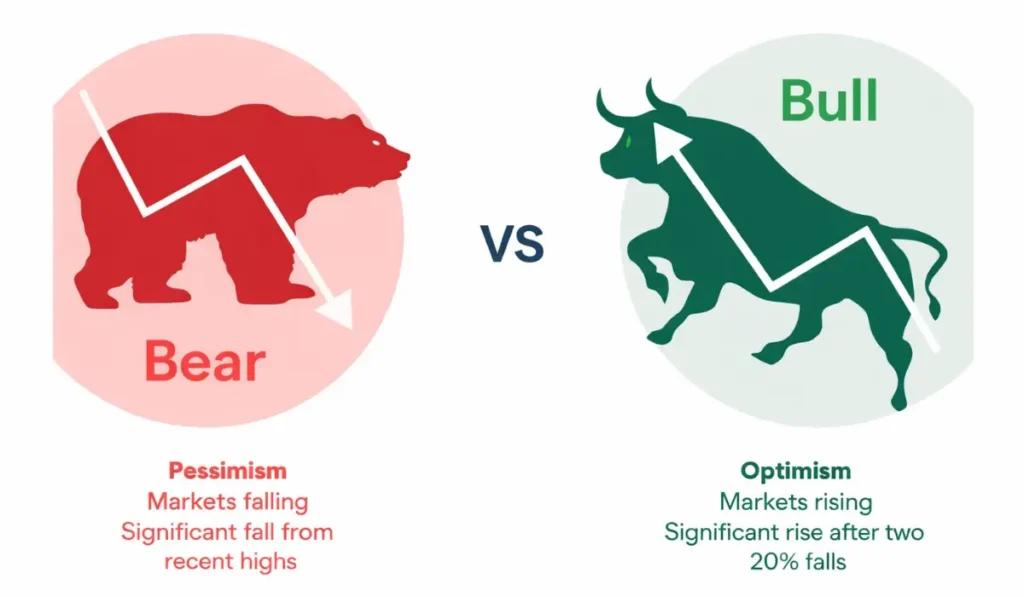
A bull market is a financial market trend where prices are rising or are expected to rise. It is mainly driven by investor optimism, high demand, strong economies, and low unemployment. It signifies investor confidence, investors eager to buy securities, and is characterized by strong corporate profits and an expanding economy.
Generally, bull markets are lengthy periods during which stock market prices usually rise, even sometimes for multiple years.
What Is A Bear Market?
A bear market is a prolonged period where stock prices fall significantly, reflecting widespread investor pessimism, low confidence, and often a slowing economy. It is characterized by negative sentiment, increased selling, and a downward trend in markets, often lasting several months or longer.
Bear markets are generally shorter time periods in which fundamental factors drive stock prices downward by around 20% or more from the previous peak or market high.
What Is A Market Correction?
A market correction refers to a temporary drop of 10% to 20% in a stock market index or security from its recent peak. It is viewed as a healthy pullback from unsustainable highs, not a crash.
This situation often occurs due to profit-taking or economic news, which is considered a normal part of market cycles. These short-term declines can help rebalance overvalued assets and provide buying opportunities, usually recovering over days or months.
What Is A Market Crash?
A stock market crash is a sudden, dramatic decline in stock prices across various sectors of a stock market. It results in a significant loss of unrealized gains. This situation is often driven by panic selling and economic factors. It is also associated with speculative and economic bubbles.
Key Differences Between Bull Market, Bear Market, Corrections, And Crashes
The key difference between a bull and bear market is that bull markets indicate rising prices and high investor confidence, whereas bear markets signal declining prices and fear. Market corrections are short-term dips of 10% up to 20%, acting as a healthy temporary pause in a prevailing trend.
On the other hand, crashes are sudden, sharp, and severe market drops, often sparking panic selling. Another factor that differentiates both markets is duration: bull markets tend to last longer than bear markets.
Final Thoughts
The stock market consists of repeating, long-term trends, including bull markets and bear markets that are interrupted by shorter-term corrections and sudden crashes. While bear markets last for months, bull markets last significantly longer, driving long-term growth despite temporary declines.
Understanding stock market cycles is crucial for managing risk, timing investment decisions, and maximizing long-term returns. Recognizing these patterns can help investors avoid emotional decision-making, ultimately navigating volatility.
FAQs
- What are the warning signs of a market crash?
Warning signs of a market crash include excessively high valuations, an inverted yield curve, rapid interest rate hikes, and high inflation.
- What is the 90% rule in stocks?
The 90-90-90 rule is an often-cited, sobering maxim in trading, stating that 90% of new traders lose 90% of their capital within their first 90 days of trading. It highlights the extreme risk of high-frequency trading, lack of proper training, overleveraging, and emotional decision-making among beginners.


