

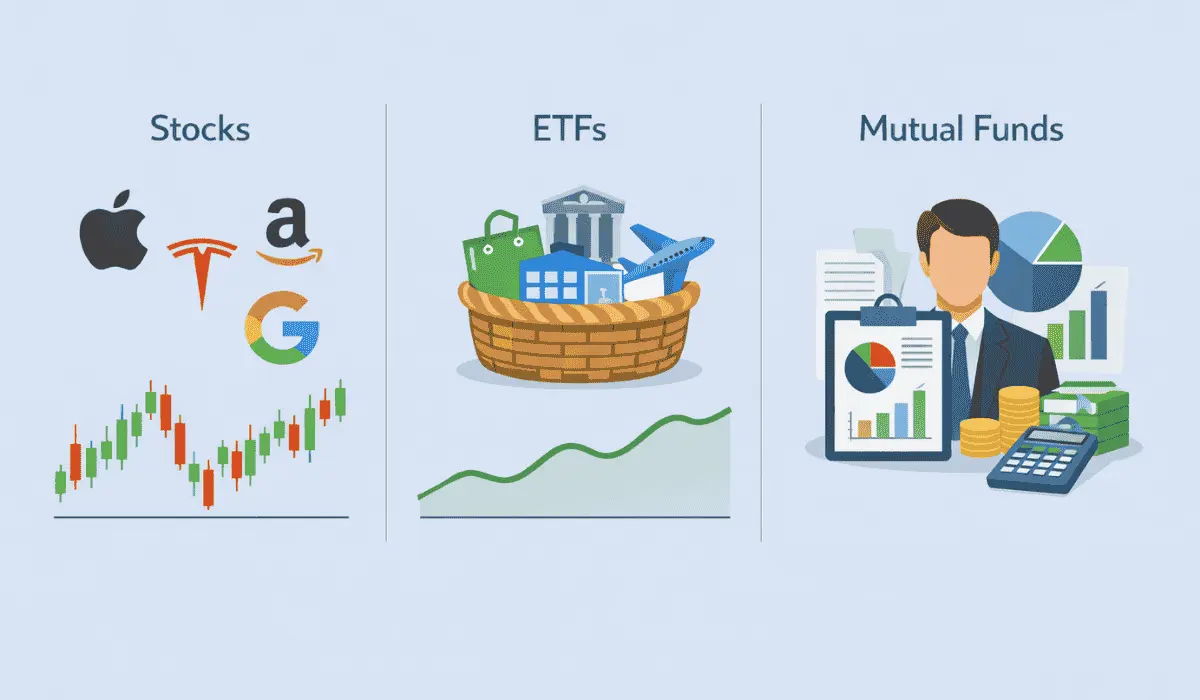
With a plethora of investment options available to enter the market, it might be a bit overwhelming to understand what suits you best. And among the many options, three methods, namely Stocks, ETFs, and Mutual Funds, stand out. In this article, we will help you understand which method of investment suits you the best, according to your financial goals and capabilities.
What are Stocks?
Stock, also known as equity, is a share of the ownership in a company, allowing the investors to own a fraction of its assets and earnings. These stocks are issued by the company to raise money, while the investors purchase them to make a profit from the price increases, as the company grows.
Stocks are bought and sold through public exchanges, and are regulated by the government bodies to protect the investors from fraudulent practices and scams. A stockholder can earn money through the stocks in two ways: dividends and capital appreciation.
Dividends are the company’s profits distributed as cash. Capital appreciation is the increase in the share’s price. The stocks are of different types, such as common stocks and preferred stocks. A common stock is a share of the company’s ownership in the company. A preferred stock does not give the stockholders voting rights, but receives payments just as the common stockholders.
Fundamentals of ETFs
An ETF, or exchange-traded fund, is an investment fund that holds one or more underlying assets and is traded on stock exchanges. Similar to stocks, they can be bought and sold on any exchange. ETFs can be used to track anything from the commodity price to a larger, diverse collection of stocks, including specific investment strategies.
Based on your investment requirement, whether to generate income, speculate, or hedge against risk in a portfolio, various ETFs are available to invest in. Most of the ETFs are set up as open-ended funds, and every ETF must be registered with the Securities and Exchange Commission (SEC).
There are many types of ETFs, including passive ETFs, actively managed ETFs, bond ETFs, industry ETFs, commodity ETFs, currency ETFs, and Bitcoin ETFs. Some of the most popular ETFs you can consider investing in are SPDR S&P 500, iShares Russell 2000, Invesco QQQ, SPDR Dow Jones Industrial Average, etc.
Mutual Fund Basics
Mutual funds are collective investments that gather money from several investors and invest the pooled money across equities, bonds, government securities, and other money market instruments. Mutual funds, similar to ETFs, are SEC-registered open-end investment funds.
People invest in mutual funds mainly to have professional management of the funds, portfolio diversification, low minimum investments, and high liquidity. Investors can earn from mutual funds either through dividend payments, capital gains distributions, or increased net asset value. The different types of mutual funds are stock funds, bond funds, target date funds, and money market funds.
As mutual funds are not insured by the FDIC or any other government agencies, they are not guaranteed and carry a certain level of risk. If the value of the fund goes down, you can end up losing a part or all of your money. Analysing the past performance is not of much importance, though it can say something about the fund’s stability or volatility, as the future does not depend on the past.
Stock vs ETF vs Mutual Funds: What are the Key Differences?
| Feature | Stocks | ETFs | Mutual Funds |
|---|---|---|---|
| Definition | Ownership, or shares of a listed company | Combined investment of securities or commodities, traded similarly to stocks | Pooled investments managed by market experts |
| Risk | High, based on the stock’s performance | Moderate diversification can reduce the risk | Generally, lower than stocks, diversification reduces the risk |
| Market Return | High, but volatile | Moderate to high | Depends on the type of fund |
| Price | Based on their market performance | Either at a premium or at a loss to the NAV of the fund | Traded at the net asset value of the overall fund |
| Trading | During regular market hours | Similar to stock, traded during market hours | Can be bought and sold only at the end of a trading day |
| Ownership of Securities | Investors gain ownership of the security | No actual ownership | Ownership in the pooled format |
| Access | A high level of market research is required before investing | Easy to trade | Beginner-friendly, easy |
| Ideal for | Risk-takers | Investors who are conscious of cost | Passive investors |
Understanding the key differences can help avoid ambiguity and taking bad financial decisions.
Stock, ETF, or Mutual Fund: Which is Suitable for You?
Each investment is different from the others, and the choice should be based on the goal of your investment.
If you are an active trader with a high tolerance for risk and have a deeper understanding of the market, stocks might be the best option for you. It offers full control over the share and has the potential for high growth.
ETFs are best suited for cost-conscious, passive, intraday investors with broad market exposure. The low trading fees, tax-efficient trades similar to stocks, offer instant diversification, helping you grow your investment portfolio.
Mutual funds, on the other hand, are a great choice for long-term investors with set goals, as well as beginners who prefer professional management of their funds. The easy SIP access makes mutual funds a beginner-friendly option, allowing you to broaden your diversification.
Conclusion
To sum up, for beginners and long-term growth seekers, start with mutual funds or ETFs. For active traders with flexibility, ETFs, while trading in real time, can lower the cost. If you want maximum control over your shares, pick individual stocks, and for a simple, automated trading experience, opt for mutual funds.
Regardless of the investment option, make sure you have done your research and have a deep understanding of the mode of investment.


