

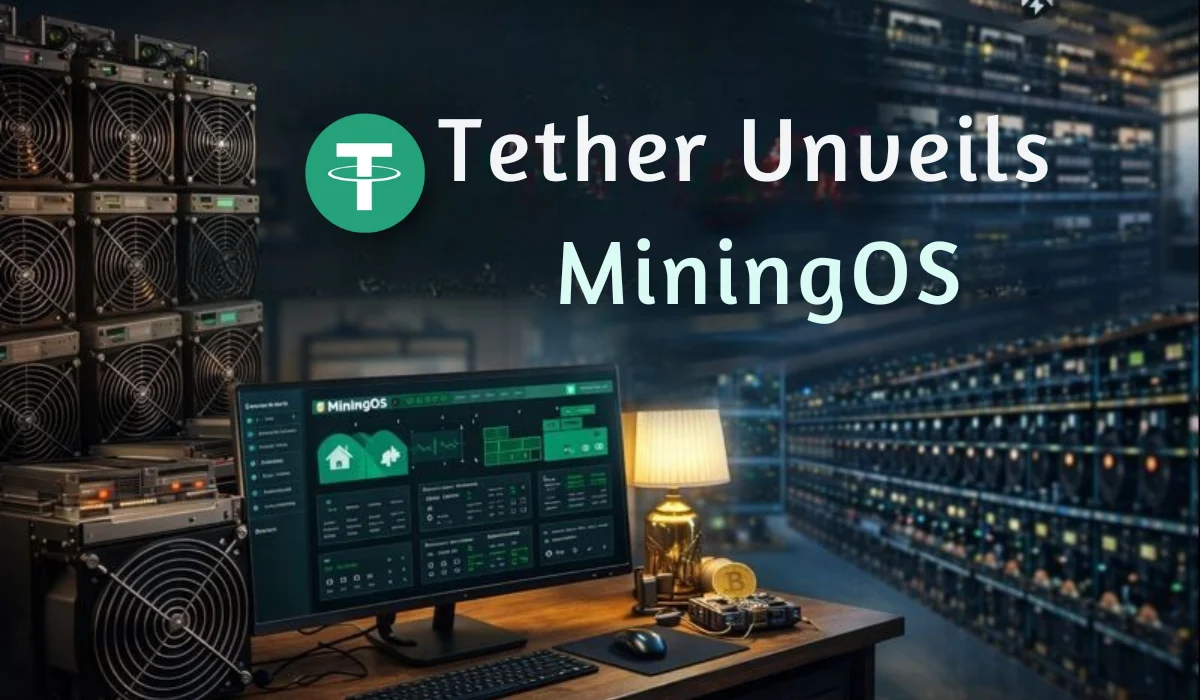
On Monday, Stablecoin giant Tether unveiled MiningOS – the company’s proprietary open-source software stack designed to streamline Bitcoin mining operations while broadening the blockchain’s decentralization.
The USDT, XAUT, and USAT issuer stated that the operating system is modular, scalable, and built for use by anyone from hobbyists to large-scale institutions. The move represents a strategic shift by the company to modernize bitcoin mining operations from a fragmented set of proprietary tools to a unified platform.
Tether ❤️ Bitcoin
— Paolo Ardoino 🤖 (@paoloardoino) February 2, 2026
Tether Mining OS is now fully opensource.
A complete operational platform that can scale from a home setup to industrial grade site, even across multiple geographies.
Super modular, P2P encrypted networking layer.
It supports a long list of miners,… https://t.co/VzXywA6IZc
Tether Unveils MiningOS To Power Home And Industrial Bitcoin Mining
Tether said on the MOS in its press release,
“The mining industry has long been limited by closed systems and proprietary tools. MiningOS changes that – introducing transparency, openness, and collaboration into the core of Bitcoin infrastructure. No black boxes. No lock-in. No limits,”
MiningOS centers around a self-hosted mining architecture that communicates with other application-specific integrated circuits (ASICs) – computers built specifically for mining bitcoin – via an integrated peer-to-peer network. The aim is to reduce reliance on centralized services and vendor lock-ins.
MOS was officially unveiled at the Plan B Forum in El Salvador on February 2. It is accompanied by a platform that enables miners to simply adjust settings to suit the scale and output of their operations. The service is custom-designed to manage and automate bitcoin mining infrastructure through a single interface.
Tether Open-Sources the Next Generation of Bitcoin Mining Infrastructure with MOS, Mining OS, Mining SDK ⛏️🟠
— Tether (@tether) February 2, 2026
Read More: https://t.co/ImTHUyC2QR
Operators no longer need to use multiple third-party platforms to monitor hashrate, energy consumption, and machine or site operations; instead, MOS allows them to oversee all these functions from a single dashboard.
Tether CEO Paolo Ardoino called MiningOS a “complete operational platform that can scale from a home setup to an industrial-grade site, even across multiple geographies.” Unlike many commercial bitcoin mining tools, the system runs locally and does not rely on centralized servers. The company said that P2P networking technology, which enables direct communication between ASICs, improves reliability and privacy.
The platform is released under the Apache 2.0 license, which means it can be used, modified, and distributed freely. MOS also relies on Holepunch P2P protocols, allowing it to establish direct connections between devices without requiring manual port forwarding or a dedicated server for ongoing communication. Tether says this combination eliminates central points of failure and backdoors into the system.
Tether first announced plans for an open-source Bitcoin mining OS last June, highlighting the importance of new miners being able to “enter the game and compete” without dependence on expensive third-party vendors.
MiningOS is built from the ground up to run on lightweight devices for smaller setups, while also supporting large-scale deployment in mining farms employing thousands of machines.
The company is also working on a companion Mining Software Development Kit (SDK), which will allow developers to build custom tools and extensions on top of the MOS. The team noted that this framework will be finalized following input from the open-source developer community.
Tether Expands Beyond Stablecoins With MiningOS Bitcoin Push
With MiningOS, Tether seeks to reduce reliance on proprietary mining software such as HiveOS and Foreman, which often charge recurring fees from users. The firm says this approach can help smaller miners compete more effectively with large public entities, including Marathon Digital Holdings (MARA), Riot Platforms (RIOT), Hut 8 Mining (HUT), and Core Scientific (CORZ), to name a few.
Tether now joins other big names in the crypto space, such as Twitter co-founder and former CEO Jack Dorsey’s Block, in releasing an open-source Bitcoin mining stack. Unlike Block’s Proto Fleet, which is designed to work seamlessly with Proto Rig – the company’s modular Bitcoin mining hardware – MiningOS is compatible with a wide range of miners.
The move is part of the company’s broader involvement in the crypto infrastructure business beyond stablecoins, playing a major role in offering network support and backing mining projects that prioritize operational efficiency and renewable energy sources. Last year, the company made a series of strategic investments in tokenization, artificial intelligence, and decentralized finance ventures, while also becoming a strong hoarder of gold, bitcoin, and U.S. Treasury bonds.
Although it had to scale back some mining operations in late 2025 due to rising energy costs, the MOS release is focused on software development rather than hardware ownership. The firm has framed the project as a long-term investment in decentralized infrastructure.
At the time of writing, Bitcoin (BTC) is trading at $78,255 – up 3.38% in 24 hours.


