

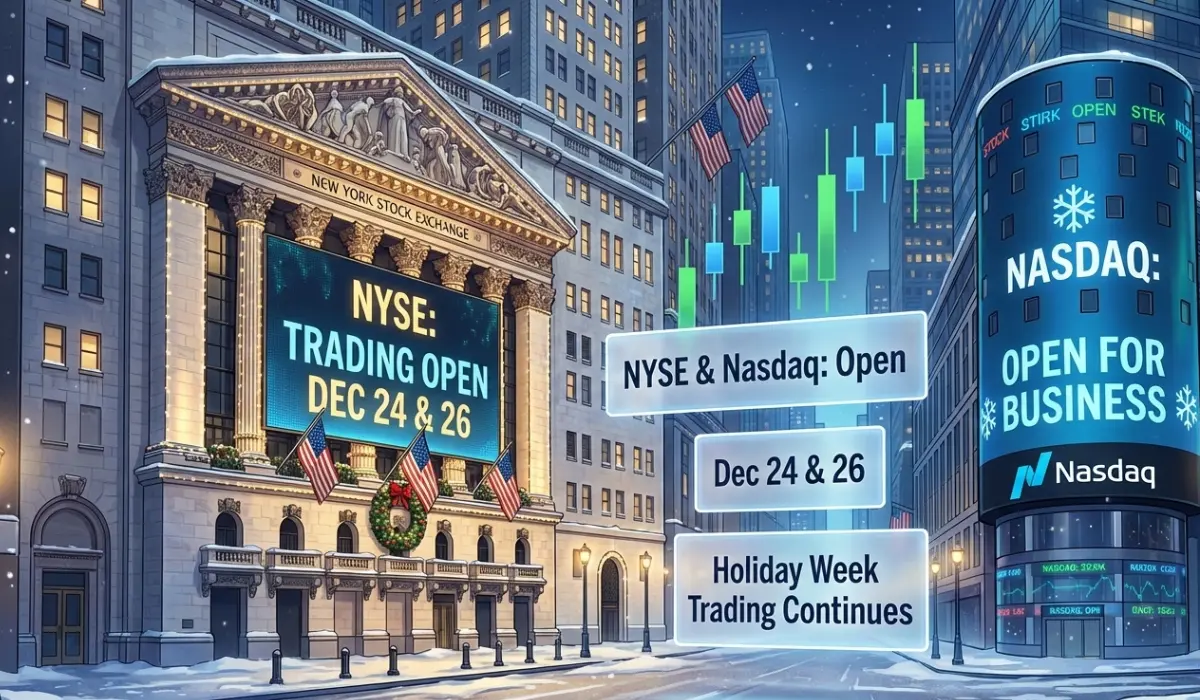
Major U.S. stock exchanges, Nasdaq and the New York Stock Exchange (NYSE), will remain open as scheduled on December 24 and December 26. The announcement comes despite President Donald Trump signing an executive order directing federal departments and agencies to be closed on both of those days.
The exchanges’ operators will close markets early on December 24, at 1:00 pm Eastern Time (ET), as previously planned. U.S. equities won’t be trading on Christmas Day, but the market will operate on a regular full trading schedule on December 26.
Trump Declares Dec. 24 and 26 Federal Holidays; U.S. Markets Remain Open
On Thursday, the President issued an executive order declaring Christmas Eve and December 26 as national holidays this year, directing all non-essential federal government operations to remain closed on those days, except for matters of national security.
This has created a five-day holiday break, excusing all employees from duty. However, the order states that agency heads can determine that certain offices and installations of their organizations remain open and that employees must report for duty. Though Trump’s gesture is common among Presidents when Christmas falls on a Tuesday or Thursday, granting both the day before and after as holidays is less common.
While the EO is directed towards executive departments and agencies of the federal government, it does not affect the private sector, as financial entities and major exchanges have confirmed that U.S. equity markets will continue their scheduled trading hours for the 2025 calendar next week.
Historically, U.S. stock exchanges are closed for nine major federal holidays annually: New Year’s Day (January 1), Martin Luther King Jr. Day (January 20), Inauguration Day (January 21), Presidents’ Day (February 17), Good Friday, Memorial Day (May 26), Independence Day (July 4), Labor Day (September 1), Thanksgiving Day, and Christmas (December 25). But they do not observe Columbus Day (October 13) and Veterans’ Day (November 11) as holidays, citing that their calendar is driven by global trading incentives rather than domestic policy.
Read More: Gulf Stock Market Treads Water as Investors Brace for Critical U.S. CPI Release
NYSE, Nasdaq to Close Early on Christmas Eve; Full Trading on Dec. 26
Shortly after the President’s announcement, the NYSE and Nasdaq released their trading for the holiday week:
- Wednesday, December 24 (Christmas Eve), the markets will observe an early close at 1:00 PM ET.
- Thursday, December 25 (Christmas Day), the markets will be closed for the full day.
- Friday, December 26, the markets will operate on a regular, full trading schedule, closing at 4:00 PM ET.
The bond market, governed by the Securities Industry and Financial Markets Association (SIFMA), however, is closed on all federal holidays, including Veterans’ Day and Columbus Day, and is expected to follow a similar path, with an early close on Wednesday and a full session on Friday.
During his first term, Trump twice designated Christmas Eve as a holiday, first in 2019 and then in 2020, as December 24 fell on a Tuesday and Thursday, respectively, in those years. President Obama also did the same in 2014, declaring December 26 (Saturday) a national holiday after Christmas fell on a Friday.
In May, Trump declared new national holidays on May 8 and November 11 to commemorate the Allied nations’ victory in World War I and World War II, respectively. The two additional holidays coming next week will bring this year’s total to 13 federal holidays.
To establish a permanent federal holiday, Congress must pass legislation, which is then signed into law by the sitting President. The most recent federal holiday added to the calendar was Juneteenth National Independence Day (June 19) in 2021 by President Joe Biden, taking the total tally to eleven days.


