

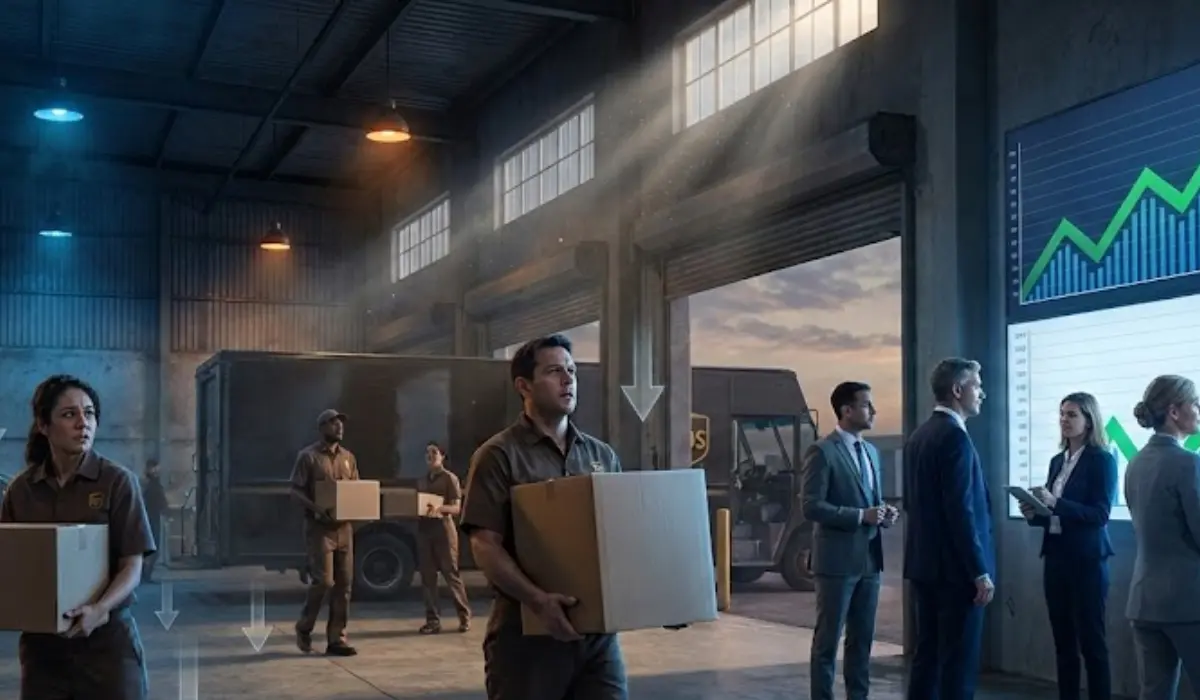
United Parcel Service (UPS) announced Tuesday a massive restructuring effort that will eliminate 30,000 operational roles in 2026, marking an aggressive acceleration of its pivot away from its largest but least profitable customer: Amazon.
Despite the deep workforce reductions, Wall Street signaled strong approval of the “Better, Not Bigger” strategy. Amazon stock (AMZN) closed at $244.68, up $6.26, or 2.63%, and edged higher in after-hours trading to $245.28, adding another $0.60, or 0.25%. United Parcel Service, Inc. (UPS) shares closed at $107.20, up $0.23, or 0.22%, reflecting modest gains.
The Amazon “Glide-Down” Plan
For years, Amazon.com (AMZN) has been both a lifeline and a liability for UPS. While the e-commerce giant once accounted for a massive portion of UPS’s daily volume, CEO Carol Tomé has been vocal about the “extraordinarily dilutive” nature of those low-margin packages.
Carol Tomé, UPS chief executive officer, commented while releasing the Q4 earnings report, “2025 was a year of considerable progress for UPS as we took action to strengthen our revenue quality and build a more agile network. Looking ahead, upon completion of the Amazon glide-down, 2026 will be an inflection point in the execution of our strategy to deliver growth and sustained margin expansion.”
During the investor call, Tomé confirmed that UPS is entering the final six months of its “Amazon accelerated glide-down plan.” The company successfully removed 1 million Amazon pieces per day from its network in 2025 and intends to shed another 1 million daily pieces through the first half of 2026.
Job Cuts and Facility Closures
The loss of Amazon volume has necessitated a significant contraction of the UPS physical footprint. After shuttering 93 buildings in 2025, CFO Brian Dykes announced that an additional 24 facilities will close in the first half of 2026.
The workforce impact will be significant, with UPS planning to eliminate approximately 30,000 jobs over the course of 2026. The reductions will be handled mainly through natural attrition, limiting the need for involuntary layoffs. In addition, the company will roll out a second voluntary separation program for full-time drivers, building on a similar buyout initiative introduced in 2025.
The restructuring is part of a broader “Network of the Future” initiative aimed at saving $3 billion this year by replacing manual labor with advanced automation and AI in sorting hubs.
Financial Outlook: Wall Street Beats
Investors cheered the company’s ability to find profit in a leaner operation. UPS reported consolidated revenues of $24.5 billion, alongside a consolidated operating margin of 10.5%, which improved to 11.8% on a non-GAAP adjusted basis. Diluted earnings per share came in at $2.10, while non-GAAP adjusted diluted EPS reached $2.38. Additionally, the board declared a quarterly dividend of $1.64, underscoring confidence in cash flow stability.
A critical driver of this success was Revenue Per Piece (RPP), which saw a domestic increase of 8.3%. By focusing on Small and Medium Enterprises (SMEs) and high-complexity healthcare logistics, UPS is proving it can maintain profitability even as total package counts decline. For the full year 2026, UPS forecast revenue of $89.7 billion, topping analyst estimates of $87.94 billion.
Operational Shifts and Safety Reforms
The company also addressed more somber operational changes. UPS has officially completed the retirement of its MD-11 cargo fleet, recording a $137 million write-off. The move follows the tragic November 2025 crash in Louisville, Kentucky, which killed 15 people. While the MD-11 was already being phased out, the disaster accelerated the transition to a modernized, more fuel-efficient fleet of Boeing 767s.
Additionally, UPS cited a stabilizing “De Minimis” impact, noting that recent regulatory changes to U.S. duty-free shipping policies have helped normalize international volumes that were previously disrupted by low-cost e-commerce competitors.
What’s Next?
As UPS transitions away from the “Amazon era,” it is doubling down on high-margin B2B and healthcare verticals. The company’s renewed Ground Saver agreement with the U.S. Postal Service is also expected to bolster the bottom line by improving the economics of the “final mile.”


