

Key Takeaways
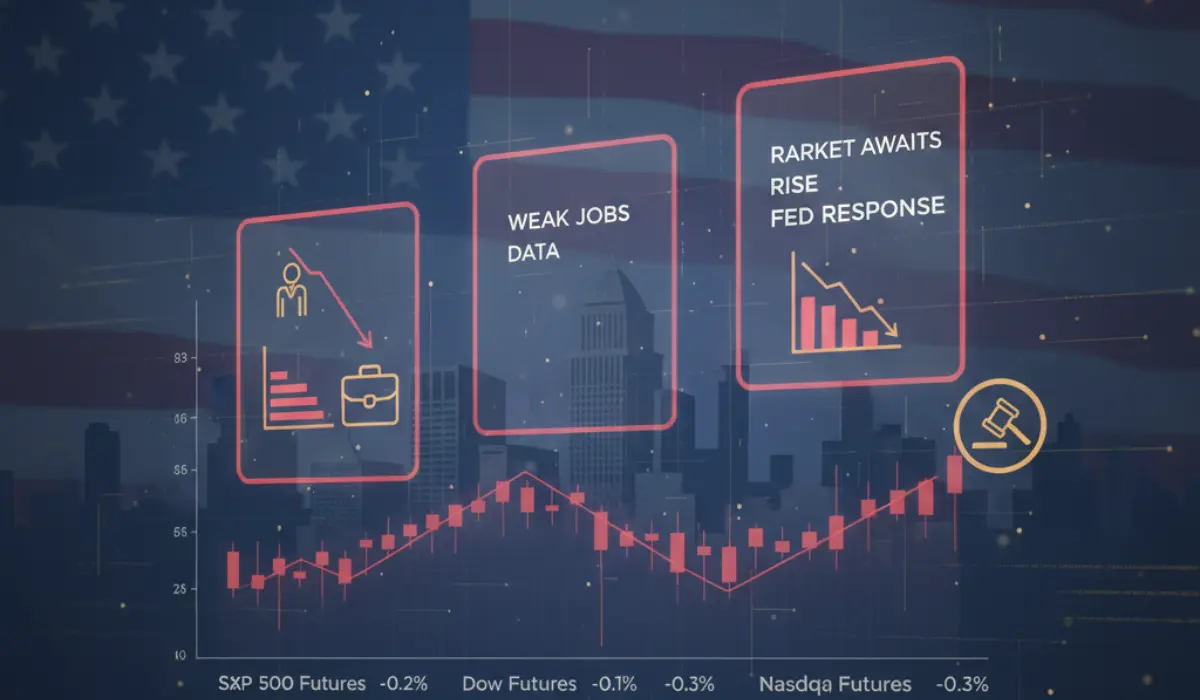
- After Tuesday’s job market report, the stock market futures moved against expectations.
- The noisy report is being held accountable for developing uncertainty among traders, which has caused this market movement.
- The market takes a broader risk-off sentiment.
- Major stock futures like the S&P 500, NASDAQ 100 futures, and Dow Jones Industrial Average all saw sliding prices.
In a rather contrary scenario, after Tuesday’s reveal of the US job market report, the stock futures slipped. Traders seem to be approaching the market cautiously, as many industry experts have warned against the credibility of the report.
The US job market report recorded 64,000 job additions. But rather disappointingly, the unemployment rate rose by nearly 4.6% when compared to the 2021 statistic. This ambiguity in the report was the major reason why stock futures suffered even while the chances of a Federal Reserve rate cut increased.
The Ambiguity In The Report
Before the reports even hit the desk, there were criticisms of the report, stating that the 43-day US government shutdown meant that the report could not be trusted. This was considered true to a large extent by most industry experts, as the projections and the report were made using data crammed into just four weeks.
Finally, when the job market report did come in, the ambiguity was visible. The discrepancy between the unemployment rate and the number of new jobs added gave subtle hints to the earlier criticism of the report being noisy.
From what could be derived from the report, the probability that the Federal Reserve will cut rates has gone up. Earlier, there was a 25 bps cut in 2025, post which the Federal Reserve had maintained a hawkish tone towards further rate cuts. However, the rising probability did not reflect in the market as traders were increasingly fearing an uncertain market due to an ambiguous report.
The Sliding Market
A confused set of investors meant that the market took on a broader risk-off sentiment. Because of this, the S&P 500 futures slid down nearly 0.2%. Other major participants followed suit as the futures market tied to the Dow Jones Industrial Average dropped 79 points, and the NASDAQ 100 futures fell by 0.3%.
For the stocks in the energy sector, Exxon Mobil and Chevron slipped roughly 2% while the US crude oil closed at a level lower since the year 2021. The energy sector fell because of the rise in the possibility of surplus production due to the rising unemployment rate.
The Interest Rate Cut
Much of the market is now focused on the FOMC, as without a clear dovish tone regarding future rate cuts, the investors’ confidence may not rebound in the near future. While the rising unemployment rate is aligned with the possibility of a further rate cut, the credibility of the report is the biggest hurdle.
Since Tuesday’s report came out, it has become clear that it couldn’t affect the market in a significant way. If this carries forward into the Federal Reserve’s decisions on a rate cut, it could hurt investor confidence further.
The major hindrance to the rate cut at the moment is the 64,000 new jobs, which surpassed almost all projections made by leading economic analysts from major firms. For instance, the Dow Jones prediction of 45,000 jobs was clearly blown off by the actual figure.
Until the picture becomes clear, investors will cling to the risk-off sentiment. If the risk appetite is to return to the market, the Federal Reserve will have to give clearer signs regarding a future rate cut. Since more reports are pending to hit the desk this week, nothing can be said for certain.


