

A debasement trade is an investment strategy used when a currency is losing value. Instead of holding cash that may lose purchasing power, the investors move their money into top assets that can hold or grow in value. This often happens during periods of inflation or when governments increase the money supply. The goal is to protect wealth and possibly benefit as the currency weakens.
Understanding Debasement in the Financial Market
Debasement means a decline in the value of a currency. In the past, this happened by reducing the metal content in coins. Today, it is mostly caused by policies like excessive money printing, low interest rates, and quantitative easing. When more money enters the system without matching economic growth, inflation rises, and money buys less over time. Governments often implement these policies to stimulate growth, alleviate debt pressure, and encourage consumer spending.
The primary goal of a debasement trade is to shift capital away from weakening fiat currencies. Some of the common assets used in debasement trade include cryptocurrencies, stocks, commodities like oil and raw materials, real estate, gold, and silver.
How to Identify a Debasement Opportunity
Investors look at key economic signals to spot when a currency may be losing value. One major sign is fiscal imbalance, such as high government deficits and rising debt levels. When debt grows too fast compared to the economy, it raises concerns about long-term stability.
Another important factor is monetary policy. Negative real interest rates mean inflation is higher than returns, reducing purchasing power. Although central banks may keep rates low to foster growth, these sustained low-interest environments often lead to currency weakening. Changes in currency trends matter too. A falling share of the US dollar in global reserves or a weaker dollar index often signals declining confidence.
Investors also watch capital flows. Increased demand for assets like gold, silver, and bitcoin shows a shift away from cash. When multiple asset classes rise simultaneously in nominal terms, it often reflects an underlying currency devaluation rather than intrinsic economic growth.
Debasement Trade vs Traditional Investing
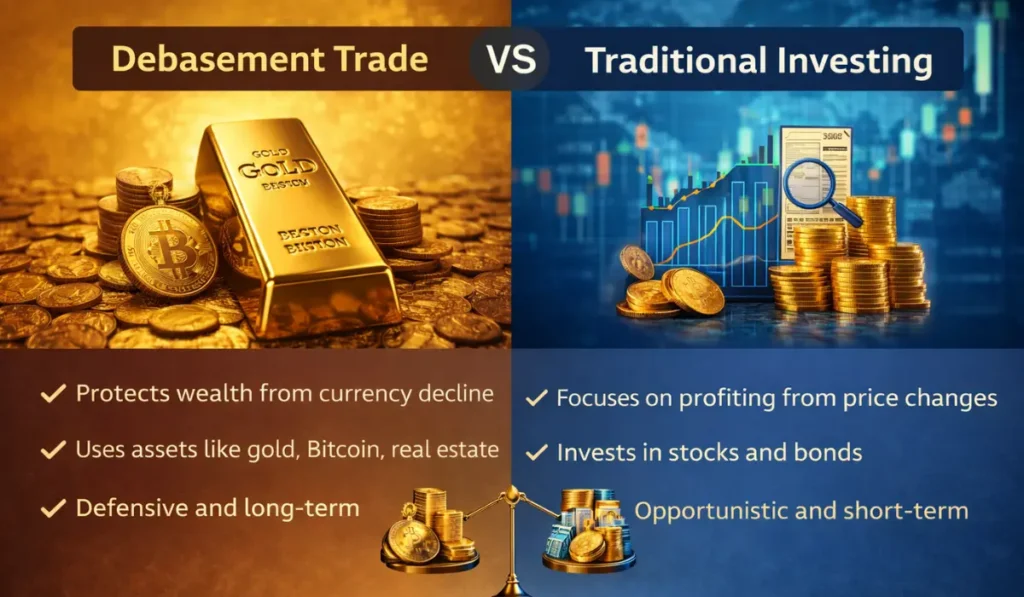
A debasement trade is all about playing it safe when money itself starts losing value. Instead of keeping cash that slowly loses buying power, investors shift their funds to assets like gold, stocks, or cryptocurrencies. The idea is simple: to hold things that can keep up with inflation and protect your wealth over time, even if markets feel uncertain.
On the other hand, a traditional trade is more about chasing opportunities. Here, investors look at price movements, company performance, or market trends to make profits. It is the classic “buy low, sell high” approach, often driven by timing and market signals.
Debasement trades are more defensive and long-term and focus on staying secure during economic changes. Traditional trades, however, are more active and profit-focused and aim to take advantage of short-term market movement.
Advantages of a Debasement Trade
A debasement trade helps protect your money when its value starts to fall. By moving into assets like gold or bitcoin, investors try to hold on to their purchasing power during inflation. It also acts as a safety net during times of rising government debt and loose monetary policies, when trust in currencies may weaken.
Another advantage is the chance to benefit from long-term trends like de-dollarization and growing interest in alternative assets. Scarce assets, such as gold and bitcoin, often gain value because their supply is limited, unlike paper money.
It also helps with diversification. Adding a small portion of these assets to the portfolio can balance risk. On top of that, increasing interest from institutions and central banks adds more confidence and demand, supporting long-term growth.
Limitations and Risks of Debasement Trades
While debasement trades can be useful, they are not always smooth or predictable. Prices of assets like gold or cryptocurrencies can move up and down quickly, which can test patience. It’s also not easy to get the timing right; currency weakness can take time to show, and markets may not react immediately.
There is also the risk of missing out on other opportunities. If too much money is parked in defensive assets, you might lose gains from regular market trends. On top of that, changing rules or regulations, especially around crypto, can create uncertainty. In the end, no strategy is risk-free, and this one is no exception.
Final Thoughts
In conclusion, a debasement trade is a simple way to protect wealth when money starts losing value. By shifting into assets that hold their worth, investors try to stay ahead of inflation and uncertainty. While it has risks, it can be a useful part of a balanced approach. The key is to stay patient, diversify wisely, and not rely on it as the only strategy.


