

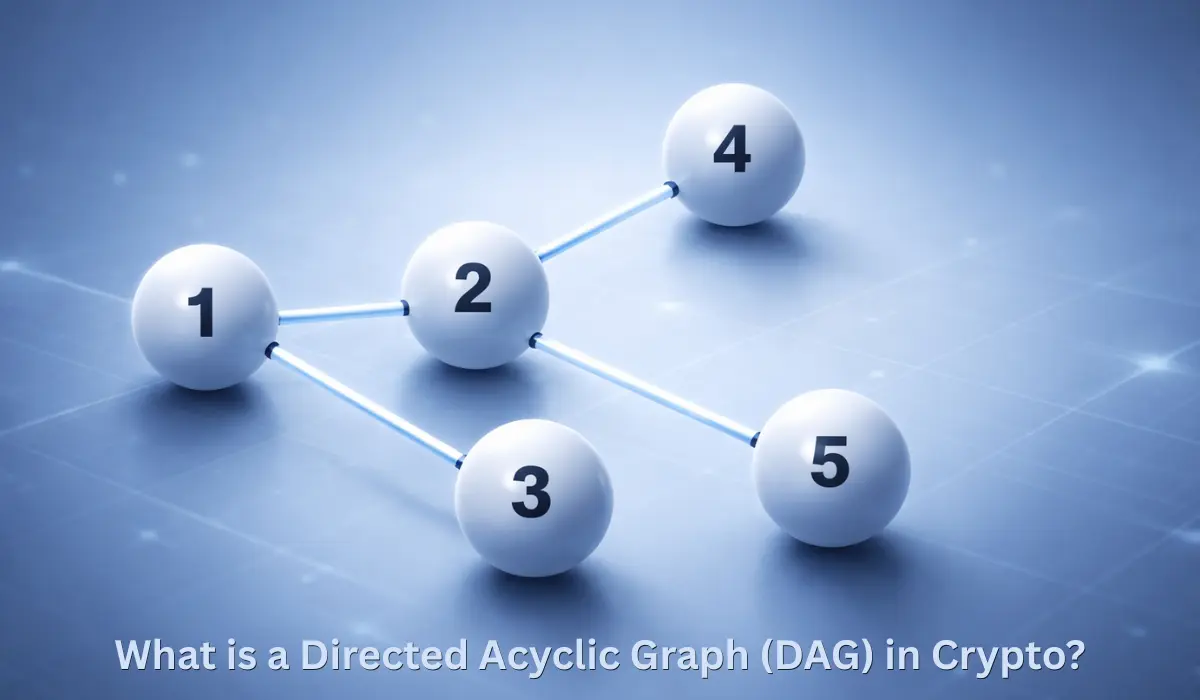
A Directed Acyclic Graph (DAG) is a network model, an alternative to blockchain technology, in which a graph-like structure is used to link the transactions to one another rather than the linear structure used by blockchain technology. However, unlike a usual graph, a DAG is constrained by two factors: it is unidirectional and acyclic.
In DAG, a transaction is linked to one or more transactions, which creates a web-like structure. The primary advantage of this web-like structure is that the scalability and speed of the transactions will be high in this model. Unlike traditional blockchains, DAGs do not require miners to confirm transactions, which reduces the transaction fee.
We will discuss DAG in detail in the further sections.
What are the Components of a DAG?
The main components of a DAG are explained below.
- Nodes or Vertices: In a DAG, nodes are fundamental units that represent transactions. There are two types of nodes: Source nodes and Sink Nodes. Source nodes represent the beginning of a graph, and they have no incoming edges. Sink nodes represent the end of a transaction, and they have no outgoing edges.
- Edges: Edges connect one node to another in a unidirectional manner. It represents the flow of the graph and establishes the dependency of the various transactions. For instance, transaction A should be completed first before transaction B starts. The direction of the flow, represented by edges, cannot be reversed.
- Path: Simply speaking, paths represent the trajectory through which a sequence of edges connects a sequence of nodes.
- Acyclic Nature: DAGs are of an acyclic nature. That means once the graph starts from a node and moves through the designated path, it cannot go back to the source node or other nodes that it has already covered.
Topological Sorting: The Logic Behind DAG
Topological Sorting is the logic behind the functioning of a DAG. It is the process of ordering the given nodes or vertices so that there is clarity as to which nodes follow the others. For instance, if there is an edge established between nodes U and V such that the edge is directed from U to V, then U should always come before V. In the case of DAG used in crypto, it is used to establish or schedule the various transactions based on the dependencies. Topological Sorting is only possible in an acyclic graph. It is impossible to implement it in a cyclical graph because of a condition called “circular dependency” or “deadlock,” where the edge is directed back to the source node.
DAG-based Cryptocurrencies: How Do They Work?
Several cryptocurrency protocols have adopted DAG as their fundamental mechanism, and many others are expected to follow suit. The structure of DAG is unique and different from the linear pattern followed by blockchain technology. One transaction (node) is connected to more than one node through edges, which form an acyclic graph-like pattern.
In DAG, transactions are not validated by miners; rather, users can directly validate the previous transactions. Each new transaction submitted by a user should approve the previous transactions. This improves throughput and reduces fees as no miners are associated with the process.
For instance, IOTA’s Tangle, a decentralized, feeless, and scalable Distributed Ledger Technology (DLT) specifically designed for the Internet of Things (IoT) ecosystem, requires each transaction to approve two others. It employs small amounts of Proof-of-Work to confirm two other transactions. In the case of Nano (XNO), a blockless lattice model is used, where each user has their own blockchain and uses balance-weighted voting to achieve consensus. The good thing is that these transactions and approvals are fee-free.
Challenges and Future of DAG
Even though DAG boasts low-cost, highly scalable transactions with faster confirmation times, it is not fully devoid of challenges. Unlike blockchains, DAGs are prone to security issues. The security of DAG-based networks strengthens with high activity. Therefore, in networks with low transaction volumes, double-spending or network split attacks can be concerning.
Some DAG projects, such as IOTA’s Tangle, have sought the help of a centralized coordinator node, at least in the early stages, which is against the decentralization principle of cryptocurrencies. Unlike the linear nature of blockchains, DAG has a complex structure that is difficult to implement and maintain. Moreover, the network is less developed compared to other blockchain networks; a high amount of activities can cause network congestion in the DAG.
The future of DAG will be bright if it reduces reliance on centralized coordinator nodes and moves towards full-fledged decentralization. Given their low-fee nature, DAG will be increasingly used across IoT devices, machine-to-machine payments, and microtransactions.
A hybrid model that combines blockchain technology and DAG is under development. It is expected to be widely adopted in the future by leveraging DAG’s fast processing and blockchain technology’s overall security.
Conclusion
DAG is an innovation that aims to help overcome the shortcomings of blockchain technology and bring in fast transaction settlement with high throughput. Even though the technology is at its nascent stage, the high rate of innovations and research is expected to create more reliable and interoperable systems, which will facilitate its widespread adoption.
Once the current challenges of DAG are resolved, it will become a promising innovation, especially in areas like cryptography and the Internet of Things. DAG is therefore set to make a mark in the field of technology in the coming years.


