

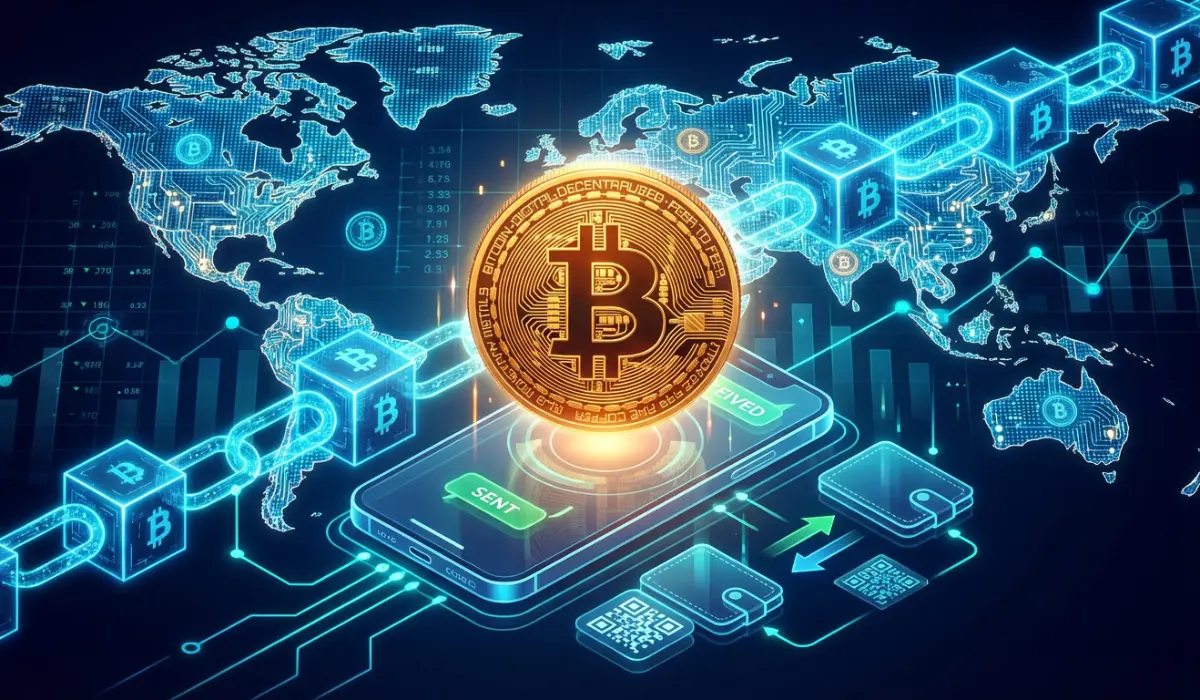
The term ‘Bitcoin’ has gained immense popularity ever since its invention in 2008 and has evolved from just an ‘internet money’ to ‘digital gold.’ It is the first decentralised cryptocurrency. Bitcoin was a revolutionary experiment and a much-awaited solution for cryptographers in the niche of digital currency. Emerging from the free-market ideology, Bitcoin has turned into a prestigious asset for millions, including individuals, major corporations, and national governments.
In this article, you will learn what Bitcoin is, how it works, and why it is emerging as one of the most sought-after tools of digital transactions.
The Evolution of Money and the Emergence of Digital Currency
From the ancient barter system to metal coins and paper currencies, money has constantly evolved and become an integral part of human life, influencing trade and the exchange of goods. As the digital era advances with groundbreaking technologies and inventions that reshape our economy, money has also entered this new era with its digital revolution.
Among the many forms of digital currencies emerged in recent years, Bitcoin stands out as the first digital cash system that can operate without the oversight of a central authority.
The Origin of Bitcoin
Bitcoin was first introduced by an anonymous person/ group through a white paper published under the pseudonym ‘Satoshi Nakamoto.’ The domain name bitcoin.org was first registered on 18 August 2008. The use of Bitcoin as a currency started in 2009.
The Symbol: ₿
The Currency Code: BTC
All the components of Bitcoin already existed in academia before Nakamoto published the white paper. Nakamoto invented Bitcoin by combining these complex data in the most ideal way, creating the first decentralized digital cash system. Nakamoto’s paper, titled ‘Bitcoin: A Peer-to-Peer Electronic Cash System, was first ignored by academics, arguing it would not work.
How does Bitcoin work?
Cryptocurrencies like Bitcoin depend on blockchain technology–a decentralized digital ledger, which is encrypted, facilitating secure, borderless transactions across peer-to-peer networks without the involvement of a third party/ central authority.
After releasing Bitcoin as an open-source software, Nakamoto created the Bitcoin network on January 3, 2009, by mining the first block of the chain called the genesis block.
Key Aspects
- Decentralization: The Blockchain technology eliminates the need for a central authority to control transactions as it works as a distributed ledger across peer-to-peer networks, making the transactions faster and more secure.
- Transparency: Every transaction through Blockchain is recorded permanently in the servers with traceable and auditable proofs.
- Divisibility: Bitcoin is highly divisible into smaller units, which allows users to own and trade fractions of a single bitcoin. The smallest unit, a sathoshi, is named after its creator.
Bitcoin functions through a network of computers. Each computer will be a component, called a ‘node’, in the peer-to-peer Bitcoin network. Each node will keep a copy of the public distributed ledger called a ‘blockchain’ independently.
The transactions are performed through cryptographic techniques. As long as the owner keeps the sensitive data a secret, the Bitcoin will be safe. The consent between each node to access the content in a blockchain is achieved through solving a mathematical puzzle, which is considered the proof of work, called ‘mining’.
The Bitcoins are connected to a blockchain through certain strings called addresses, which are encoded with the hash of a single public key. Creating an address involves generating a private key and computing it together to form the address. It’s impossible to find the private key in the reverse order, keeping the public key safe when the address is published.
Owners need their private key to use a bitcoin. They need to digitally sign the transactions with their private key, which will be verified through the network using the public key. All transactions, once they are broadcast to the network, will be confirmed through a process called mining in 10-20 minutes, which involves the computer hardware doing intense mathematical calculations to add the value to the blockchain and increase security.
Through this process, miners can collect a transaction fee for the confirmed transactions along with the bitcoins.
Conclusion
Bitcoin is the first decentralized digital cash system, which is programmed to be a finite resource. Bitcoin is limited by its maximum supply cap of 21 million coins, which will be reached by 2140. This scarcity makes it the ‘digital gold.’
Bitcoin attracts millions of people also due to the anonymity it provides, while all the transactions remain transparent and risk-free. This anonymity is what makes the national governments cautious about Bitcoin. Even then, as we step into 2026, Bitcoin is receiving broader support and rising attention around the globe.
FAQ
No. Bitcoin is not 100% secure, even though it is technically secure, and its proof-of-work consensus and decentralization protect it from hackers. The Safety of Bitcoin also relies on how the owner keeps the sensitive data, like the private key/ seed and other login credentials.
The price volatility: The Bitcoin prices fluctuate rapidly and extremely, sometimes within hours or a day.
Regulatory Uncertainty: Many governments take sudden and intense regulatory measures to control the Bitcoin network. These measures can influence the market faster and result in great losses.
Security Risks: While Bitcoin offers high security, it is not entirely secure from scammer are cyber attacks. Private keys getting stolen or lost can result in huge losses. Also, digital wallets are not entirely safe, especially if they are stored in software.
The future of Bitcoin is determined by technological, economic, and regulatory factors. There are several uncertainties and concerns still associated with Bitcoin, addressing which can significantly influence the future of Bitcoin.
For a beginner, the easiest way to buy Bitcoin is through a reputable cryptocurrency exchange or brokerage app. Eg: Coinage, Kraken, Gemini, Strike, etc.


