

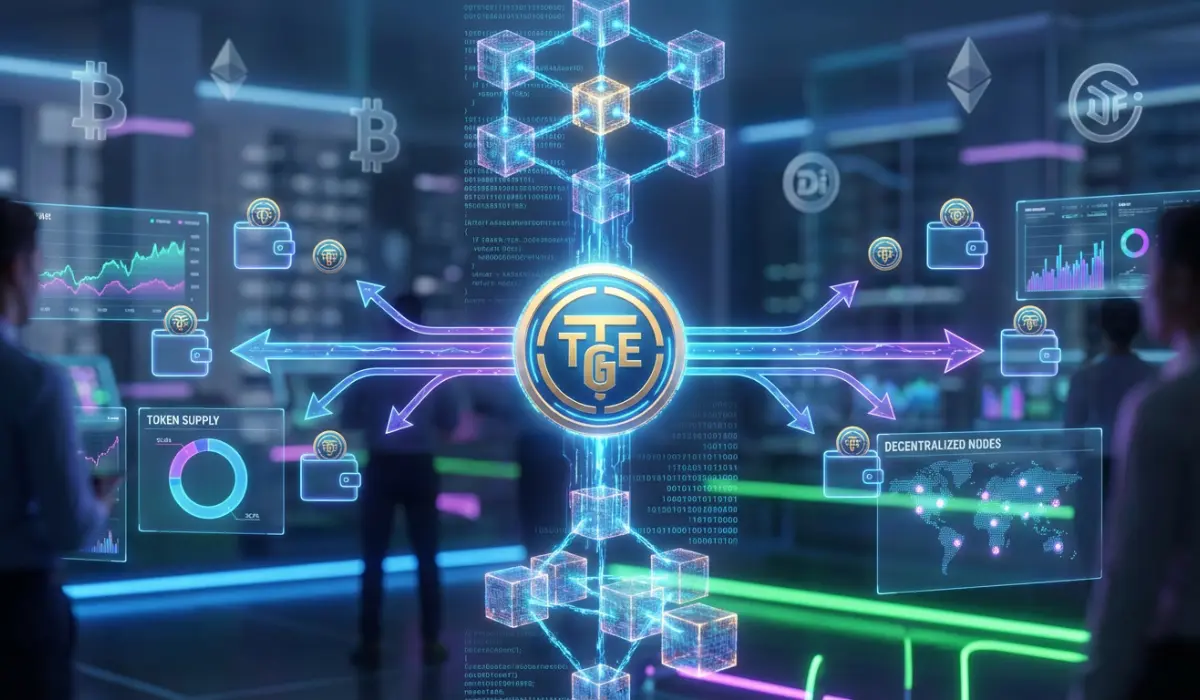
A Token Generation Event or TGE is a process of officially minting a new, native cryptocurrency token by a blockchain project and distributing it to the public and private investors, community members, and other stakeholders. These tokens are often utility tokens, intended for building a functional ecosystem for the project rather than a tool for investment.
TGEs are the key component for a broader token launch and are essential for all types of token sales, including the crypto pre-sales.
Key Purposes
- Aligning Stakeholders: TGEs provide a structured way to align stakeholders (team, early backers, community) with clear allocations and a vesting schedule.
- Community Building: TGE builds an early foundation for the token holders and the economy by incentivising them to support the growth of the crypto project.
- Utility Activation: TGE introduces the token’s functionality to the market, such as voting rights, staking rewards, or access to specific products and services.
- Decentralization: By distributing tokens among many users, TGE ensures that no single entity controls the network, enhancing the stability and security of the token.
- Enhancing Market Visibility: TGE generates significant media attention and marketing buzz, thus boosting the token’s visibility to potential users and investors.
- Fundraising and Capital Generation: TGE enables startups to bypass traditional financing and access global capital rather than securing funds from the limited local or private networks.
- Building Initial Liquidity: It establishes a market for the token, allowing it to be traded in decentralized (DEX) and centralized (CEX) exchanges, often by bootstrapping the market.
Initial Coin Offering (ICO) vs Token Generation Event (TGE)
Initial Coin Offering (ICO) has traditionally been the crowdfunding method for a blockchain project, where young crypto projects sell their tokens to investors and traders in order to raise capital, usually when the platform is yet to fully develop. The tokens are bought by the investors in exchange for cryptocurrency or fiat, with the expectation that the token will gain value and provide utility once the project launches.
Whereas a TGE focuses on the creation and distribution of tokens within a functioning ecosystem, not for early-stage projects. It occurs after the initial fundraising phases or developmental milestones, marking the official creation and distribution of tokens to investors, team members, and the community. Rather than solely raising the capital, the main goal of a TGE is to activate the token’s utility within the ecosystem.
The Regulatory Benefits of TGE
Because of the key difference in the goals, ICO carries higher risks compared to TGE. Since ICOs involve investing in a project that is not yet operational or fully developed, they have faced significant scrutiny across the world due to concerns regarding fraudulent activities in the digital sphere. While TGE can pass such risks as a mature entity, since it has a lesser direct involvement in fundraising.
Because of this reason, TGE is more preferred in the US to emphasize the utility of tokens over speculative investment, and to stay on better terms with the SEC. Since TGE’s separate fundraising process from the token generation process ensures transparency and compliance with the regulatory frameworks, which determines whether a token is an economic infrastructure or a speculative asset.
The Launching Strategy
A TGE event does not happen in a vacuum. For a TGE to occur, specific vehicles or channels are used by the projects to distribute the tokens. In the modern financial landscape, Launchpads and Airdrops are the two primary pillars of a launch strategy.
Crypto Launchpad: The Gatekeepers
Instead of launching on their own website, most projects today partner with launchpads. These are specialized platforms that vet projects and provide an organized environment for the TGE. They can be decentralized or centralized.
- Leading launchpads like Binance Launchpad, DAO Maker, or Polkastarter are great at evaluating a project through a deep due diligence process. They conduct a thorough investigation to identify potential risks, verify information, and ensure that the project is viable, credible, and suitable for the organization’s goals. For an investor, a launchpad often becomes a seal of approval.
- They often require investors to stake the launchpad’s own native tokens. This is beneficial for the most loyal community members to get a guaranteed allocation of the new project’s tokens.
- Launchpads provides a technical infrastructure that handles the smart contract deployment and distribution mechanics of TGE, enabling the project team to concentrate on the project development.
- Many launchpads provide listing support for the project by clearing a direct path to the exchanges immediately after the TGE. This ensures a home for the token to trade as soon as it is born.
Airdrops: Earning Your Way into TGE
Airdrops have significantly evolved from free money to strategic reward systems. Many modern TGEs often use airdrops to distribute a massive portion of their supply to the people who actually used the protocol’s testnet or mainnet before the token existed, thus ensuring a usage-based distribution. With this massive distribution, the projects also ensure a trading base for the token.
Sending tokens to thousands of users simultaneously prevents whales from hoarding the initial supply, which is crucial for decentralised authority, healthy governance, and security. Also, the standard airdrops require users to perform specific tasks, like following social media pages or posting about the event, creating a massive buzz, and FOMO around the token, boosting its visibility.
The Final Pillars of a Successful TGE
Even though a token’s birth is marked at a TGE, two key factors influence its long-term survival by bridging the gap between the technical event and the market-ready asset. They include:
- Security through Audits: Before the minting process, the smart contract, which is the technical blueprint of the TGE, should be under rigorous evaluation to ensure that the minting and distributing functions are free of risks. It is conducted using third parties (firms like CertiK or Hacken), ensuring the user’s safety as well as the project’s reputation.
- Exchange Listing: Until the liquidity pools are officially seeded, TGE is a process of generation, where the tokens are merely being created in the blockchain. Only after the token hits a DEX or CEX for listing will it be alive in the market.
The Accountability Shift: From Paper to Proof
With TGE, the crypto project gained more value as it transitioned into an officially established circulating digital asset from a mere theoretical framework, which was valued based on a whitepaper rather than the team’s reputation.
With a TGE, a token enters exchanges, availing ‘entry points’ for the general public and ‘exit liquidity’ for early users. Also, now that the token has a market cap and a live ticker, every development update or missed deadline will be reflected in the price in real-time, thus locking the token with accountability.
FAQ
While they seem functionally similar, a TGE is a broader term that focuses on the technical creation and utility building. Whereas an ICO is usually focused on fundraising only, which makes it riskier, forcing the market to evolve towards TGE.
To participate in a TGE, the user must have a compatible digital wallet and should be verified through KYC to ensure that they meet the legal residency requirements. Once cleared, the user can exchange established cryptocurrencies like ETH or USDC for the new project tokens at a set rate.
During a TGE, the price volatility will be extremely high, as the market is discovering the token for the first time. Initial introductions with a lack of liquidity can result in aggressive price fluctuations in either direction.
Vesting schedules can protect the project’s long-term stability by restricting the development team and the early backers from selling off their tokens all at once. This locking period conveys the commitment of the founders toward the project’s sustained growth.


