

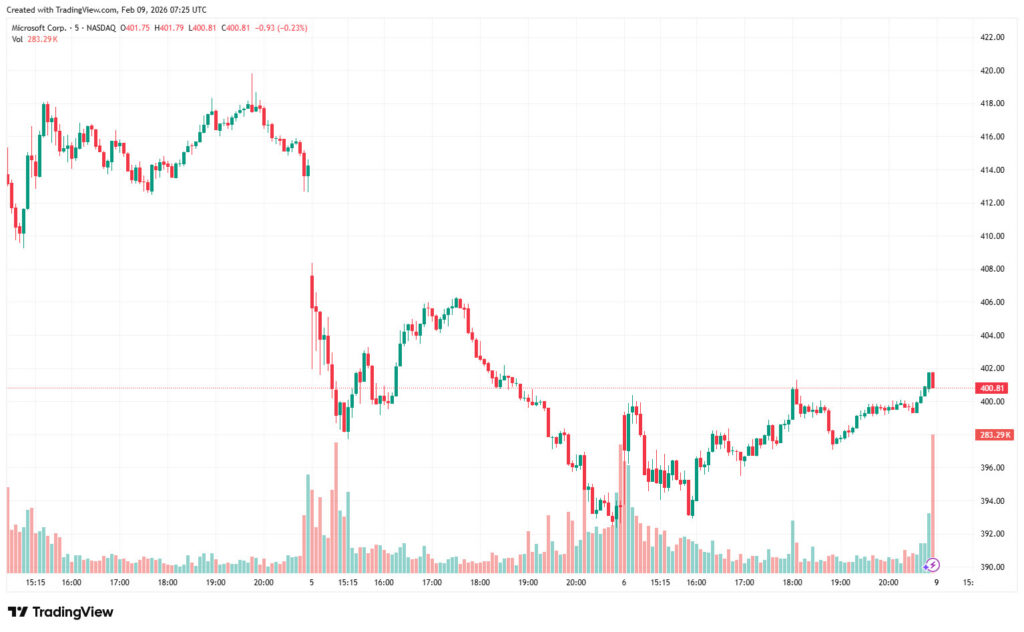
Microsoft Corporation (MSFT) shares closed at $401.14 on February 6, up $7.47 or 1.90%, before rising another 1.21% to $405.99 in overnight trading as investors weighed whether the stock remains a compelling long-term buy. Microsoft (MSFT) had earlier made a decisive platform-level move that blends cybersecurity, operating system efficiency, and long-term financial strategy. From January 15, 2026, Windows 11 officially blocked new installations of legacy v3 and v4 print drivers, accelerating a transition that has been signaled for years.
While the change is technical on the surface, its implications ripple across enterprise IT departments, small businesses, and investors tracking MSFT stock, which was trading at $401.14 in recent sessions.
What’s Changing in Windows 11
Under the new enforcement phase, Windows 11 no longer accepts traditional v3 and v4 Drivers through Windows Update or standard submission channels such as WHQL / Attestation. Instead, Microsoft is mandating modern, driverless printing built around Mopria (IPP) and the Internet Printing Protocol (IPP).
This means older multifunction printers (MFPs), common in small offices and professional home setups, will lose automatic driver delivery unless vendors migrate to IPP-based solutions. Existing installations may continue to function temporarily, but new deployments and clean installs will be blocked.
For enterprise IT admins, this marks a clear deadline to audit printer fleets. For small business owners, especially in the US “prosumer” segment, it may translate into unexpected hardware refresh costs.
The Security “Why”: PrintNightmare Still Looms
Microsoft’s justification is rooted in security. Legacy print drivers operate deep in the Windows kernel, making them a prime target for exploitation. The infamous PrintNightmare vulnerability demonstrated how attackers could escalate privileges using the Windows Print Spooler, turning printers into an enterprise-wide threat vector.
According to Microsoft, v3 and v4 Drivers were the primary attack surface exploited during PrintNightmare, and maintaining backward compatibility has prolonged kernel-level risk. By enforcing IPP-based printing via Mopria, Windows 11 shifts printer logic out of the kernel and into user-mode services, dramatically reducing exploit potential. In short: fewer drivers, less kernel code, smaller attack surface.
The impact will be felt most acutely by Enterprise IT administrators, who must ensure vendor compliance and avoid print outages. Small and mid-sized businesses, many of which rely on aging MFPs that may never receive IPP firmware updates. In prosumer offices, where “it just works,” Windows Update printing has been the norm. Microsoft has been clear that the transition timeline is fixed, with January 15, 2026, marking Phase 2 enforcement, not a soft recommendation.
MSFT Stock: What’s Ahead?
From a market perspective, this is about more than printers. With a market cap of $2.98 trillion, Microsoft is under pressure to streamline legacy components while ramping spending on Azure, AI infrastructure, and Copilot-driven services.
Investors increasingly view the removal of old print code as technical debt reduction, a way to improve operating system margins and long-term maintainability. In an environment where peers like Nvidia dominate AI hardware narratives, and Meta leans heavily into AI platforms, Microsoft’s strategy is to tighten its core OS while reallocating engineering resources toward higher-growth segments.
At $401.14, MSFT stock reflects expectations that Windows becomes leaner, more secure, and cheaper to maintain, freeing capital and talent for AI monetization.
Windows 11 halting legacy print drivers is a security-first, margin-aware decision that underscores Microsoft’s broader shift away from backward compatibility at all costs. For IT admins and small businesses, the message is clear: audit your printers now. For investors, it’s another signal that Microsoft is pruning low-value legacy systems to focus on AI-driven growth. This isn’t just a print policy change; it’s a strategic reset. Moreover, Microsoft reported revenue of $81.3 billion, representing a 17% year-over-year increase, or 15% growth on a constant-currency basis.


