

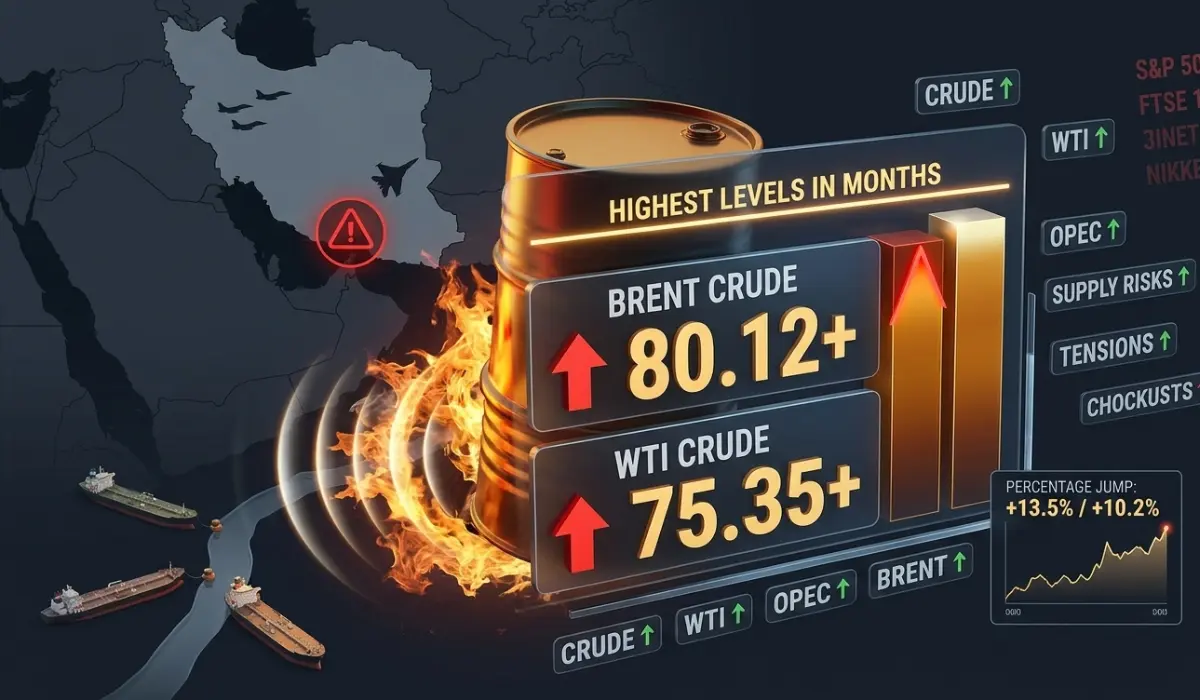
Global energy markets were thrown into a state of intense volatility on Monday as oil prices surged in response to a dramatic military escalation between the United States and Iran.
Traders are pricing in a significant “war premium” following Operation Epic Fury, a series of coordinated U.S. and Israeli military strikes that have left the world’s most critical energy chokepoint, the Strait of Hormuz, in a state of paralysis.
Oil Futures Soar Amid U.S.–Iran Conflict and Hormuz Blockade
As the first full trading session of the week opened, the impact was immediate and severe. Brent Crude, the international benchmark, spiked as much as 13% in early trading, hitting a 14-month high of $82 per barrel before settling near the $79 mark. Simultaneously, West Texas Intermediate (WTI) surged over 8%, trading near $72.60 per barrel.
The shockwaves extended beyond crude oil; European natural gas prices soared by 28% amid fears of a prolonged supply disruption, and U.S. analysts warned that domestic gasoline prices are on a trajectory to exceed $3.00 per gallon.
The primary driver of this market panic is the operational status of the Strait of Hormuz. While a formal blockade has not been declared, the Iranian Revolutionary Guard Corps (IRGC) has issued aggressive warnings to commercial vessels, resulting in what maritime experts describe as an effective closure. Ship-tracking data currently indicates that tanker traffic through the 21-mile-wide waterway has plummeted by approximately 70%. Hundreds of oil tankers and Liquefied Natural Gas (LNG) carriers are reportedly anchored outside the strait, awaiting security clearances.
The stakes for the global economy are immense. Roughly 20 million barrels of oil per day — representing 20% of global consumption — and 20% of the world’s LNG supply transit the Persian Gulf. With maritime insurance premiums jumping by 50% overnight and some providers canceling “war risk” coverage entirely, the cost of moving energy from the Middle East to markets in Asia and Europe has become prohibitively expensive and physically dangerous.
OPEC+ Hikes April Output by 206K Barrels to Combat Gulf Blockade
The geopolitical catalysts for this crisis were established over a violent weekend. On February 28, the U.S. military launched Operation Epic Fury, targeting Iranian command centers and nuclear infrastructure. The operation, confirmed by President Donald Trump as a preemptive measure to neutralize long-term threats, resulted in unprecedented internal chaos in Tehran. Iranian state media has since confirmed the death of Supreme Leader Ayatollah Ali Khamenei during the strikes. In retaliation, Iran launched missile barrages at U.S. installations across the region, including bases in the United Arab Emirates, Qatar, and Bahrain.
In a bid to stave off a global recession, eight OPEC+ countries, including Saudi Arabia and Russia, held an emergency meeting on Sunday. The group agreed to increase production by 206,000 barrels per day starting in April. However, market analysts remain skeptical of the move’s efficacy.
One senior energy economist argued that the issue is not a lack of oil in the ground, but the inability to move it out of the Gulf. They added that until the U.S. Navy’s 5th Fleet can guarantee a safe passage through the Strait of Hormuz for commercial shipping, including oil tankers, OPEC’s extra barrels are “effectively trapped.”
The 5th Fleet, headquartered in Bahrain, oversees a vast area including the Persian Gulf, Gulf of Oman, and Strait of Hormuz. It conducts patrols, deters threats like Iranian seizures of vessels, and supports the free flow of commerce through the critical global chokepoint.
The market now braces for two possibilities. If the U.S. naval escorts can quickly restore the flow of traffic in the Strait, prices may stabilize in the $80 range; however, if the IRGC maintains its stance and physical damage is reported at Saudi or Iraqi refineries, analysts warn of a triple-digit oil price scenario, where it could rapidly climb toward the $150 per barrel mark.
For the time being, the world remains on the edge, watching the events unfolding in the Persian Gulf to anticipate the next move in a conflict that has fundamentally reshaped the global energy landscape over the weekend.


