

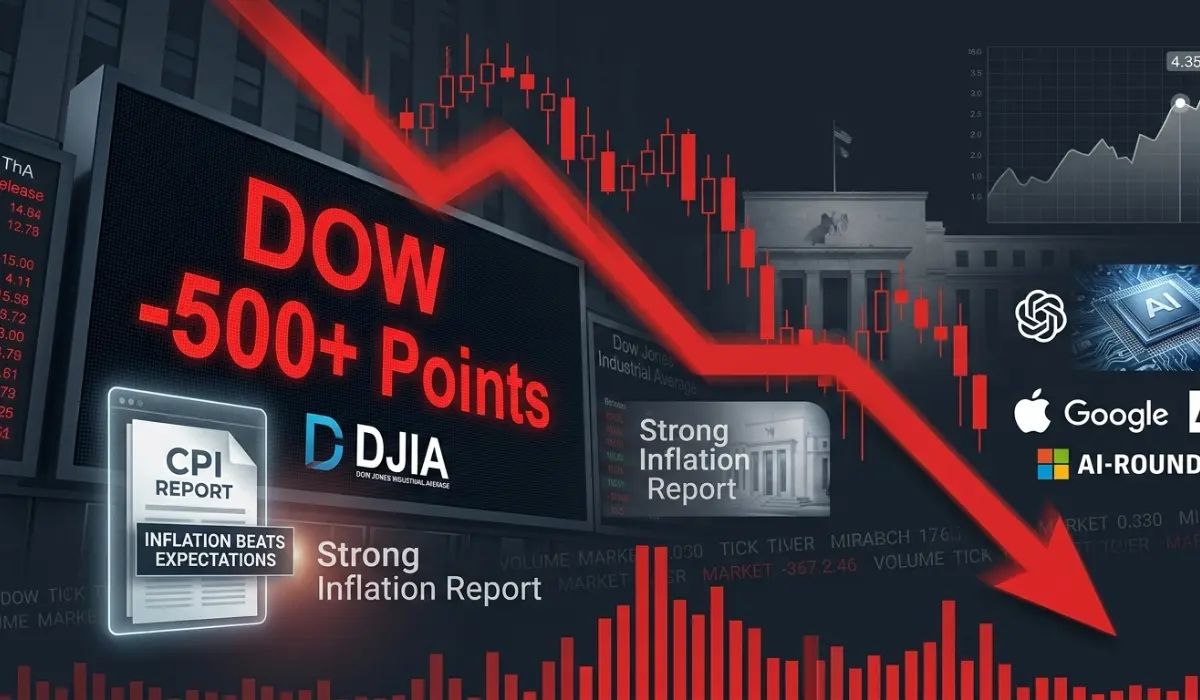
The U.S. stocks declined on February 28, 2026, followed by the U.S. Bureau of Labor Statistics (BLS) report of the latest Producer Price Index (PPI), which came in significantly higher than expected. The report added sticky inflation to a list of concerns that have caused recent market turbulence, including mounting fears about the artificial intelligence’s economic impact, which weighed on investors.
Markets Slide as Dow Drops Over 500 Points
The Dow Jones Industrial Average (DJI) led the way down with a drop of 521.28 points, lower 1.05%, to close at 48,977.92. Meanwhile, the S&P 500 and the Nasdaq Composite fell 0.43% and 0.92% to close at 6,878.88 and 22,668.21, respectively. Furthermore, the CBOE Volatility Index (VIX), often referred to as Wall Street’s ‘fear gauge’, rose 14% to 21.35, signaling an increased ‘fear,’ due to a sudden shift in market regime from complacency to caution.
The Dow barely stretched out a gain in February, keeping its nine-month winning streak intact, with the blue-chip index rising 0.17% for the month. At the same time, the S&P 500 and Nasdaq finished in the red amid the growing fears about the impact of artificial intelligence on specific industries and the broader economy. Exacerbating market fears, Jack Dorsey’s fintech company, Block Inc., said it would be laying off nearly half of its workforce, despite rising profits and increased share buybacks. Block’s shares surged nearly 20% after the structural changes.
The U.S. wholesale inflation level rose 2.9% in January on an annualized basis, which is much higher than the 1.6% estimates of the economists. Exports noted that the hotter-than-expected reading would persuade the Federal Reserve (the Fed) to hold off on rate cuts. As a result, there would be a risk of reduced liquidity in financial markets.
Big Tech Faces Rotation Out of High-Growth Names
Stocks linked to private credit were also under pressure, as investors anticipated that they could potentially suffer as a result of the UK mortgage provider Market Financial Solutions’ collapse. Apollo and Jefferies dropped more than 8% and 9%, respectively.
The software sector also had a volatile session, with Nvidia (NVDA) shares sliding 4.16% today, extended by a post-earnings slide as investors reassessed the company’s massive growth and current valuation. Likewise, Microsoft (MSFT) and Alphabet (GOOGL) are witnessing modest declines as the market rotates out of high-multiple growth names. Leading the Dow decline, financial stocks such as American Express (AXP) and Goldman Sachs (GS) fell 7.9% and 7.4%, respectively.
Dell Technologies (DELL) stood out as a rare winner, rising 21.93% to $148.08 due to strong AI server demand. The firm announced that its AI-optimized server backlog has reached a staggering $43 billion and further projected that AI-related revenue could double to $50 billion by fiscal 2027. Additionally, Paramount Skydance (PARA) gained 20.84% after clinching a $110 billion acquisition of Warner Bros. Discovery. At the same time, Warner Bros Discovery slipped 1.9%.
Netflix (NFLX) rose 8.6% after officially announcing it had withdrawn from its pursuit of Warner Bros. Discovery. Salesforce (CRM) rose 4%, following a strong fourth-quarter earnings beat and an optimistic outlook for its enterprise AI tools.
Energy markets witnessed a sharp move amid the geopolitical tensions. The U.S benchmark crude oil rose 3.2% to $67.27 per barrel, while Brent crude gained 3.1% to $73.04. However, the escalating tension between the United States and Iran has elevated fears that any conflict could disrupt global oil supplies.
Investors Brace for Labor Market Cooldown
The yield on the 10-year Treasury hovered near 3.97%. It briefly swiveled higher following the inflation report, yet it is down from its 4.02% level late Thursday. Treasury yields often fell when nervousness is high, and investors are moving into safer investments or assets.
In the meantime, the market is closely awaiting the February employment report scheduled for release next Friday, March 6th. Analysts are expecting the job growth to moderate to approximately 65,000 positions. Geopolitical risks will also pose as a wildcard.


