


The terms “bull” and “bear” refer to market conditions that are rising or falling over time, respectively. A bull market represents a period of rising stock prices that is marked by high investor confidence, optimism, and economic growth. On the other hand, a bear market signifies a usually 20% or more decline in stock prices that is characterised by fear. Understanding these trends is essential for investors because they influence investment strategies and decisions, thereby helping navigate market cycles effectively. This article further discusses the key differences between bull and bear markets. So, keep reading to learn more.
Key Differences Between Bull And Bear Markets
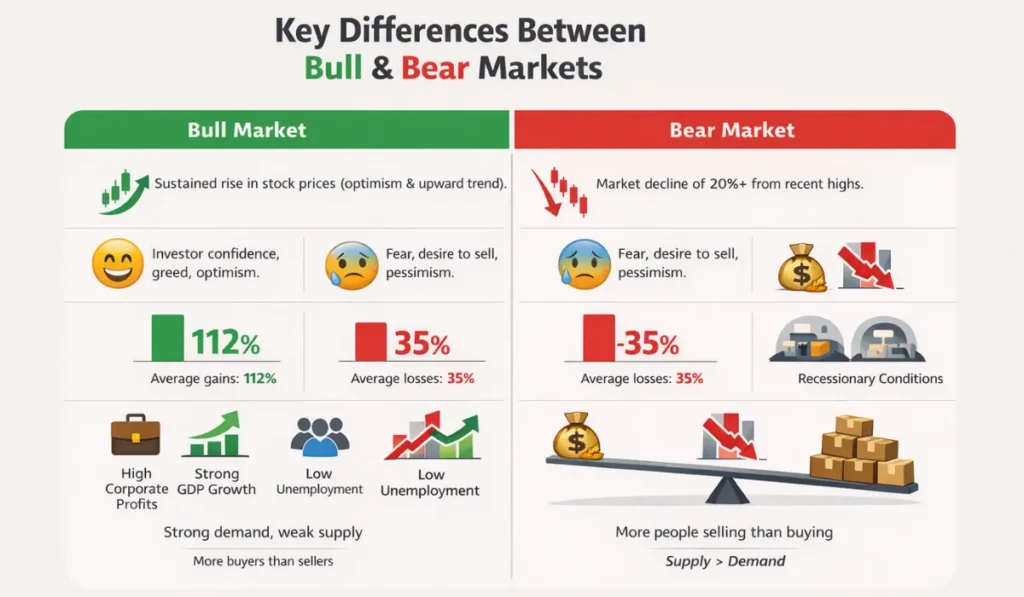
The key differences between bull and bear markets are:
- Bull markets are characterised by a sustained rise in stock prices, whereas bear markets are defined by a drop of 20% or more from recent highs.
- While bull markets are driven by investors’ confidence, greed, and optimism, bear markets are driven by fear, a desire to sell, and pessimism.
- Bull markets can see average gains of 112%, and bear markets average losses of 35%
- Bull markets thrive on high corporate profits, strong GDP growth, and low unemployment. On the other hand, bear markets are associated with high inflation, weak or failing GDP, and recessionary conditions.
- In a bull market, there would be strong demand and weak supply for securities, and in a bear market, more people are looking forward to selling than buying.
Economic Conditions That Drive Bull And Bear Markets
Strong economic indicators, favourable market conditions, and investor confidence are what often drive bull markets. Robust economic growth is the primary contributor. Monetary policies also play a key role in initiating and sustaining bull markets, as central banks carry out growth policies such as lowering interest rates. A lower interest rate helps reduce costs, along with encouraging consumers and businesses to take out loans for investment and spending. Additionally, psychological factors and market sentiment contribute to bull markets. Apart from this, technological changes, positive news cycles, and strong corporate earnings create a sense of optimism among investors. However, when more people enter the market and expect continued growth, this collective confidence ends up inflating asset prices.
As for bear markets, negative investor sentiment, economic downturns, and external shocks trigger them. Among them, a weakening economy contributes the most. Reduced consumer spending, rising unemployment rates, and declining GDP indicate that businesses will likely face slower growth and lower earnings. When investors anticipate decreased profitability, they may start selling off stocks. This can ultimately result in a decline in market prices. Tightening monetary policies can worsen the start of a bear market. Borrowing costs increase for customers and businesses when central banks increase interest rates to fight inflation. Other factors that spark bear markets include natural disasters, geopolitical crises, and pandemics. They can introduce risk and uncertainty while prompting investors to move their capital into safer assets like gold. However, this sudden shift away from equities can result in sharp declines in stock prices.
How Long Do Bull And Bear Markets Typically Last?
Bull markets are historically known to last longer than bear markets. It can also sometimes extend over a decade. Bear markets, on the other hand, are shorter, often lasting from a few months to a couple of years. Note that bear markets occur less frequently.
Investment Strategies For A Bull And Bear Market
Some of the investment strategies for a bull market include:
- Buy and hold – Investing early and holding for the duration of the market rise.
- Focus on companies that have high growth potential.
- Shift investments toward sectors that are expected to outperform, such as technology.
- Increase equity allocation, as stocks typically perform well.
- Regularly view and sell some positions to lock in gains.
Here are the investment strategies for a bear market:
- Shift to stocks with stable dividends, such as utilities, consumer staples, and healthcare.
- Invest fixed amounts regularly to purchase more shares at lower prices.
- Purchase only quality companies that are temporarily undervalued.
- Hold cash to take advantage of lower prices later.
- Spreading investments across different asset classes to help reduce risk.
- Invest in companies with a strong history of paying dividends for steady income.
How To Identify A Bull Or Bear Market Early
Identifying a bull or bear market early involves monitoring a 20% shift in index prices from recent highs/lows, analysing economic data, and gauging investor sentiment. Bull markets feature economic growth and rising confidence, whereas bear markets show fear and contraction. You can differentiate them early by analysing market behaviours. In bull markets, investors are willing to take risks and increase holdings to chase profits. On the contrary, in bear markets, investors panic, reducing risk and fleeing to safer assets to minimise losses.
Final Thoughts
The bull and bear markets describe long-term stock market trends based on investor sentiment and price movement. A bull market signifies rising prices, and a bear market indicates falling prices. Even though bear markets are challenging, they offer opportunities for long-term investors to purchase stocks at lower, discounted prices. Understand that both cycles are normal parts of the financial landscape. Learning about these cycles and their key differences can help investors manage risk, often by holding or buying in a bull market and exercising caution or diversifying during a bear market.


