

Risk management in the stock market is a critical process of identifying, assessing, and controlling potential losses in order to protect capital and balance risk with reward. Investors often use strategies such as diversification, stop loss orders, and position sizing to minimize the impact of volatility. This can help make informed decisions, ensuring long-term survival and profitability. Risk management is important for staying in the market by keeping losses small and manageable, rather than trying to avoid them entirely, and involves a systematic, disciplined approach to trading. This article further explains stock market risk management that every investor must know. So, keep reading to learn more.
Types Of Risk In The Stock Market
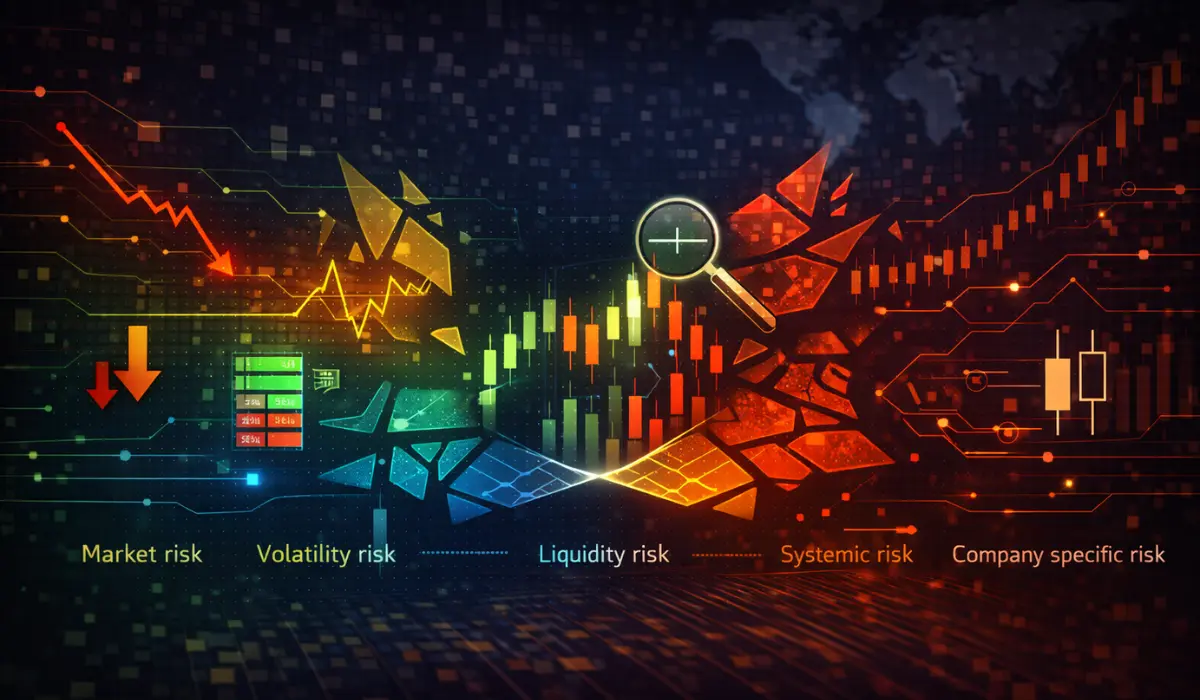
Indeed, trading can be exciting and even profitable, but there are certain types of risks investors should be aware of. Stock market risks include systematic risks (market-wide, uncontrollable, like recessions) and unsystematic risks (company-specific, like poor management). Key types include market, liquidity, interest rate, inflation, currency, and credit risks, which can be mitigated through diversification, research, and hedging. Systematic risk is the risk inherent to the entire market or market segment that cannot be diversified away. Unsystematic risk is the risk associated with a specific company or industry, which can be reduced through diversification. Other common investment risks include liquidity risk, credit or default risk, reinvestment risk, and operational risk.
Why Risk Management Is Essential For Every Investor
It is important for investors to incorporate risk management practices in order to prevent losses from getting out of control. Often, beginners fail not because their strategy is wrong, but because they end up ignoring the risks. Risk management matters to preserve capital and reduce emotional stress. Without money, one cannot trade, which is why it is crucial to protect the capital, as it represents future opportunity. Learning and being aware of the risk upfront can make it easier for investors to stay calm during volatility. Risk management also ensures consistency and improves decision-making. Having consistent risk per trade makes drawdowns manageable and returns more stable. When risk is under control, emotions such as fear and greed will have less influence on decision-making.
Understanding Risk Tolerance And Investor Profile
Risk tolerance is the degree of volatility or potential loss an investor is willing to accept for higher returns. It is influenced by both emotional comfort and financial capacity. It is a core component of an investor profile, balancing age, time horizon, income, and goals to determine appropriate asset allocation. Risk tolerance is your emotional ability to handle market volatility and your financial ability to bear losses without impacting your lifestyle. As for investor profiles and risk tolerance levels, there are three levels:
- Conservative – Prioritizes capital preservation over high returns, prefers fixed income, cash, or bonds.
- Moderate – Seeks a balance between growth and safety, prefers a mix of stocks and bonds.
- Aggressive – Willing to accept high volatility and potential losses for maximum long-term growth. Investors would be heavily invested in equities.
Key Risk Management Strategies In Stock Market Investing
Diversification
Diversification- the first and one of the most important strategies. Spreading your investments across several stocks, asset classes, sectors, and industries can help reduce the adverse effects of a single poor-performing stock or market changes that affect other better-performing stocks.
Stop loss orders
Stop loss orders can help set a price level at which an investor can sell stock to limit losses. In case the stock price hits or drops below this level, the order would be executed automatically, leading to no further losses.
Position sizing
It is important to allot appropriate position sizing because risking too much capital on one trade can cause significant losses.
Allocating risk capital
Allocating a portion of the capital as risk capital is crucial, as it represents the money one is willing to risk in stock while keeping the rest in safer investments. By limiting risk capital exposure, one can avoid significant losses and maintain financial stability.
Managing portfolio actively
Managing a portfolio actively by monitoring and adjusting the portfolio to changing market conditions helps evaluate market trends, company performance, and economic indicators to make better, informed decisions.
Research and analysis
Conducting thorough research and analysis is crucial to making informed trading decisions. It is advised to study market trends, company fundamentals, financial statements, technical indicators, and news. Doing so can help make wiser choices and combat unexpected losses.
Hedging
Hedging utilizes financial tools, such as options or futures, to balance potential losses.
Risk-reward ratio
Evaluating the risk-to-reward ratio can help weigh potential gains against losses with each trade. A good ratio indicates that potential rewards outweigh risks.
Common Risk Management Mistakes Investors Make
One of the common mistakes investors make is being overconfident in specific stocks or sectors. Relying heavily on one stock or sector ends up increasing vulnerability to downturns. Ignoring the importance of stop-loss orders can make things go south. Failing to use stop-loss orders often leads to significant losses, especially in volatile markets. Not adjusting strategies as market conditions change can be a huge mistake. Other common risk management mistakes investors make include acting on emotion, failing to rebalance, and ignoring risk tolerance.
Final Thoughts
Risk management happens to be the foundation of successful trading. Having a proper strategy can help protect capital, stabilize performance, and allow to perform consistently. The primary goal of risk management is to avoid major losses that prevent future trading, thereby prioritizing survival over high returns. By implementing proper techniques, investors and traders can navigate market volatility and maintain a healthier financial outlook.


