

Costco Wholesale Corporation is back in focus as U.S. markets reopen after the MLK Day holiday. The warehouse club leader enters 2026 with enviable fundamentals, but also with a valuation that has become increasingly difficult to ignore. Costco Wholesale Corporation (COST) closed Friday at $963.61, up 0.72%. Costco shares are up roughly 166% over the past five years.
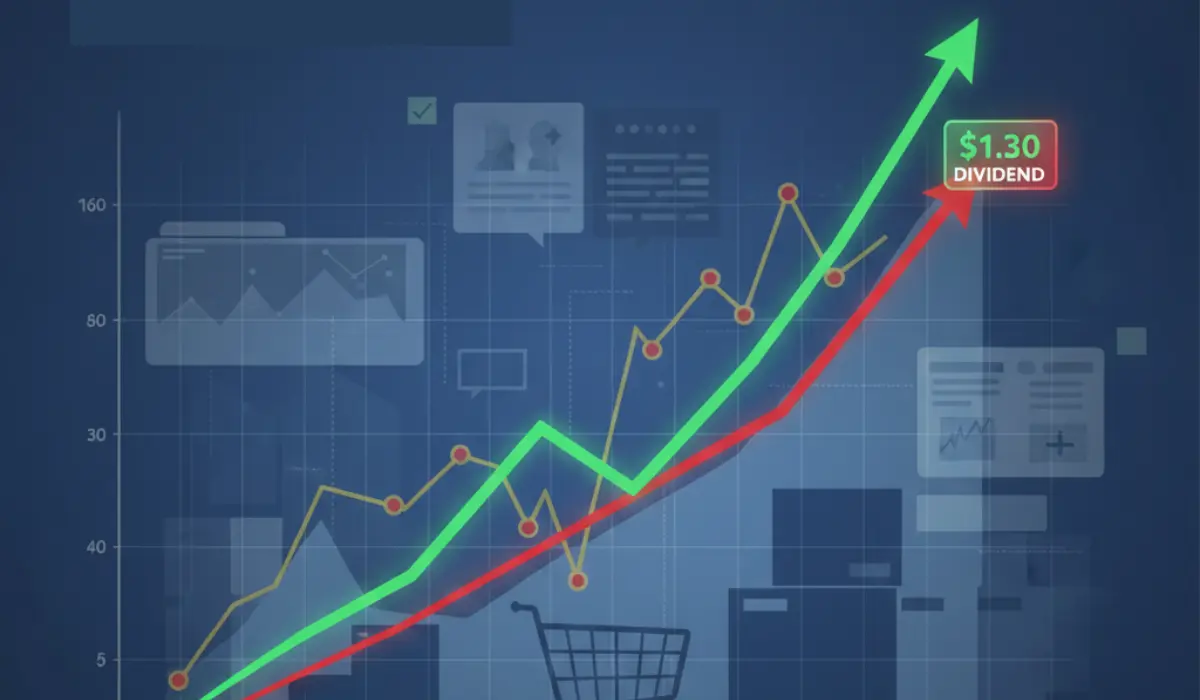
Last week, Costco Wholesale Corporation announced a Quarterly Cash Dividend of $1.30 per share, payable on February 13, 2026, to shareholders of record as of January 30, 2026. For income-focused investors, the headline number matters: the payout translates to an annualized $5.20 per share, or a yield of roughly 0.5% at the current stock price of about $963. While modest, the dividend reinforces Costco’s reputation for shareholder discipline, especially when paired with its history of large special dividends, including the $15 per share payout in 2024 that many long-term U.S. investors still cite as a benchmark.
Earnings Growth Outpaces Big-Box Peers
Beyond the dividend, operating performance remains strong. In December, Comparable Sales (Comps) rose 7.0%, underscoring the resilience of Costco’s membership-driven model and its exceptionally loyal customer base. E-commerce increased 18.9%, a granular data point often missed in surface-level coverage but critical for understanding how Costco is competing in the evolving warehouse club space. The digital surge was aided by stronger same-day delivery and a new incentive: 5% gas rewards on branded credit cards.
Financially, Earnings Per Share (EPS) growth continues to track ahead of peers like Target (TGT) and Walmart (WMT), supported by scale advantages and disciplined pricing. Millerchip noted that the company is balancing margin pressure with volume gains, a strategy that has helped Costco defend share even as consumers remain value-conscious in early 2026.
Costco currently operates 923 warehouses worldwide, including 633 locations in the United States and Puerto Rico, 114 in Canada, 42 in Mexico, 37 in Japan, 29 in the United Kingdom, 20 in Korea, 15 in Australia, 14 in Taiwan, seven in China, five in Spain, three in France, two in Sweden, and one each in Iceland and New Zealand, while also running e-commerce operations in the U.S., Canada, the U.K., Mexico, Korea, Taiwan, Japan, and Australia.
Valuation Becomes the Central Question
The real debate, however, centers on valuation. Costco (COST) currently trades at a Price-to-Earnings (P/E) ratio near 51x, or roughly 51.5x forward earnings. That multiple is well above Costco’s own 10-year median near 36x and significantly richer than Walmart’s roughly 40x P/E or Target’s much lower 13x. Some analysts argue the stock is now “priced to perfection,” leaving little margin for error if growth cools or macro conditions worsen.
Supporters counter that the premium is justified. The Bull Case rests on Costco’s high membership renewal rate, accelerating Digital Sales growth, and a balance sheet that allows for both regular dividends and the potential for future special payouts. A Discounted Cash Flow (DCF) framework often shows Costco fairly valued if high-single-digit growth persists for several years.
The Bear Case, by contrast, focuses squarely on expectations. At 51x earnings, even minor disappointments in Comparable Sales (Comps) or EPS could trigger volatility, especially as markets digest post–MLK Day positioning and reassess consumer stocks relative to high-growth sectors.
For now, Costco Wholesale Corporation remains one of the highest-quality names in U.S. retail. As of January 20, 2026, Costco’s fundamentals remain solid, but the valuation leaves little room for complacency.


