

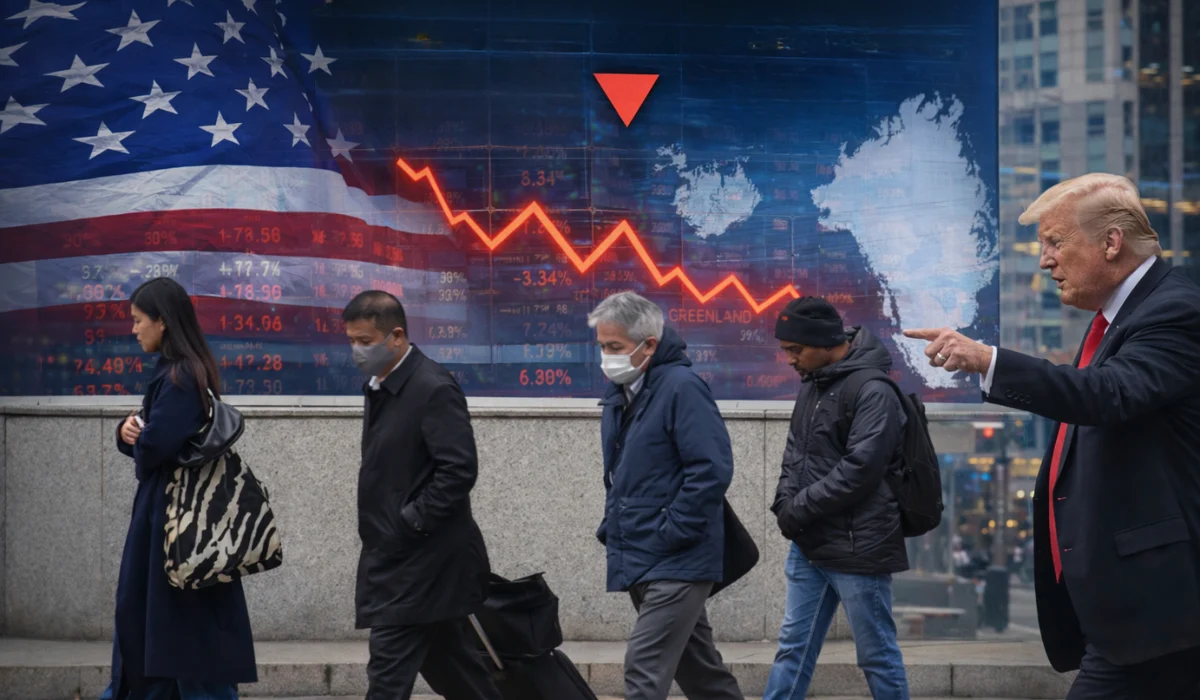
U.S. stock futures slid sharply early Tuesday as investors digested the escalation in transatlantic tensions, after President Donald Trump threatened sweeping tariffs on key allies unless they support Washington’s push to secure Greenland for U.S. national security interests. The prospect of a trade war rooted in territorial ambition rather than traditional trade imbalances pushed markets decisively into risk-off mode.
At the latest check, Mini Dow Jones Industrial Average futures (YM=F) were down 737 points, or 1.49%, at 48,810, while E-Mini S&P 500 futures (ES=F) fell 108.25 points, or 1.55%, to 6,868.50, underscoring broad weakness at the market open. Nasdaq 100 futures (NQ=F) were down 499 points, or 1.94%, at 25,190. The sell-off underscores growing concern that Trump’s tariff threat could evolve into a broader transatlantic trade war.
Greenland Dispute Drives Geopolitical Shock
The renewed volatility follows comments from Donald Trump linking potential tariffs, starting at 10% on February 1 and escalating to 25% by June 1, to Denmark’s refusal to negotiate over Greenland, an autonomous territory under Danish sovereignty. Trump framed Greenland as critical to U.S. defense infrastructure, including the “Golden Dome” missile defense system, intensifying fears that economic pressure is being used as leverage for territorial acquisition.
The United States has argued that Greenland’s strategic Arctic location is essential for long-term security planning, but Denmark has repeatedly rejected any suggestion of a sale, calling the territory non-negotiable.
The geopolitical tensions continue to escalate between the U.S and European countries. In his latest post on Truth Social, Donald Trump stated that the United Kingdom was planning to transfer control of Diego Garcia, the site of a major U.S. military base, to Mauritius, calling the move unnecessary and a serious national security mistake.
Trump argued that the decision would be viewed as a sign of weakness by China and Russia, which he said respond only to displays of strength. He claimed that, under his leadership, the United States had regained global respect within a year.
“The UK giving away extremely important land is an act of GREAT STUPIDITY, and is another in a very long line of National Security reasons why Greenland has to be acquired. Denmark and its European Allies have to DO THE RIGHT THING.” He added in a Truth Social post published today.
European Markets Tumble as Leaders Push Back
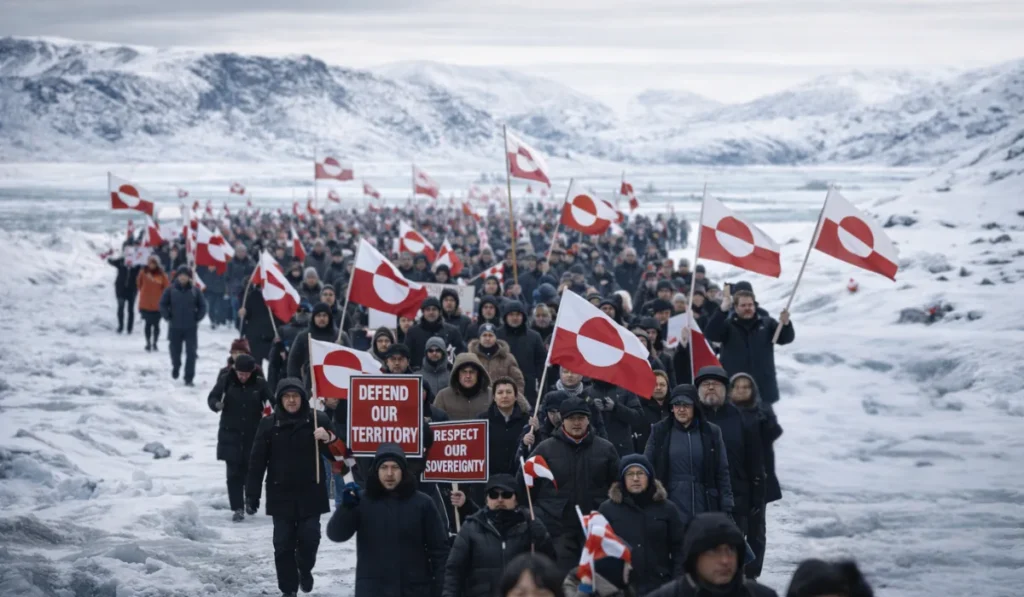
European equities mirrored the sharp downturn in U.S. futures. At the latest check, Europe’s major benchmarks were lower, with the FTSE 100 down 118.96 points, or 1.17%, at 10,076.39, while France’s CAC 40 fell 87.53 points, or 1.08%, to 8,024.49, in early trading.
Political leaders responded forcefully. UK Prime Minister Keir Starmer warned that trade coercion tied to territorial disputes sets a dangerous precedent. The European Union (EU) said it is reportedly preparing up to €93 billion ($107 billion) in retaliatory tariffs if Washington follows through, raising fears of a prolonged standoff that could disrupt U.S.–Europe trade corridors.
The dispute has also placed strain on NATO, as allies worry that economic threats between members could undermine political cohesion at a time of heightened global tensions.
Risk aversion drove investors toward traditional safe havens. Gold reached $4,689.39 per ounce on Monday. Meanwhile, crude oil prices, including WTI and Brent, slipped. At the latest check, WTI crude was down 20 cents, or 0.34%, at $59.14 a barrel, while Brent crude slipped 16 cents, or 0.25%, to $63.83.
What Investors are Watching Next
Traders are now watching for diplomatic signals from Washington, including any role played by Vice President J.D. Vance in easing tensions. Attention is also turning to the Federal Reserve, as investors assess whether worsening financial conditions could influence the central bank’s policy outlook.
For now, U.S. futures sink as Wall Street grapples with a rare fusion of geopolitics and economic policy, one that could keep volatility elevated well beyond the opening bell.


