

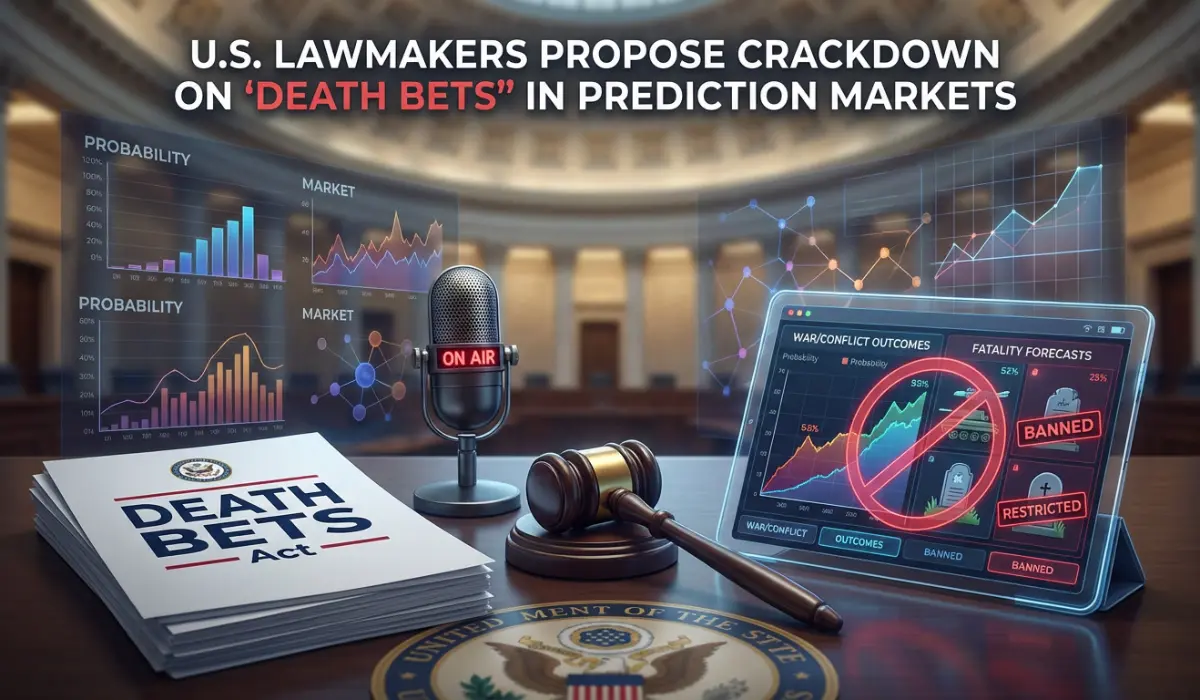
A coalition of U.S. Democrats has introduced the “Discouraging Exploitative Assassination, Tragedy, and Harm Betting in Event Trading Systems Act”, or the DEATH BETS Act, aimed at codifying a blanket ban on prediction market contracts that allow wagers on war, death, and assassination.
The move comes following controversies over well-timed bets on platforms like Polymarket and Kalshi, specifically wagers that profited from U.S.-Israeli airstrikes on Iran.
Democrats Move to Ban “Death Bets” in Prediction Markets
The bicameral bill unveiled by Representative Mike Levin and Senator Adam Schiff on Tuesday seeks to amend the Commodity Exchange Act to explicitly prohibit any entity registered with the U.S. Commodity Futures Trading Commission (CFTC) from listing contracts that involve, relate to, or reference terrorism, assassination of public figures, war, or specific military operations, or individual deaths.
In a statement, Rep. Levin highlighted that over $500 million was wagered on the timing of U.S. military strikes on Iran alone, which he called “unacceptable.” The landmark bill arrives as prediction markets face backlash over featuring contracts tied to geopolitical conflicts, political violence, and the fate of world leaders.
Under current law, the CFTC has discretion to prohibit such contracts only if it determines they run contrary to the public interest. But the DEATH BETS Act would remove that discretion entirely, codifying the ban into the Commodity Futures Act regardless of which administration heads the agency.
Last month, Sen. Schiff sent a letter to CFTC Chairman Michael Selig urging him to “clearly reiterate” that his agency would prohibit any contracts that resolve upon or closely correlate to an individual’s death. The letter was co-signed by Democratic Senators Catherine Cortez Masto, Richard Blumenthal, Cory Booker, Tim Kaine, and Jack Rosen.
“These contracts present dangerous national security risks, including creating incentives to incite violence, foment geopolitical conflicts, and disclose classified information,” wrote the lawmakers.
The letter cited two Polymarket bets; one on whether Venezuela’s Nicolas Mauro would be removed from power, which netted one trader more than $400,000 after US forces captured the former President in January, and the other on Russia capturing the Ukrainian town of Myrnohad, where bettors reportedly earned upwards of 33,000%.
Last week, Polymarket pulled a controversial market that had asked traders to bet on whether a nuclear weapon would be detonated this year. The move came after the contract, titled “Nuclear weapon detonation by…”, drew widespread backlash across social media.
It attracted more than $838,000 in trading volume on the marketplace, with contracts tied to several timelines, including March 31, June 30, and before 2027. Before archiving, Polymarket shared an X post suggesting a 22% probability of a nuclear weapon detonating by the end of the year.
Iranian Strike Wagers Spark Insider Trading Controversy
Prediction markets have become vehicles for insider trading. Hours before the U.S. and Israel hit Iran, more than 150 Polymarket accounts placed four-figure bets correctly predicting a strike by the following day. According to an analysis made by The New York Times using the platform’s trading data, those accounts netted around $855,000 in a late surge. Meanwhile, another trader under the username “Magamyman” profited over $533,000 betting on the airstrike and the fate of Iran’s former Supreme Leader, Ayatollah Ali Khamenei.
Rival exchange Kalshi also faced similar controversy after an event betting on the removal of Khamenei drew more than $54 million in trading volume. The exchange even invoked a “death carveout” clause to settle positions at the last traded price rather than paying out in full after his death was confirmed on March 1, 2026. He was killed in an operation targeting high-ranking military and government officials.
Kalshi is facing a class-action lawsuit over its handling of the contract, with plaintiffs accusing the platform of shortchanging winning bets by applying the clause that prevented the market from resolving with a full payout following Khamenei’s death.
While speaking at the FIA Global Cleared Markets Conference in Boca Raton, Florida, CFTC Chair Selig announced that he has directed agency staff to draft guidance on how event contracts may be listed and traded. He said the Commission would launch the proposed rulemaking in advance to seek public comment.


