

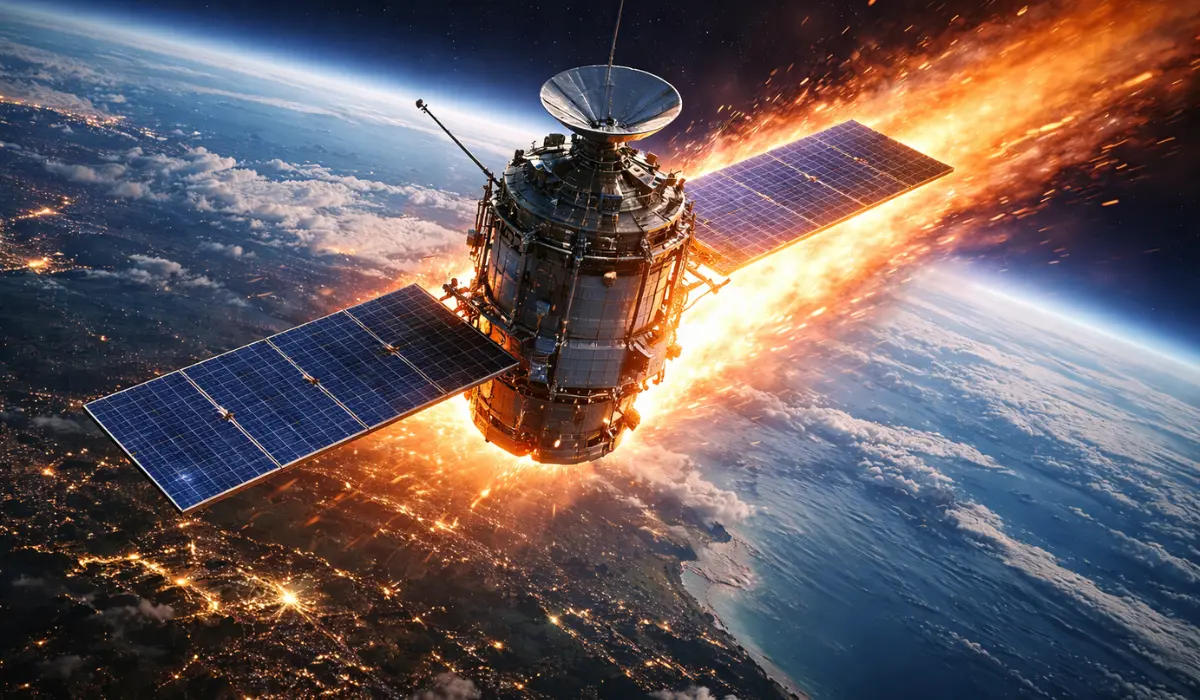
NASA’s 14-year-running satellite Van Allen Probe A, launched in August 2012, is set to return to Earth in the next few hours. The 1,323-pound spacecraft’s unmediated reentry into Earth’s atmosphere has raised concerns among the populace. According to the U.S. Space Force, the satellite was expected to hit the Earth on Tuesday, March 10, at 7:45 p.m. EDT. Hours later, current reports suggest that the Van Allen Probe A is still a few hours away from visible descent.
The probe was scheduled to lose its orbit and fall back to Earth by 2034. Its premature return is a sign of intensifying solar activity and its impact on orbital infrastructure. NASA’s calculations report a 1:4200 chance of the satellite’s reentry causing any significant casualties.
Legacy of the Radiation Belt Storm Probes
Van Allen Probe A is part of the two Van Allen Probes (A & B), launched on August 30, 2012, as part of NASA’s two-year mission to explore the Van Allen belts, Earth’s two permanent radiation belts shielding the planet from cosmic radiation and solar storms. The mission was later extended to seven years after the probes made several valuable discoveries about the belts, including the existence of a third transient radiation belt, which can form as a result of intense solar activity.
The belts are notorious for their intense radiation, potentially fatal to astronauts who voyage there. Understanding them is crucial to comprehending the dynamics of space weather. The Van Allen Probes have proved beneficial in understanding solar activity to better predict its impact on satellites, space travel, as well as the communications, navigation, and power grids right here on Earth, which are inherently connected to satellite activity.
The mission ended in 2019 after the two satellites ran out of fuel. It was then scheduled for the satellites to reenter Earth by 2034.
Satellite Fragments to Survive Vaporization, Says NASA
As Van Allen Probe A prepares for its homecoming, NASA comments on the uncontrolled reentry, saying that “NASA expects most of the spacecraft to burn up as it travels through the atmosphere, but some components are expected to survive reentry.” However, a fraction of the satellite is expected to survive the vaporization as it enters the Earth’s atmosphere.
“The risk of harm coming to anyone on Earth is low – approximately 1 in 4,200,” says NASA. While uncontrolled reentries from space happen quite often, the current risk ratio provided by NASA exceeds the U.S. government’s standard of a 1 in 10,000 chance, signaling higher odds of the uncontrolled reentry causing damage.
Upon the subject, NASA has reportedly notified the U.S. Department of State about a waiver of non-compliance, based on the scientific benefits of the mission and the low risk of harm expected by the agency.
8-Year Premature Descent: Causes
The defunct probes were originally projected to remain in orbit until 2034. Their 8-year early descent is a direct consequence of the current Solar Maximum. As solar activity peaked throughout 2025 and 2025, increased radiation heated and expanded Earth’s thermosphere.
This atmospheric expansion created significantly more orbital drag than mission planners initially expected, effectively pulling the probe out of its high-earth orbit and toward the surface years ahead of schedule. While Van Allen Probe A is about to reenter Earth, its twin, Van Allen Probe B, is currently expected to remain in orbit until 2030.
Should You Be Concerned?
The data uncovered by the Van Allen Probes for more than a decade has helped in smoother operations, both on and off the planet, making their contribution to science significant.
Originally scheduled to re-enter the Earth’s atmosphere by 2034, the higher-than-normal solar activity of recent years has consequently led to the premature descent of the probe.
While a 1:4,200 risk ratio exceeds the standard U.S. government threshold of 1:10,000, NASA maintains that the danger to individuals is statistically low. Most of the 1,323-pound craft will vaporize upon entry, leaving only the most heat-resistant components to reach the surface.
As satellite launches become more frequent, this premature reentry highlights the need for more reactive orbital decay models that account for volatile space weather.


