

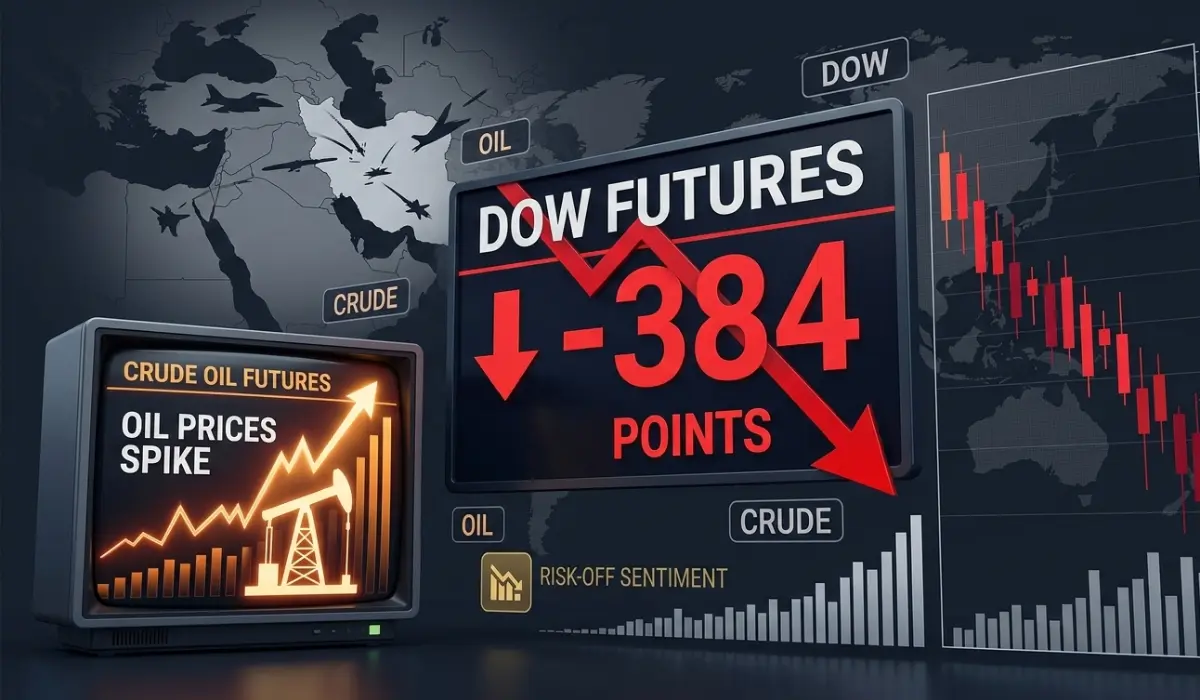
Dow futures dropped as markets reacted to the U.S. and Israeli military strikes on Iran, which escalated geopolitical tensions over the weekend. The Dow futures fell sharply by over 384 points, roughly 0.78%. While the prices of oil spiked amid supply disruption concerns, with U.S. crude rising over 8% to above $72 per barrel and Brent crude jumping as much as 13% to around $80. Reflecting broader risk-off sentiment, the S&P 500 futures lost 1% and the Nasdaq 100 futures fell a little more than 1%.
In the meantime, Gold futures climbed 2%, reflecting a flight to safe-haven assets. U.S. President Donald Trump reported that the conflict will last for a while as he makes regime change a goal (Reuters), raising concerns over the market.
Global Energy Markets on Edge
The assault, launched after Iran rejected demands to scale back its nuclear program, reportedly killed Supreme Leader Ayatollah Ali Khamenei, triggering fears of prolonged conflict in the Middle East. This marked a watershed moment for the Islamic Republic, reflecting a consequential episode since 1979. Operation Epic Fury is the code name for the joint strikes against Iran.
Iran is the fourth-largest oil producer in OPEC, and now uncertainty hangs over who will ultimately govern the country amid the leadership vacuum. Investors are closely eyeing the Strait of Hormuz, the narrow waterway through which 20% of the world’s oil passes. If the conflict could disrupt commercial tanker traffic through the strait, the ripple effect on the global energy markets would be severe. It is a major flashpoint, and fears of its closure have heightened the market anxiety.
The Islamic Revolutionary Guards Corps (IRGC) has reportedly warned ships that passage through the Strait is not permitted. Additionally, Greece’s shipping ministry has advised the vessels to avoid the Persian anchor or to be stationary near the Strait of Hormuz. Shipping giant Maersk and others have suspended transit through the Strait, and Iran has reportedly struck oil tankers, further destabilizing the energy markets.
Inflation Worries and AI Sector Swings Add to Market Strain
This geopolitical attack adds to an already uneasy environment for equities. The Bitcoin dropped below $67,000 late on Sunday after recovering from a sharp sell-off immediately followed by the U.S. and Israel air strikes and the subsequent counterattacks in the region. The token fell roughly 1.11% over the past 24 hours, currently trading at $66,677.30, if it breaks below $66,000, it risks a drop toward the $65,076 swing low. Ethereum also fell about 2.48% to currently trade at $1,971.00, after tumbling approximately 10% in the wake of the attacks.
However, the haven assets have witnessed a rather subdued response; gold prices are currently trading around the $5,362 an ounce mark, while silver prices are trading at $93.93. The US Dollar index is also trading up around 0.3%, nearing levels of 98.
The conflict adds volatility to markets already unsettled by inflation concerns and AI sector swings. Economic focus now shifts to the upcoming data, including Friday’s February jobs report, though geopolitical risk dominates near-term market outlook.


