

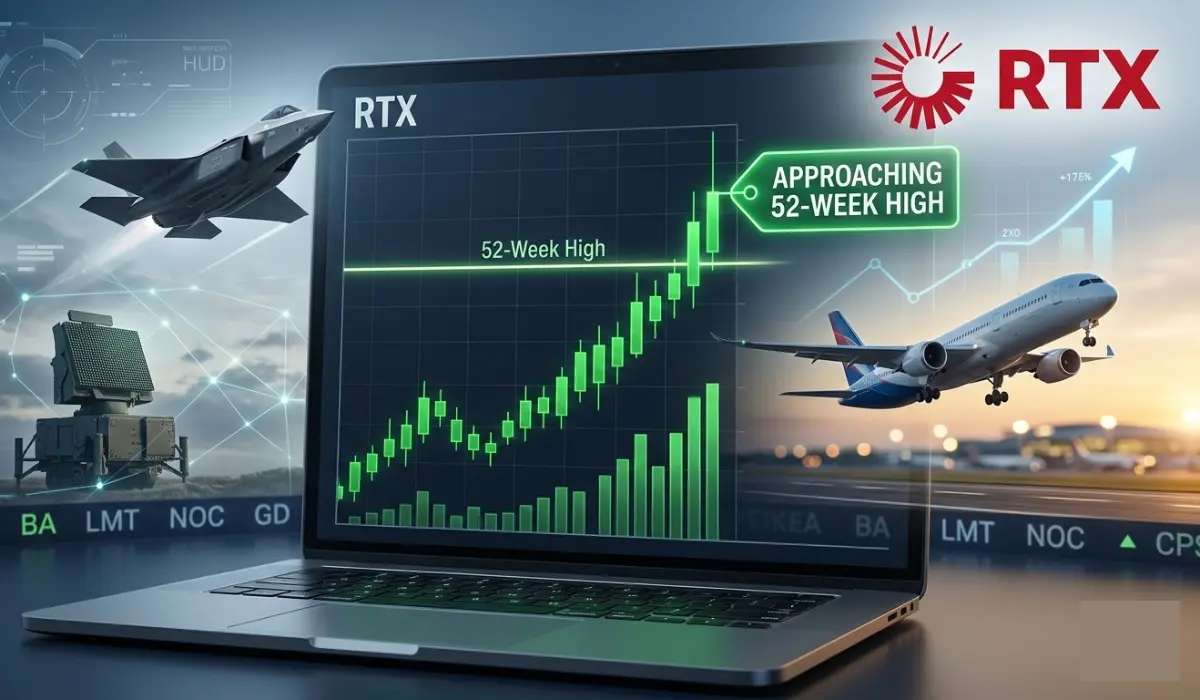
Shares of RTX Corporation (NYSE: RTX) closed higher on Friday, February 27, demonstrating resilient strength as a dual wave of bullish catalysts — ranging from decisive military operations to massive commercial aviation orders — positioned the aerospace and defense giant near its yearly high.
RTX ended the week at $202.62, up 2.52% from the previous close, as investors processed the latest evidence of the company’s dominant market positions across its portfolio. This gain also aligns with recent news on the U.S. military strikes in Iran involving Tomahawk missiles produced by RTX’s Raytheon division, boosting sentiment across the defense market ahead of Monday’s opening.
Iran Strikes via Tomahawk Launch RTX and Defense Stocks
During the ongoing “Operation Epic Fury,” U.S. forces utilized Tomahawk Land Attack Missiles (TLAM) against multiple strategic locations in Southwestern Iran, primarily the regional military command centers and manufacturing facilities. The missile’s use underscores its enduring importance to the Pentagon.
The Tomahawk is a long-range, all-weather, jet-powered, subsonic cruise missile primarily used for deep-strike warfare against high-value targets. The specific variant reportedly deployed, the Tomahawk Block IV, represents a significant upgrade from its predecessors. It features an improved turbojet engine that offers a range of approximately 1,000 miles, allowing it to strike targets with extreme precision from deep within international waters.
On Saturday, the missiles demonstrated their advanced capability to navigate complex, heavily defended terrain by utilizing their Terrain Contour Matching (TERCOM) and Digital Scene Matching Area Correlation (DSMAC) guidance systems, which allow the Tomahawk to fly exceptionally low, evading enemy radar, while its two-way satellite datalink enables commanders to reprogram the missile in flight to change targets or adjust the timing of the strike to coordinate simultaneous impacts. This specific operational success highlighted RTX’s missile defense superiority and reaffirmed the long-term necessity of its production lines.
The Pentagon has already put an order for 57 units of these non-nuclear missiles, costing about $1.3 million each, for 2026 amid production ramp-ups to 1,000 units annually. This highlighted RTX’s role in affordable mass weaponry strategies.
Delta Adds 34 Airbus A321neos with RTX Engines
The positive defense news was quickly followed by gains for RTX’s commercial aviation business, led by its Pratt & Whitney division. On Friday, Delta Air Lines placed orders for 34 additional Airbus A321neo aircraft, with delivery expected to begin in 2029.
This deal is a huge win for RTX (formerly Raytheon), as these advanced commercial airliners are powered by Geared Turbofan (GTF) engines supplied to Airbus by the company. GTF decouples the fan from the engine core, allowing both to operate at optimal speeds. This technology delivers a double-digit reduction in fuel consumption, noise, and emissions compared to previous-generation aircraft. The Delta agreement also includes long-term engine maintenance contracts, providing RTX with a reliable, decades-long stream of aftermarket revenue.
While RTX’s Pratt & Whitney division has recently grappled with widespread engine inspection programs and delivery delays for some GTF customers, Delta’s commitment to additional aircraft signals that the airline has long-term confidence in the GTF program and the technical resolutions that RTX is implementing.
The confluence of these two major developments has created a powerful narrative heading into the new trading week. RTX stock is now trading just a fraction below its 52-week high of $206.73 sats. Analysts note that while geopolitical events provide a short-term catalyst, the Delta order reinforces the strength of RTX’s commercial backlog.
RTX reported strong 2025 results with $88.6 billion in sales and $6.29 in adjusted earnings-per-share (EPS), projecting sales of $92-$93 billion and an EPS of $6.60-$6.80 for 2026.
As global infrastructure becomes increasingly digitized — from satellite communications to advanced defense systems — the ripple effects extend well beyond aerospace. Reliable connectivity and secure payment frameworks are fueling parallel growth in online industries, including fintech platforms and Best Crypto Casinos that rely on encrypted blockchain transactions. Just as RTX leverages precision engineering and scalable production to maintain competitive advantage, digital-first sectors are prioritizing security, transparency, and operational efficiency to meet the expectations of a rapidly evolving global user base.


