

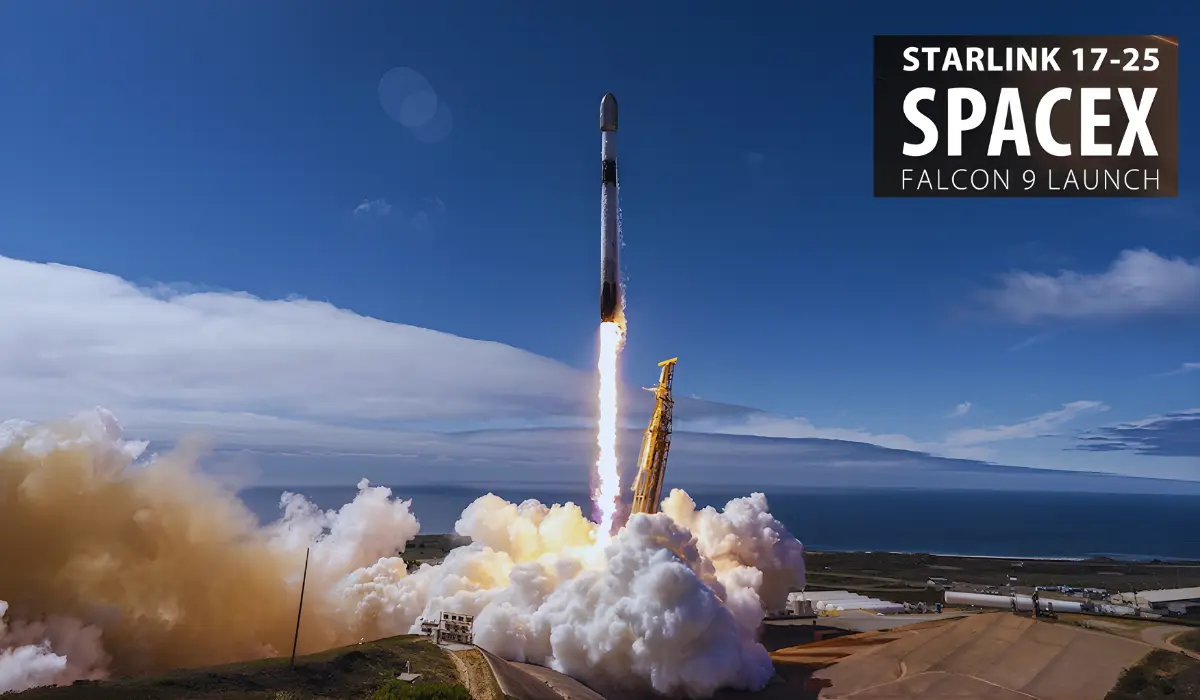
Millions of Americans across the East Coast may have unknowingly witnessed more than a visual spectacle Sunday night. A SpaceX Falcon 9 launch offered a clear demonstration of the operational scale and consistency that continue to separate the company from its competitors.
Falcon 9 launches 29 @Starlink satellites from Florida pic.twitter.com/mo7yyEursa
— SpaceX (@SpaceX) March 2, 2026
The Falcon 9 rocket lifted off from Cape Canaveral Space Force Station at 9:56 p.m. EST on March 1, deploying 29 Starlink satellites into low Earth orbit. The mission, designated Starlink 10-41, produced a glowing plume visible across multiple states, from Florida to Connecticut, and marked another data point in SpaceX’s sustained launch tempo.it
Why the Falcon 9 Launch Was Visible Across the East Coast
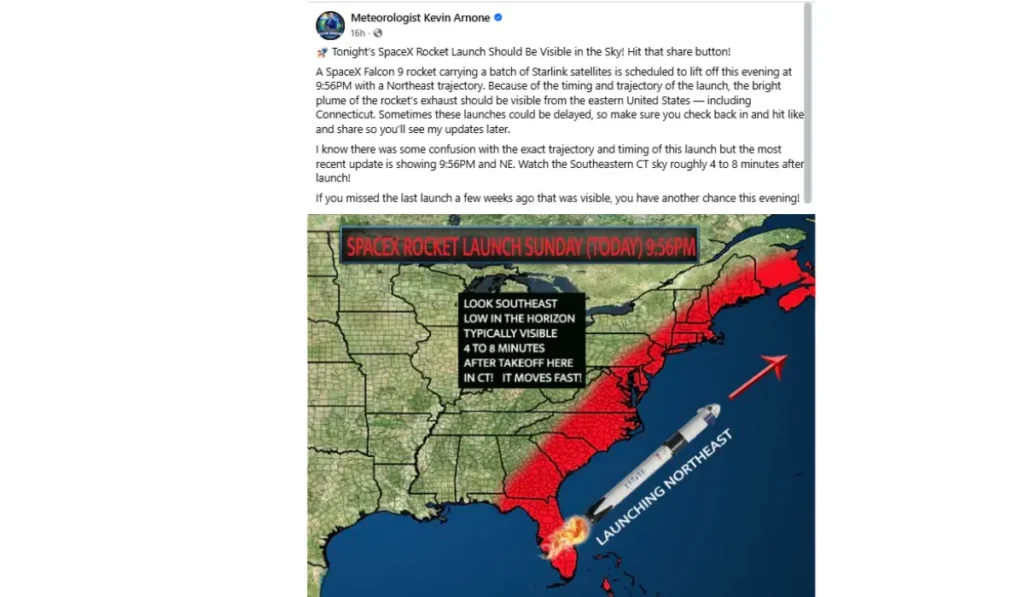
Unlike many recent missions that followed a southeast trajectory, the Falcon 9 ascended northeastward, allowing the rocket’s exhaust plume to catch sunlight at high altitude. The result was a bright streak and faint spiral pattern visible to skywatchers across large portions of the eastern United States.
Residents in Florida, Georgia, the Carolinas, New York, and Connecticut reported seeing the phenomenon within minutes of liftoff, prompting a surge in online searches questioning whether a rocket launch had just occurred.
According to a social media post by meteorologist Kevin Arnone, the rocket was expected to be visible in Connecticut’s southeastern sky approximately four to eight minutes after launch, a timeframe that aligned closely with eyewitness reports.
SpaceX stated that no sonic booms were anticipated in Brevard County, and weather conditions were near optimal. The U.S. Space Force’s 45th Weather Squadron had forecast a 90% probability of favorable launch conditions, with only minor cloud concerns well ahead of liftoff.
A Veteran Booster Makes History Again
The Falcon 9 first-stage booster completed its 26th flight, landing successfully on a SpaceX drone ship in the Atlantic Ocean roughly eight minutes after liftoff.
This level of reusability remains unmatched in the aerospace industry and continues to be a cornerstone of SpaceX’s cost-efficient launch model. The successful landing further demonstrates the maturity of the Falcon 9 system, now considered one of the most reliable orbital launch vehicles ever flown.
At 11:03 p.m. EST, SpaceX confirmed the successful deployment of all 29 Starlink satellites into low Earth orbit.
Watch Falcon 9 launch 29 @Starlink satellites to orbit from Florida https://t.co/EYUwM6Oz6e
— SpaceX (@SpaceX) March 2, 2026
What Is Starlink 10-41 and Why Does It Matter?
Starlink 10-41 represents SpaceX’s 22nd Starlink mission of the year, adding to a rapidly growing constellation designed to provide high-speed broadband internet worldwide – particularly in rural and underserved areas.
With each launch, SpaceX strengthens its position as the dominant force in satellite-based internet, supporting everything from residential customers to emergency services and military communications.
The mission also marked a return to northeast-bound Starlink launches after several months dominated by southeast trajectories, signaling operational flexibility as SpaceX fine-tunes coverage across North America and beyond.
In many ways, Starlink’s rapid expansion mirrors the broader digital economy’s shift toward decentralized infrastructure. High-speed satellite connectivity plays a growing role in industries that rely on secure, borderless transactions — from remote fintech services to online gaming platforms. As internet access becomes more reliable even in rural regions, markets such as Best Crypto Casinos continue to expand their reach, operating on blockchain-based systems that prioritize transparency, fast payouts, and global accessibility. The same technological backbone enabling satellite-powered broadband is also supporting the next generation of digital commerce.
Meanwhile in California: A Tale of Two Launches
While Florida celebrated a flawless mission, events unfolded very differently on the West Coast.
Earlier on March 1, SpaceX successfully launched another Falcon 9 from Vandenberg Space Force Base, carrying 25 Starlink V2 Mini satellites on the Starlink 17-23 mission. That booster, B1082, completed its 20th flight and landed safely on the drone ship Of Course I Still Love You in the Pacific Ocean.
But later that same day, Firefly Aerospace was forced to scrub its Alpha rocket launch from the same base due to high winds.
The contrast was stark: SpaceX executed two successful orbital launches from opposite coasts within hours, while Firefly’s highly anticipated Stairway to Seven mission was delayed indefinitely.
Why Firefly’s Scrub Still Matters
Firefly’s Alpha rocket was scheduled to conduct a test flight, not a commercial payload delivery. The mission aimed to validate first- and second-stage performance ahead of the company’s upcoming Block II upgrade, which promises enhanced reliability and manufacturability.
The company has faced recent challenges, including a failed 2025 mission and a booster explosion during ground testing in Texas. Although the March 1 scrub was weather-related, it highlights the difficulty of competing in an industry where SpaceX has set an extraordinarily high bar.
Still, Firefly remains focused on gathering data and preparing for future launches, with its Block II Alpha rocket expected to debut later this year.
What Comes Next for SpaceX?
With successful launches from both Florida and California on the same day, SpaceX shows no signs of slowing its aggressive schedule.
The company is expected to:
- Continue frequent Starlink deployments
- Support U.S. government and defense missions
- Expand coverage across North America
- Prepare for future Starship test flights
For Americans on the ground, that likely means more unexpected sky shows — and more moments of confusion that quickly turn into Google searches.
If you looked up Sunday night and wondered what you saw, now you know: it was another chapter in SpaceX’s relentless push to redefine access to space.


