

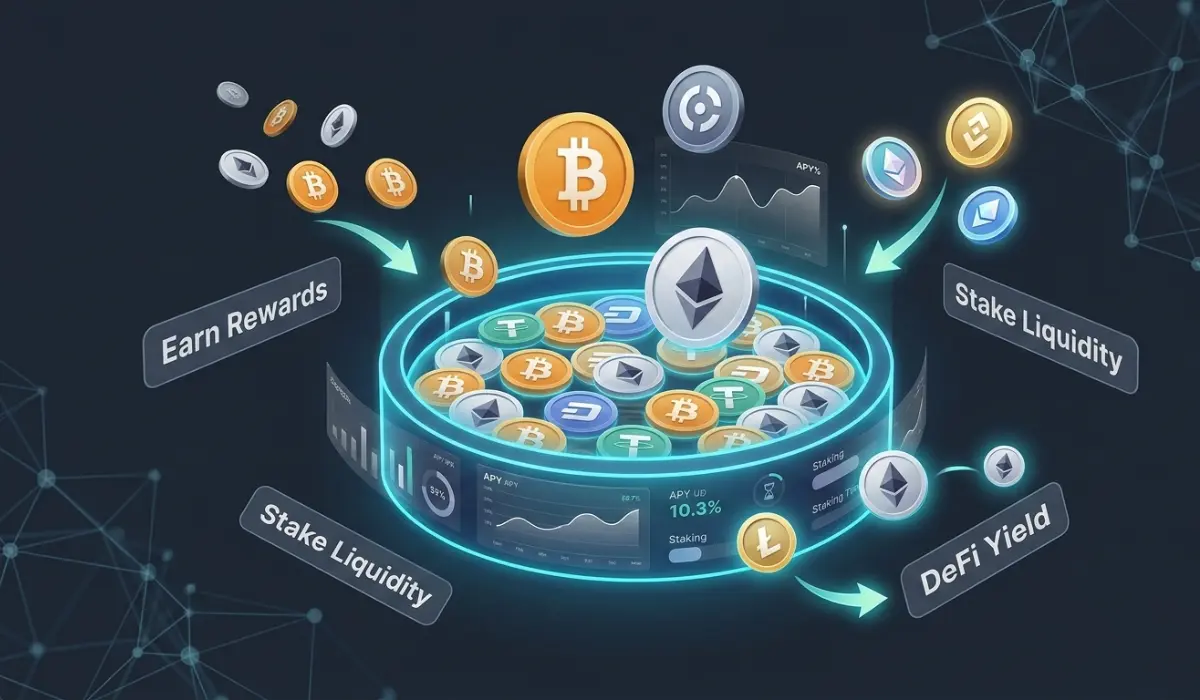
Liquidity mining is a Decentralized Finance (DeFi) mechanism where users or liquidity providers deposit cryptocurrency pairs into a liquidity pool on a decentralized exchange (DEX) to facilitate trading. In return for enabling smooth trading and reducing slippage, providers earn rewards in the form of platform tokens, transaction fees, or governance tokens. To fully understand liquidity mining, one needs to know about DEXs and automated market makers (AMMs), which facilitate the process. This article further discusses how liquidity mining works in DeFi, how liquidity providers make money, and the risks one should be aware of. So, keep reading to learn more.
How Does Liquidity Mining Work In DeFi And DEXs?
Liquidity mining in DeFi is a process where users deposit crypto assets into a liquidity pool to facilitate trading, earning rewards in transaction fees and governance tokens. It is a subset of yield farming designed to boost liquidity without huge initial capital, allowing users to earn passive income. Since DEXs (Decentralized Exchanges) operate autonomously, using smart contracts, they are not controlled by a centralized entity. They aim to replace centralized exchanges by providing a more decentralized trading environment. It is true that DEXs initially struggled with liquidity, making it challenging to complete trader orders. However, it changed with the emergence of Automated Market Makers (AMMs).
What Are Liquidity Pools And AMMs?
Liquidity pools are the smart contracts that store paired cryptocurrencies. When someone tries to swap one asset for another, the funds are drawn from the pool, which allows for instant transactions. Automated Market Makers (AMMs) are exchanges that use liquidity pools rather than order books in order to match buyers with sellers. In other words, AMMs are algorithms that manage these pools, setting asset prices based on supply ratios. Together, liquidity pools and AMMs enable continuous, automated, and decentralized trading (DEXs) without traditional order books for centralized intermediaries.
Liquidity Mining vs Yield Farming: What’s The Difference?
Liquidity mining and yield farming are both DeFi’s passive income strategies. Liquidity mining contains a broader range of opportunities in Web3 and is a form of yield farming. However, many other strategies come under yield farming because yield farmers hunt for the highest reward opportunities across DeFi. They often use metrics such as annual percentage rate (APR) and annual percentage yield (APY), and proprietary algorithms to identify the optimal rewards. Even though yield farmers often use liquidity mining as part of their strategy, it is only one part of their DeFi farming equipment.
How Do Liquidity Providers (LPs) Make Money?
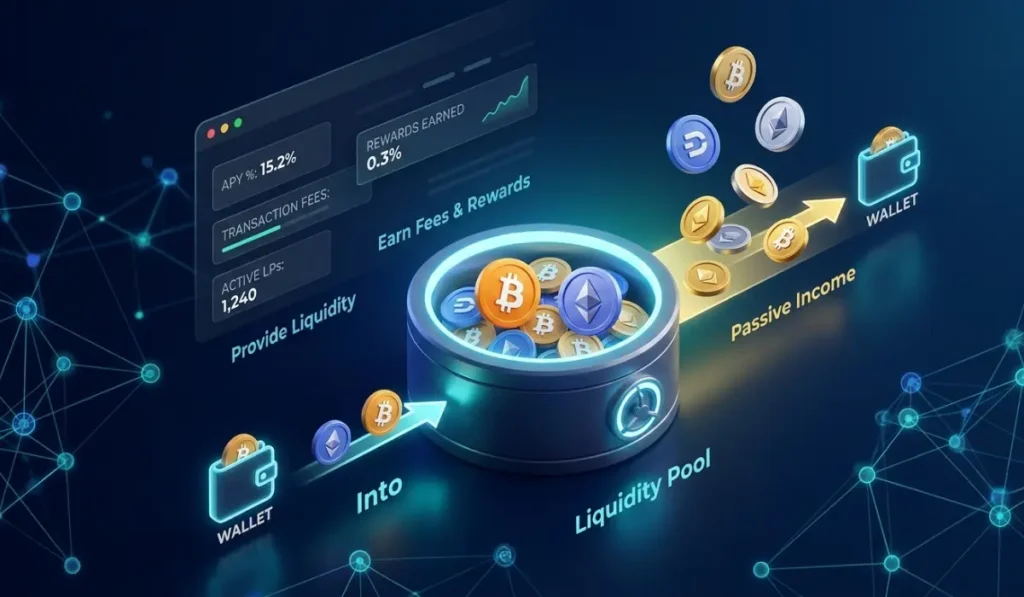
The funds in liquidity pools are contributed by individuals who own the respective coins or tokens. These individuals are known as the liquidity providers who supply their assets to the liquidity pool. They would then receive compensation in return in the form of fees and tokens, depending on their share of the total pool liquidity. This very process of supplying cryptocurrencies to liquidity pools and receiving compensation in return is known as liquidity mining. Liquidity providers make money primarily by depositing pairs of tokens into DEX liquidity pools and earning a proportional share of trading fees from every swap. They also generate income through liquidity mining and potential token price appreciation.
What is Impermanent Loss in Liquidity Mining?
Liquidity mining offers a way for cryptocurrency holders to receive compensation from their assets. However, it also comes with its own set of risks. While liquidity providers receive compensation from transaction fees and token rewards, they may face risks like impermanent loss. An impermanent loss happens when the value of the deposited assets decreases compared to holding them outside the liquidity pool. Liquidity miners must understand these factors before dealing with liquidity mining to prevent significant losses. Even though temporary, impermanent loss is often unrealized. It mainly occurs when AMM rebalances token ratios to match market prices, causing liquidity providers to hold more of the devalued asset.
Is Liquidity Mining Profitable? – Final Thoughts
Liquidity mining is a process in which participants supply cryptocurrencies into liquidity pools in order to receive compensation based on their share. This is a strategy used in DeFi to allow users to receive compensation from their digital assets. Indeed, liquidity mining can be profitable because yielding double or triple-digit percentage returns by rewarding users with fees and governance tokens for providing liquidity to decentralized exchanges (DEXs). However, it is not guaranteed profit as it carries significant risks, including impermanent loss, smart contract vulnerabilities, and high volatility. Thus, it is best suited for those with a high risk tolerance and a good understanding of the DeFi markets.
FAQs
To start liquidity mining, set up a DeFi-compatible wallet, fund it with crypto, and connect to a decentralized exchange (DEX) like Uniswap or PancakeSwap. Then deposit a pair of tokens into a pool to earn liquidity pool tokens and trading fees.
Liquidity mining can be highly profitable, offering high-yield passive income and governance tokens, but it is a high-risk, complex strategy that may not be suitable for all investors. It exposes one to significant impermanent loss, smart contract bugs, and high volatility.
Liquidity mining risks include significant impermanent loss, smart contract bugs, rug pulls, and token volatility. Other hazards involve high gas fees, platform-specific exploits such as flash loans, and regulatory uncertainty.
Yes, it is possible to make a living off liquidity mining by earning transaction fees and token rewards, but it requires substantial capital, high-risk tolerance, and active management to overcome volatility and impermanent loss.


